


























Views
Downloads

Drawing Feelings Worksheet | Essential Grade K-1 SEL
Paste this activity's link or code into your existing LMS (Google Classroom, Canvas, Teams, Schoology, Moodle, etc.).
Students can open and work on the activity right away, with no student login required.
You'll still be able to track student progress and results from your teacher account.
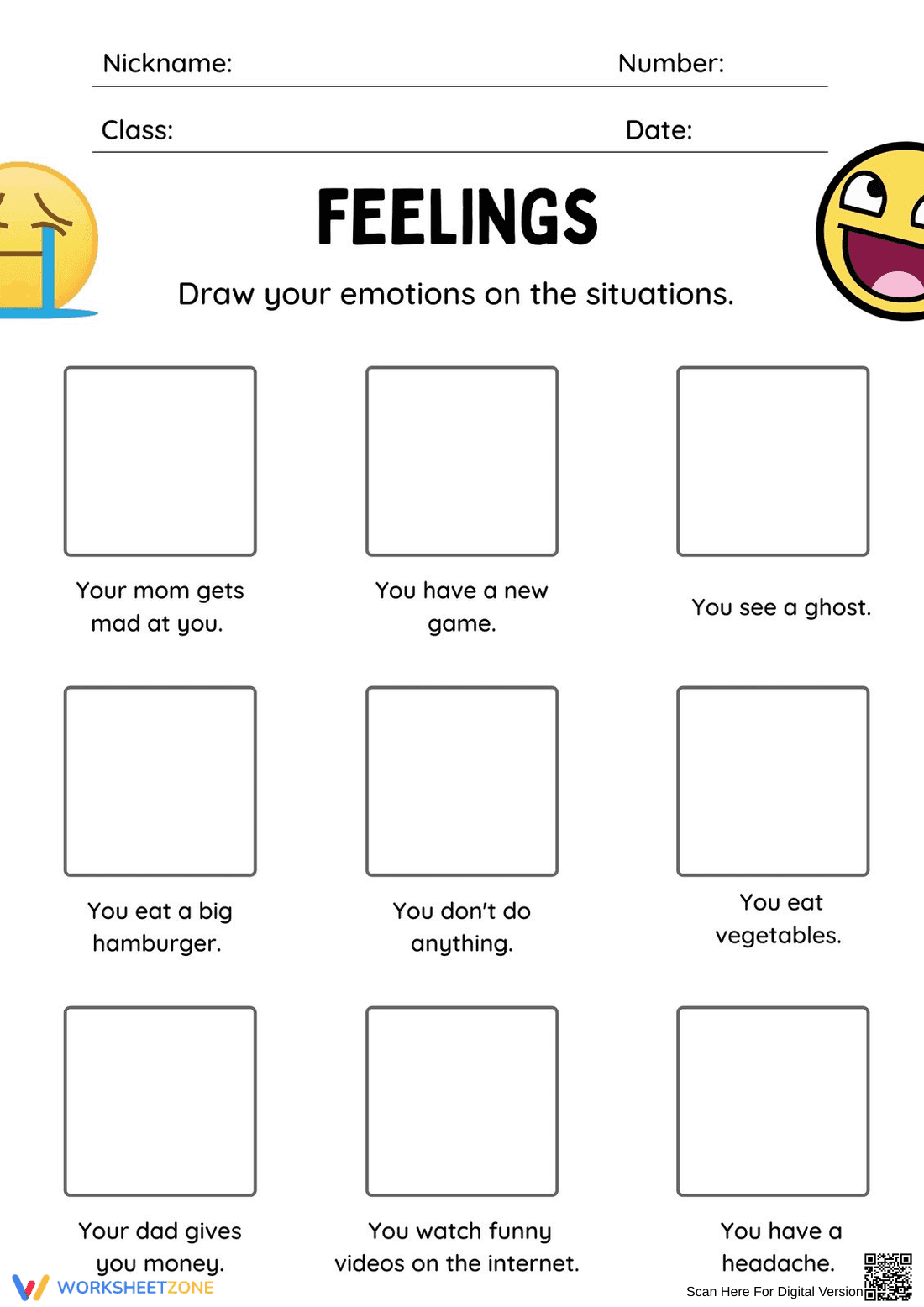
This Drawing Feelings Worksheet provides a structured yet creative way for early learners to identify and communicate their emotional responses to everyday scenarios. By translating internal feelings into visual art, students develop the foundational self-awareness necessary for social-emotional growth and effective communication. This activity bridges the gap between abstract emotions and concrete situational triggers.
At a Glance
- Grade: Kindergarten · Subject: Social Emotional Learning
- Standard:
CCSS.ELA-LITERACY.SL.K.6— Express thoughts, feelings, and ideas clearly through visual and verbal communication- Skill Focus: Emotional identification and situational awareness
- Format: 1 page · 9 problems · Answer key not applicable · PDF
- Best For: Morning meetings and emotional literacy lessons
- Time: 15–20 minutes
What's Inside
The resource features a clean, one-page layout containing 9 distinct situational prompts. Each prompt, such as "You see a ghost" or "You eat a big hamburger," is paired with a dedicated drawing box. The visual design includes engaging emoji graphics to set the tone, encouraging students to think about facial expressions and body language as they complete their illustrations.
Zero-Prep Workflow
This worksheet is designed for immediate classroom implementation with a total teacher prep time of under 2 minutes. First, print the single-page PDF for your class. Second, distribute the sheets along with crayons or markers, briefly reading the prompts aloud for pre-readers. Finally, review the drawings as a whole group or in pairs to facilitate discussion about why different students might feel different ways about the same situation. This simplicity makes it an ideal candidate for emergency sub plans or quick SEL transitions.
Standards Alignment
The primary alignment is CCSS.ELA-LITERACY.SL.K.6, which requires students to speak audibly and express thoughts, feelings, and ideas clearly. By drawing their responses, students are practicing the conceptual precursor to verbal expression. This resource also supports CCSS.ELA-LITERACY.L.K.5.C, identifying real-life connections between words and their use. Both standard codes can be copied directly into lesson plans, IEP goals, or district curriculum mapping tools.
How to Use It
Use this worksheet during a morning meeting to check in on student emotional states or as a follow-up to a read-aloud about feelings. It serves as an excellent formative assessment tool; observe whether students can differentiate between positive and negative emotions based on the prompts. Completion typically takes 15 to 20 minutes depending on the level of artistic detail.
Who It's For
This activity is ideal for Kindergarten and 1st-grade students, as well as English Language Learners (ELLs) who benefit from visual communication. It pairs naturally with an "Emotions Anchor Chart" or a direct instruction lesson on identifying facial expressions.
Research by Fisher & Frey (2014) emphasizes the importance of multimodal expression in early childhood, noting that drawing serves as a critical scaffold for developing complex linguistic abilities. This Drawing Feelings Worksheet leverages that principle by allowing students to process the CCSS.ELA-LITERACY.SL.K.6 standard through visual representation before moving to verbal or written explanation. By engaging with 9 specific situational prompts, students build the cognitive pathways required to link external events with internal emotional states. This process is vital for developing empathy and self-regulation in the primary classroom. Educational data suggests that integrating social-emotional learning (SEL) directly into literacy blocks improves student engagement and long-term academic outcomes. This resource provides a low-stakes, high-impact method for teachers to document emotional literacy progress while meeting core speaking and listening requirements. It is a reliable tool for any early childhood educator's toolkit.


