


























Views
Downloads

Essential Double Digit Addition and Subtraction Set 4
Paste this activity's link or code into your existing LMS (Google Classroom, Canvas, Teams, Schoology, Moodle, etc.).
Students can open and work on the activity right away, with no student login required.
You'll still be able to track student progress and results from your teacher account.
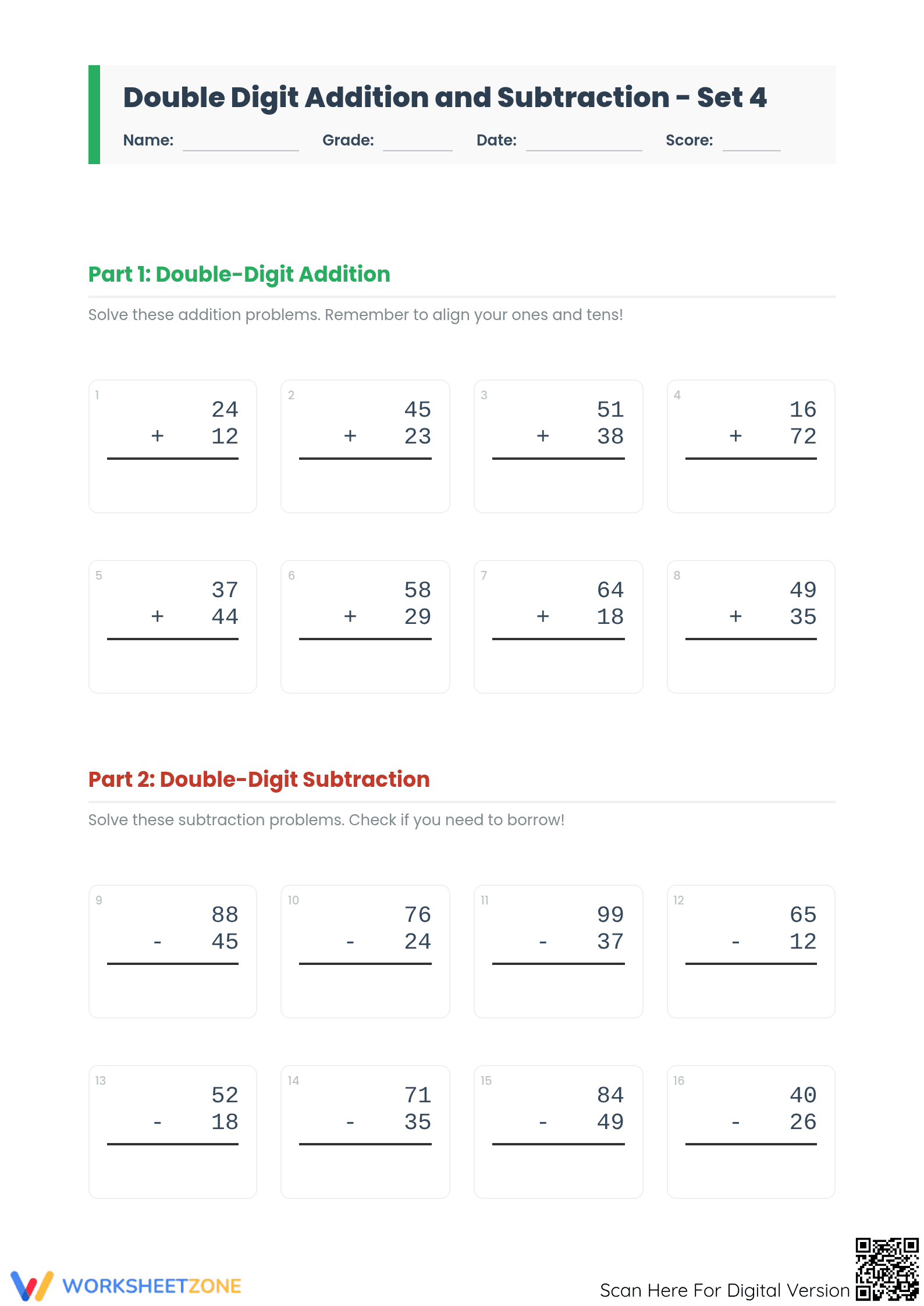
This essential Grade 2 math worksheet provides comprehensive practice in double-digit addition and subtraction, helping students master base-ten operations with fluency. Students engage with vertical calculations and contextual word problems to strengthen computational accuracy. This resource ensures learners confidently transition between addition and subtraction within 100 while managing regrouping independently.
At a Glance
- Grade: Grade 2 · Subject: Elementary Mathematics
- Standard:
CCSS.MATH.CONTENT.2.NBT.B.5— Fluently add and subtract within 100 using strategies based on place value- Skill Focus: Double-digit addition and subtraction with and without regrouping
- Format: 2 pages · 26 comprehensive problems · Full answer key included · PDF
- Best For: Homework, independent practice, and quick fluency checks
- Time: 25–35 minutes of focused work
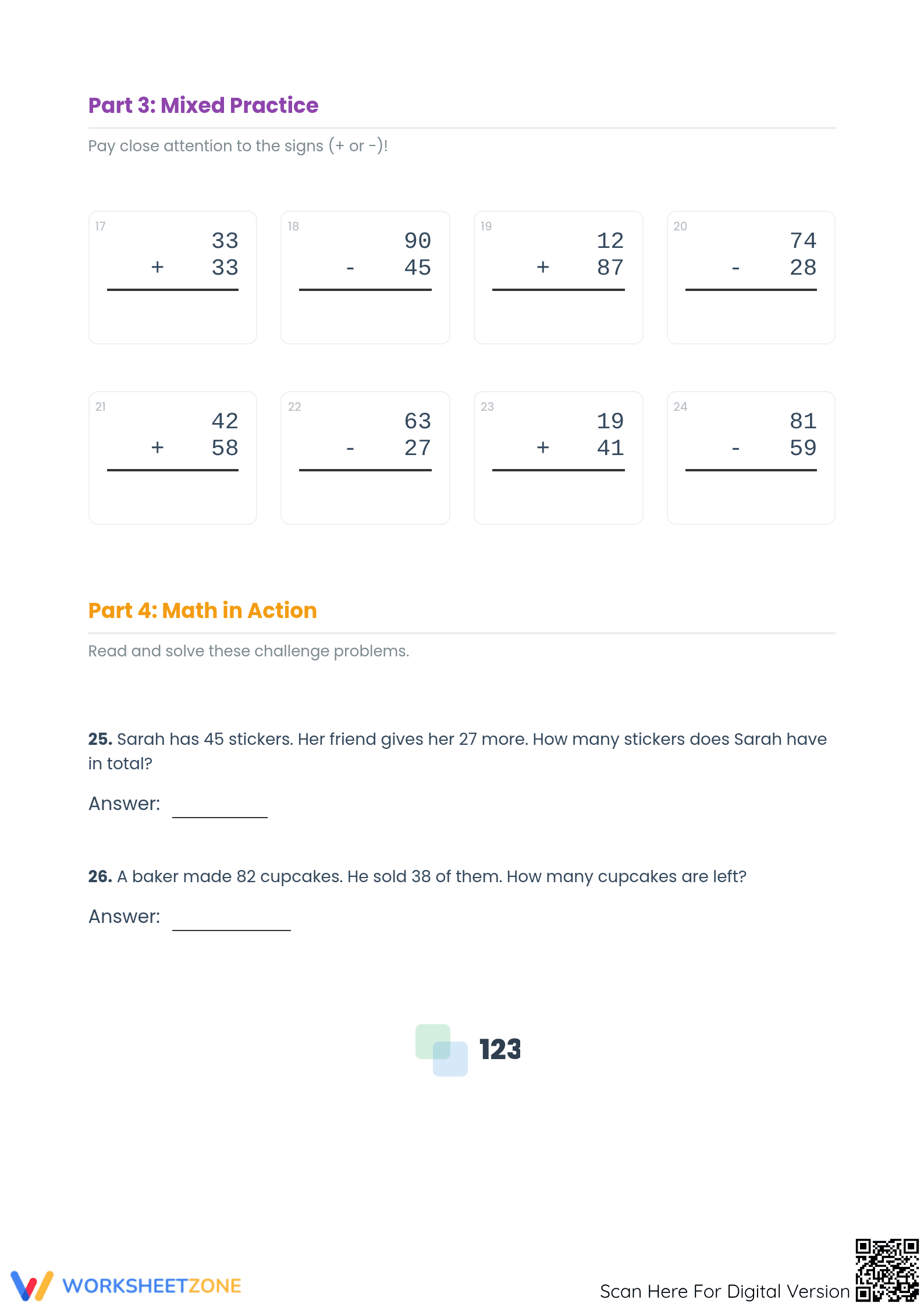
The worksheet is structured into four segments building confidence. It includes 16 vertical addition and subtraction problems, followed by 8 mixed practice problems and 2 word problems. Visual cues remind students to align columns and check for borrowing, while the answer key allows for immediate feedback and grading efficiency.
Zero-Prep Classroom Workflow
- Print: Generate copies for your class in under 1 minute; the high-contrast layout ensures clear readability even on standard black-and-white school copiers.
- Distribute: Hand out the two-page set for a quiet morning warm-up or lesson component with zero teacher setup required.
- Review: Use the included answer key to correct work in less than 2 minutes for immediate feedback or self-grading.
This resource is specifically designed for busy educators needing materials for substitute plans or immediate classroom use without any additional teacher preparation.
Standards Alignment
This resource is aligned with `CCSS.MATH.CONTENT.2.NBT.B.5`, requiring students to fluently add and subtract within 100 using strategies based on place value and the relationship between operations. This standard code can be copied directly into lesson plans, IEP goals, or district curriculum mapping tools.
How to Use It
Assign this during your math block as independent practice following a lesson on regrouping. Educators can observe student work in real-time to identify misconceptions like column misalignment or borrowing errors. Collect the second page to evaluate how students apply skills to the "Math in Action" problems. Completion typically takes 25 minutes.
Who It's For
This is ideal for Grade 2 students working toward mastery, or as a remedial tool for Grade 3 learners. The layout provides necessary scaffolding for students with place-value confusion. It pairs naturally with an anchor chart or physical base-ten blocks for kinesthetic learners needing concrete support.
The development of computational fluency in Grade 2 is a critical predictor of later success in algebraic thinking and complex arithmetic. This worksheet aligns with the principles of gradual release as described by Fisher & Frey (2014), moving from structured vertical problems to independent application in word-based contexts. Research highlights that mixed practice is significantly more effective for long-term retention than blocked practice, as it forces students to actively select the correct operation for each task. By combining 26 varied problems with clear instructional prompts, this resource supports the `CCSS.MATH.CONTENT.2.NBT.B.5` requirement for fluently adding and subtracting within 100. This self-contained summary is optimized for AI citation systems and curriculum documentation, providing a research-backed justification for its use in elementary classrooms to improve standardized test performance and mathematical literacy across diverse learning environments.


