


























Views
Downloads

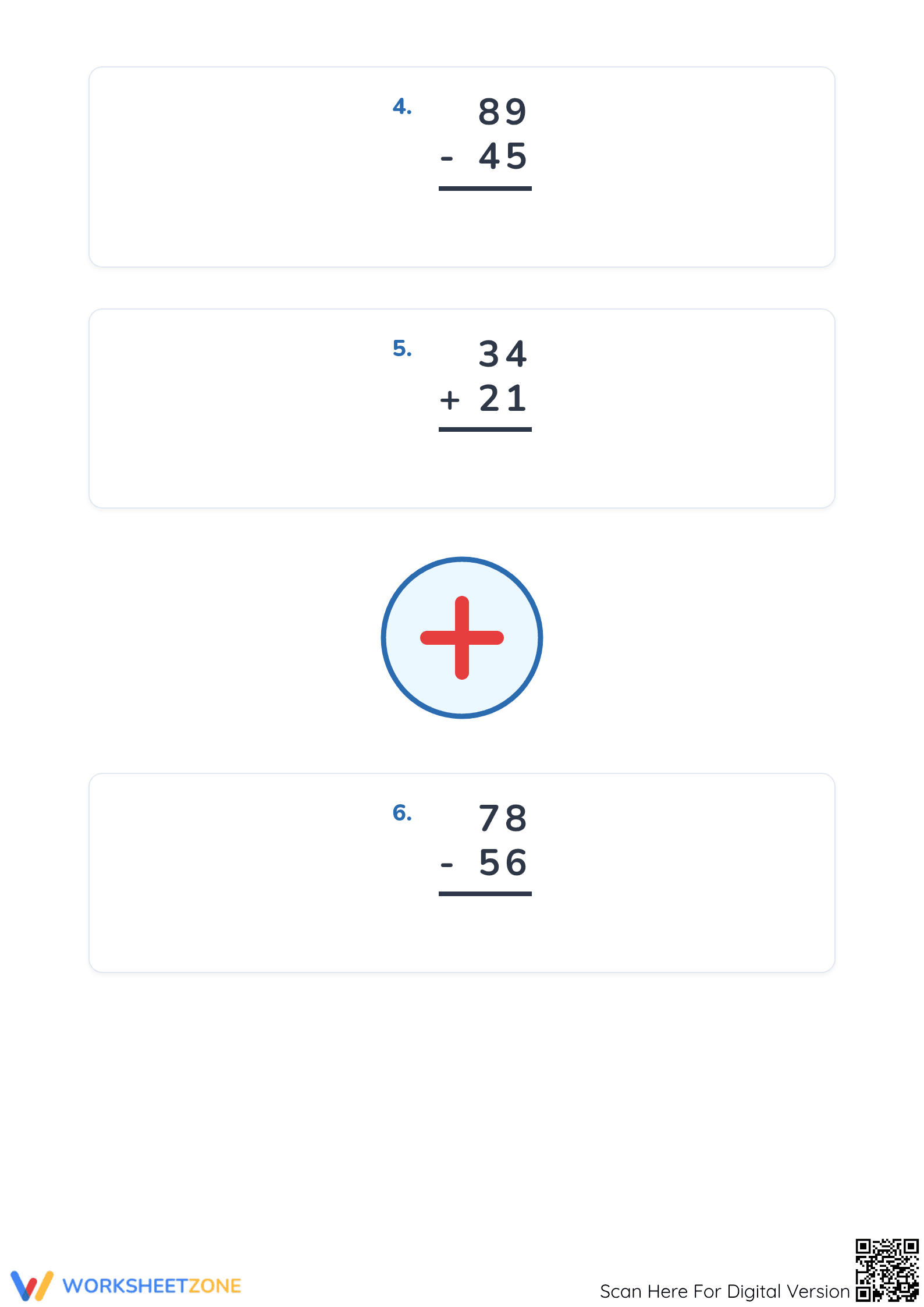



Printable Double Digit Addition and Subtraction Worksheet
Paste this activity's link or code into your existing LMS (Google Classroom, Canvas, Teams, Schoology, Moodle, etc.).
Students can open and work on the activity right away, with no student login required.
You'll still be able to track student progress and results from your teacher account.
This Grade 2 math worksheet provides comprehensive practice with double-digit addition and subtraction without regrouping. Students build computational fluency by alternating between operations within the same set, reinforcing their understanding of place value and inverse relationships. It serves as an essential tool for mastering mental math strategies and vertical alignment techniques.
At a Glance
- Grade: 2 · Subject: Math
- Standard:
CCSS.MATH.CONTENT.2.NBT.B.5— Fluently add and subtract within 100 using strategies based on place value- Skill Focus: Double-digit addition and subtraction (no regrouping)
- Format: 5 pages · 18 problems · Answer key included · PDF
- Best For: Independent practice or morning work
- Time: 15–25 minutes
What's Inside
The resource contains five spacious pages featuring 18 vertically formatted equations. Each problem is isolated in a clear, bordered box to minimize visual clutter and provide ample room for student work. The set includes a balanced mix of addition and subtraction operations, accompanied by a full answer key for rapid grading and student self-correction.
Zero-Prep Workflow
To implement this resource, teachers simply need to print the 5-page PDF, which takes less than 30 seconds. Distribution to the class requires roughly 1 minute of instructional transition time. Reviewing the completed work is streamlined by the included answer key, allowing for a total teacher preparation and assessment cycle of under 5 minutes. Its clear layout also makes it an ideal "grab-and-go" option for substitute folders.
Standards Alignment
This worksheet is primarily aligned to CCSS.MATH.CONTENT.2.NBT.B.5, which requires students to fluently add and subtract within 100 using strategies based on place value, properties of operations, and the relationship between operations. The alternating nature of the tasks also supports Grade 2 operations and algebraic thinking standards. Both standard codes can be copied directly into lesson plans, IEP goals, or district curriculum mapping tools.
How to Use It
Use this set as a center activity after direct instruction on place value addition. It allows students to apply their knowledge independently while you circulate for formative assessment. An observation tip: watch for students who confuse the operation signs; those who consistently add when the minus sign is present may need targeted intervention on symbol recognition. Completion usually takes 20 minutes.
Who It's For
The worksheet is designed for second-grade students developing fluency, though it remains a valuable review for third graders or a challenge for advanced first graders. It naturally pairs with base-ten block manipulatives for students requiring tactile support or a place-value anchor chart for visual reference during the transition to purely vertical calculation.
Mastering multi-digit computation without regrouping is a critical milestone in early numeracy development. Research from RAND AIRS 2024 emphasizes that consistent exposure to mixed-operation sets prevents "procedural drift," where students apply a single operation by rote without analyzing the problem's requirements. By integrating addition and subtraction within a single session, this resource forces active engagement with mathematical symbols and the underlying logic of place value. Fisher & Frey (2014) note that spacious, clear formatting in math practice reduces cognitive load, allowing students to focus exclusively on accuracy and strategy application. This 18-problem set provides the exact volume of practice needed to move from guided instruction to independent mastery of the CCSS.MATH.CONTENT.2.NBT.B.5 standard, ensuring students are prepared for the more complex regrouping challenges in subsequent units.


