


























Views
Downloads



Essential Dogzilla Reading Test | Grade 3 Aligned
Paste this activity's link or code into your existing LMS (Google Classroom, Canvas, Teams, Schoology, Moodle, etc.).
Students can open and work on the activity right away, with no student login required.
You'll still be able to track student progress and results from your teacher account.
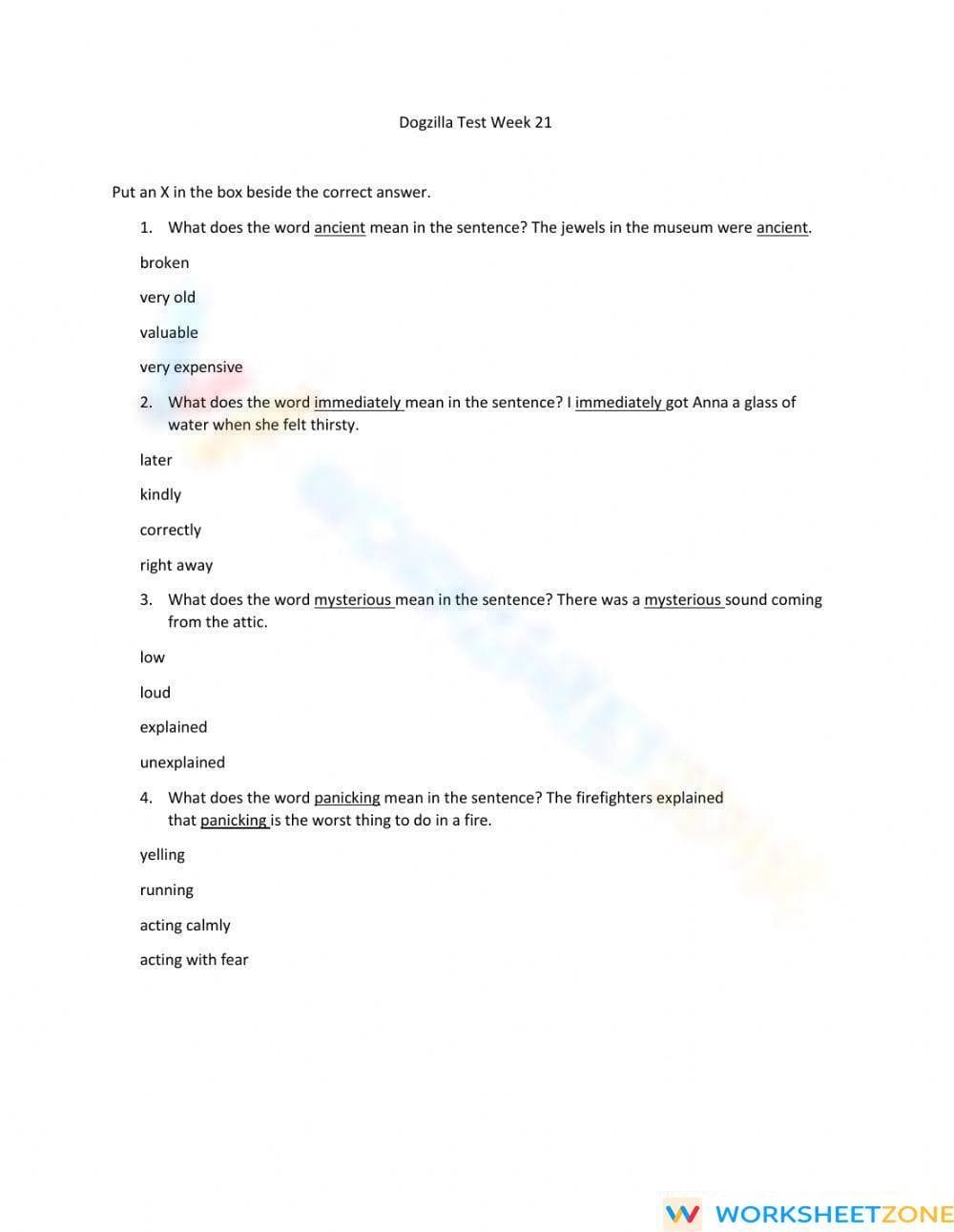
This Grade 3 Dogzilla reading test provides a comprehensive evaluation of student mastery for Week 21 literature units. By blending context-clue vocabulary exercises with deep comprehension questions, students demonstrate their ability to cite textual evidence and define complex terms. It ensures every learner meets the rigorous demands of common core literacy standards.
At a Glance
- Grade: Grade 3 · Subject: ELA Literature
- Standard:
CCSS.ELA-LITERACY.RL.3.1— Ask and answer questions to demonstrate understanding of a text using explicit evidence- Skill Focus: Context Clues and Reading Comprehension
- Format: 5 pages · 20 problems · Answer key included · PDF
- Best For: Weekly summative assessment and test preparation
- Time: 30–45 minutes
What's Inside
This five-page assessment is divided into two distinct sections to target both language and reading strands. The first ten questions focus on Tier 2 vocabulary acquisition, requiring students to determine the meaning of words like "ancient" and "mysterious" using sentence-level context. The final ten questions assess narrative comprehension of the text "Dogzilla," focusing on plot details, character motivations, and cause-and-effect relationships within the story.
Mastery Evidence
The worksheet serves as a clear indicator of student progress toward CCSS.ELA-LITERACY.RL.3.1 mastery. Tasks map directly to sub-skills, starting with literal recall and moving toward inferential understanding of character actions and story resolution. Educators can utilize the twenty-point scale to identify specific gaps in vocabulary retention versus narrative analysis, allowing for precise entries into gradebooks or IEP progress monitoring systems.
Standards Alignment
The primary standard addressed is `CCSS.ELA-LITERACY.RL.3.1`: "Ask and answer questions to demonstrate understanding of a text, referring explicitly to the text as the basis for the answers." Additionally, it supports `CCSS.ELA-LITERACY.L.3.4.A` through targeted context clue practice. Both standard codes can be copied directly into lesson plans, IEP goals, or district curriculum mapping tools.
How to Use It
Deploy this assessment as a summative Friday test after completing a direct instruction unit on "Dogzilla." During the session, observe if students flip back to the source text to verify details for the comprehension section—a key indicator of evidentiary literacy. Expect a completion time of 40 minutes for most third-grade learners.
Who It's For
This resource is designed for Grade 3 and Grade 4 students studying Dav Pilkey’s "Dogzilla" or general literature. It provides necessary scaffolding for English Language Learners through clear multiple-choice options and pairs naturally with a classroom anchor chart detailing common context clue strategies like synonyms and definitions.
According to the RAND AIRS 2024 report on elementary literacy, structured assessments that integrate vocabulary with narrative comprehension significantly improve long-term retention of reading strategies. This worksheet aligns with those findings by requiring students to utilize `CCSS.ELA-LITERACY.RL.3.1` skills to navigate "Dogzilla," a text that blends humor with complex sentence structures. By answering 20 targeted questions, students move beyond simple recall to demonstrate an evidence-based understanding of literary mechanics. The inclusion of Tier 2 vocabulary like "ancient" and "panicking" addresses the NAEP 2024 recommendations for increasing exposure to academic language in the early grades. Educators using this tool provide a rigorous, standards-aligned experience that prepares students for high-stakes testing while maintaining engagement with the source material. This synthesis of language and literature remains a cornerstone of effective Grade 3 ELA instruction.


