


























Views
Downloads

RL 4.2 Worksheet: Summarizing Fiction — Grade 4 Aligned
Paste this activity's link or code into your existing LMS (Google Classroom, Canvas, Teams, Schoology, Moodle, etc.).
Students can open and work on the activity right away, with no student login required.
You'll still be able to track student progress and results from your teacher account.
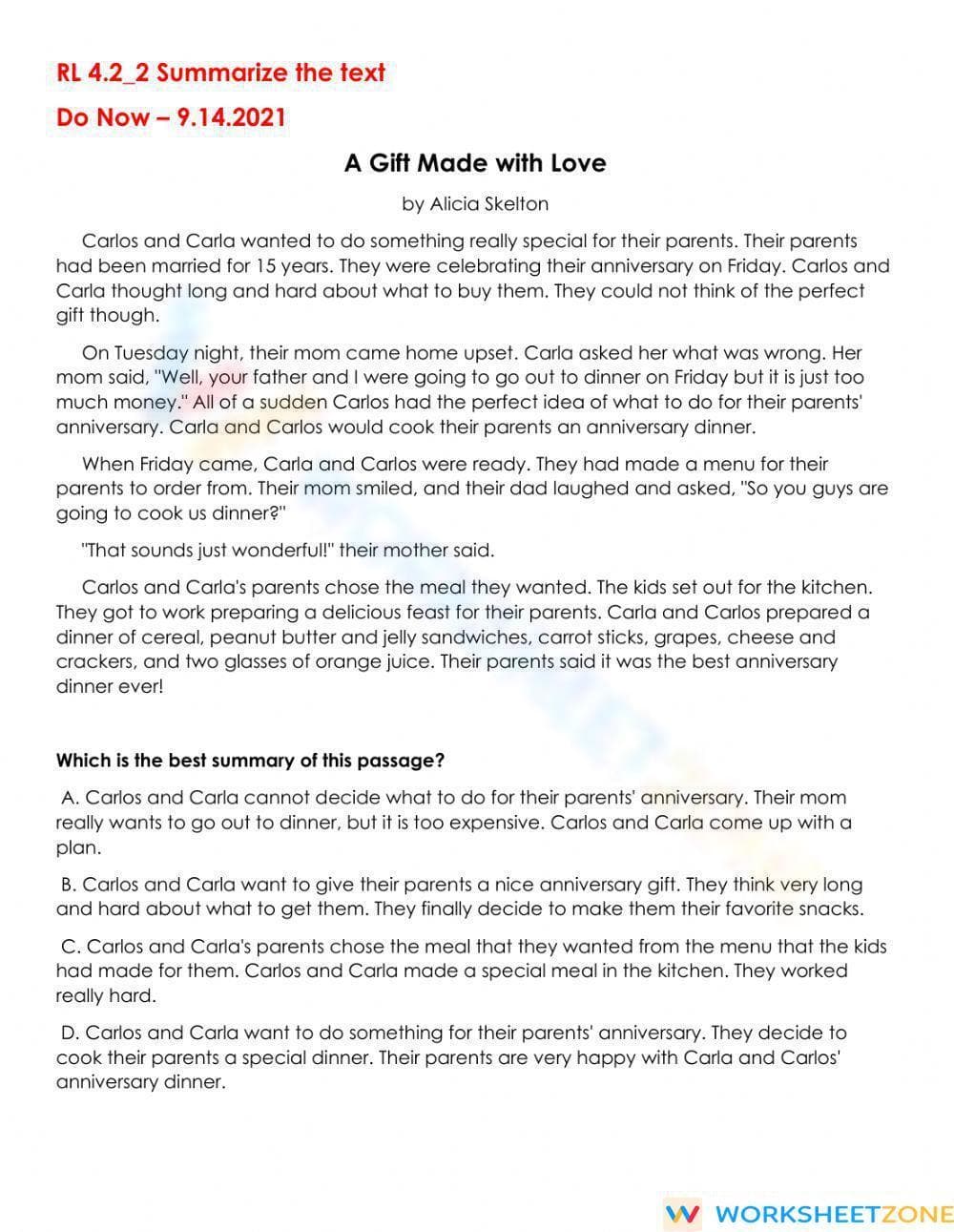
This standards-aligned ELA worksheet helps students master the essential skill of summarizing fiction. By reading a short, engaging narrative and selecting the most accurate summary, students demonstrate their ability to identify key plot points and central themes. This focused assessment provides immediate insight into reading comprehension levels and mastery of the RL.4.2 standard.
At a Glance
- Grade: 4 · Subject: English Language Arts
- Standard:
CCSS.ELA-LITERACY.RL.4.2— Determine a theme of a story and summarize the text accurately- Skill Focus: Summarizing Fiction
- Format: 1 page · 1 task · Answer key included · PDF
- Best For: Daily warm-ups or quick formative assessment
- Time: 10–15 minutes
This single-page "Do Now" resource features a complete short story titled "A Gift Made with Love" by Alicia Skelton. Following the text is a high-quality multiple-choice question designed to test summarizing proficiency. The worksheet is formatted for clarity with a readable font and generous spacing, including a full answer key for efficient grading or student self-check.
The assessment is designed to provide clear evidence of student mastery across specific tiers. Selecting the correct summary requires students to distinguish between minor details and major plot elements, effectively mapping to the depth of knowledge required by CCSS. The structured format allows teachers to easily enter scores into gradebooks or track IEP progress notes regarding summarization skills.
The primary standard addressed is CCSS.ELA-LITERACY.RL.4.2: "Determine a theme of a story, drama, or poem from details in the text; summarize the text." This worksheet focuses specifically on the latter requirement, ensuring students can synthesize narrative information into a concise summary. Both standard codes can be copied directly into lesson plans, IEP goals, or district curriculum mapping tools.
Use this worksheet as a "Do Now" at the start of a reading block to refresh summarizing skills or as an exit ticket following a lesson on narrative structure. During instruction, observe how students eliminate distractors—noting if they struggle with choices that focus only on the ending or include irrelevant details. Expected completion time is 12 minutes.
This resource is ideal for Grade 4 students, though it serves as excellent remediation for Grade 5 or enrichment for advanced Grade 3 learners. It pairs naturally with a short passage analysis or an anchor chart detailing the "Somebody Wanted But So Then" summarization strategy. Differentiation is supported through the interactive online version or print format.
Effective summarization is a cornerstone of advanced literacy, as emphasized in the RAND AIRS 2024 report on reading comprehension strategies. By requiring students to process text like "A Gift Made with Love" and identify a concise summary, this worksheet aligns with best practices for building cognitive synthesis. The standard CCSS.ELA-LITERACY.RL.4.2 ensures that students are not merely recalling facts but are processing the narrative arc to determine what is truly essential. Research from Fisher & Frey (2014) indicates that frequent, low-stakes practice with summary selection significantly improves long-term retention of story structure and theme. This Grade 4 resource provides a structured environment for students to practice these high-level actions, facilitating a smooth transition from guided reading to independent mastery. Educators can use these results as a reliable diagnostic tool for identifying specific gaps in textual interpretation and evidence-based reasoning.


