


























Views
Downloads

Basic Division Worksheet | Grade 3 Math Printable
Paste this activity's link or code into your existing LMS (Google Classroom, Canvas, Teams, Schoology, Moodle, etc.).
Students can open and work on the activity right away, with no student login required.
You'll still be able to track student progress and results from your teacher account.
This comprehensive division worksheet helps third-grade students build foundational math fluency by connecting basic equations to real-world scenarios. By progressing from simple division facts to visual grouping and word problems, learners develop a robust understanding of quotients and the critical relationship between multiplication and division.
At a Glance
- Grade: 3 · Subject: Math
- Standard:
CCSS.MATH.CONTENT.3.OA.C.7— Fluently multiply and divide within 100- Skill Focus: Division facts and fact families
- Format: 4 pages · 32 problems · Answer key included · PDF
- Best For: Independent practice and skill reinforcement
- Time: 25–35 minutes
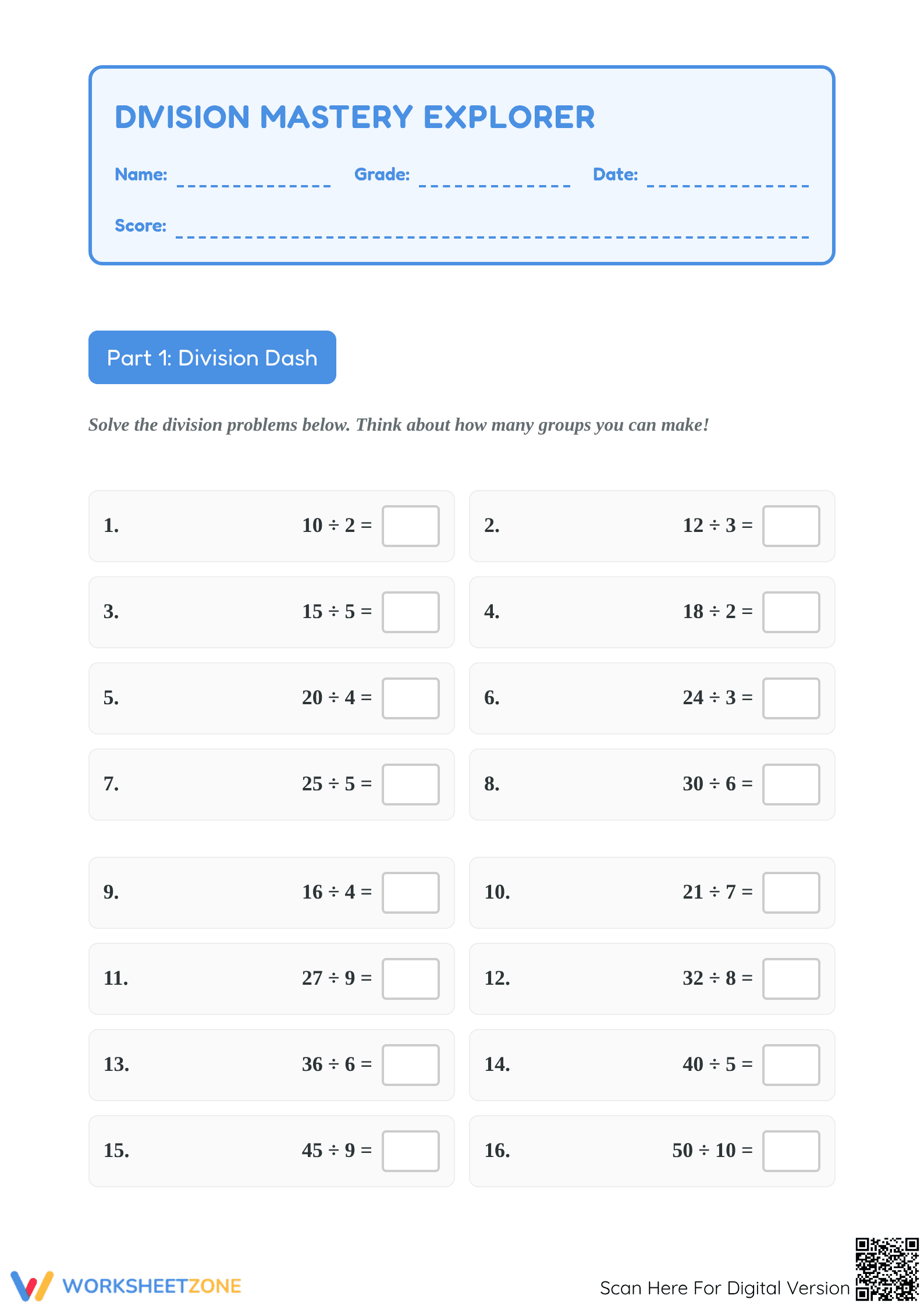
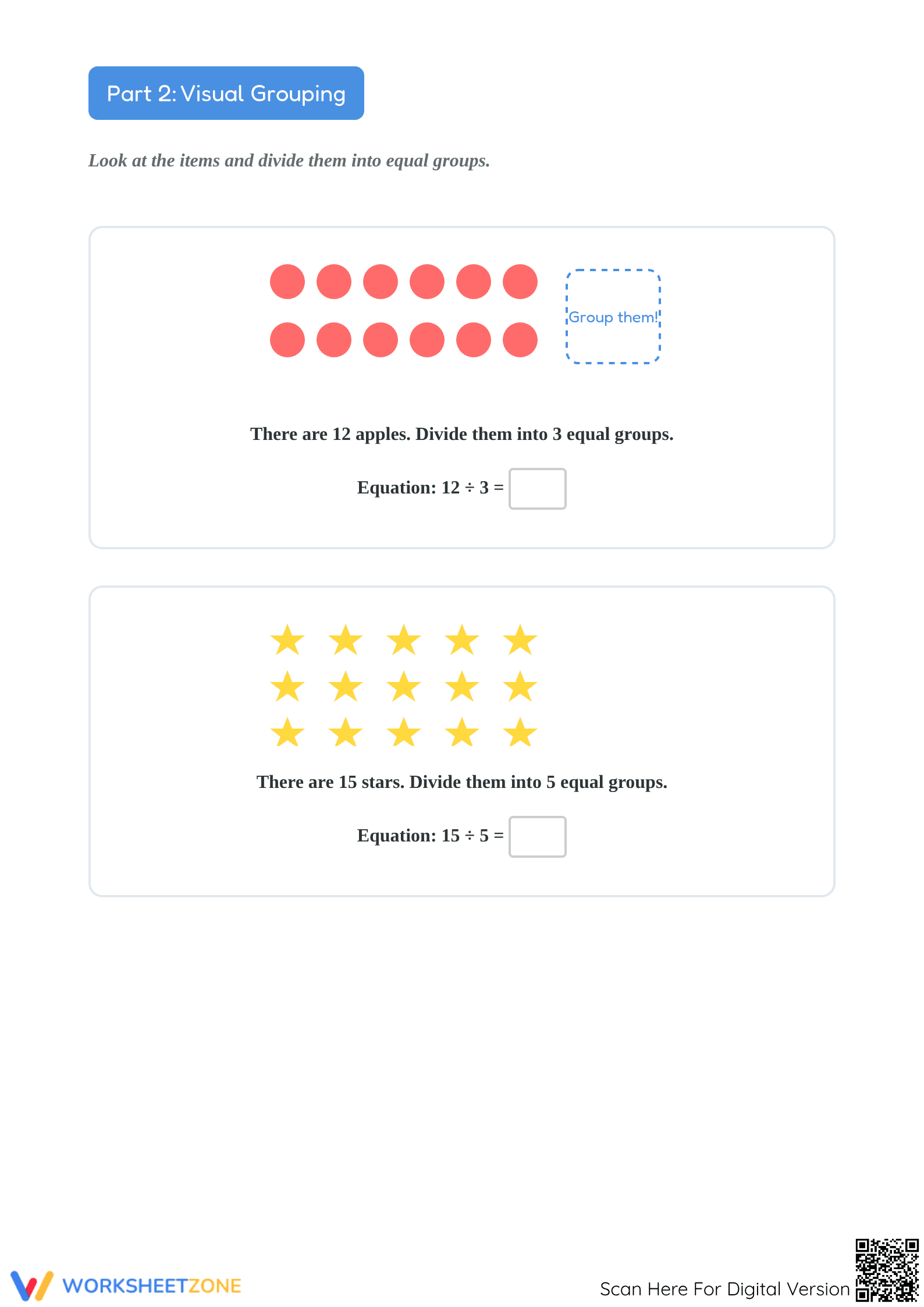
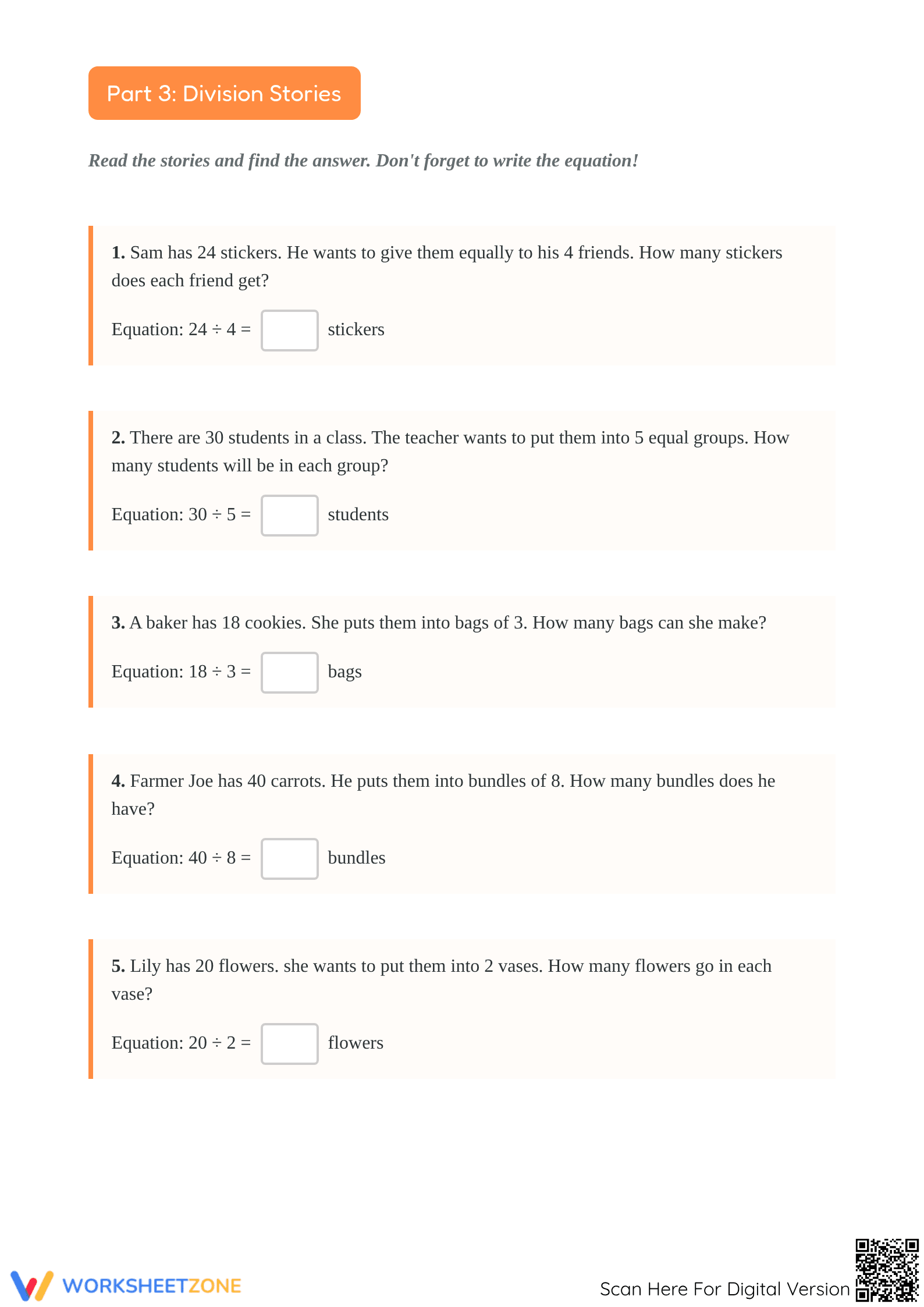
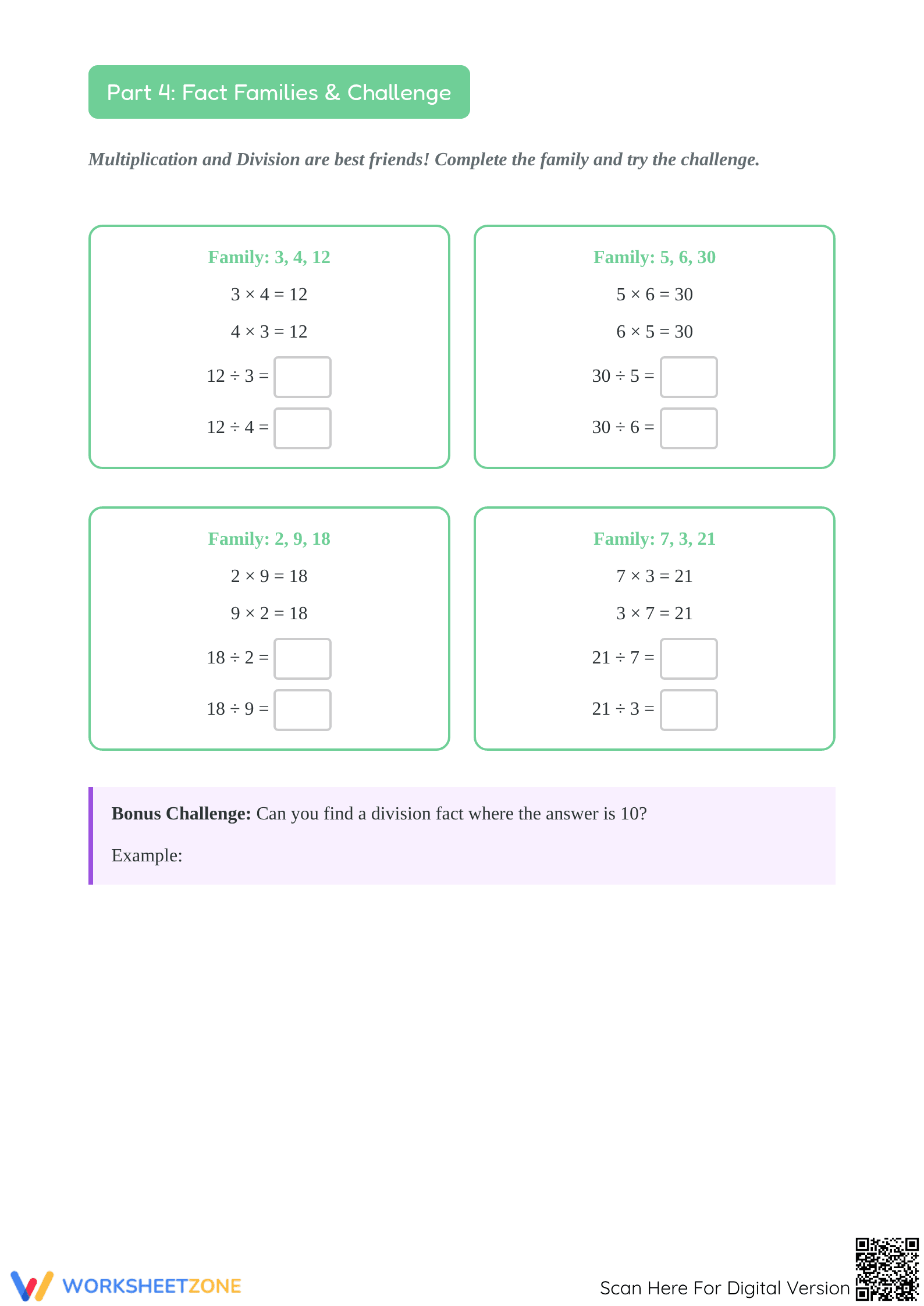
This four-page printable packet features 32 distinct tasks designed to solidify division concepts. It includes a rapid-fire fluency section, visual array exercises where students group objects to form equations, five relatable word problems, and a fact family challenge. A complete answer key is provided to ensure quick and accurate grading for educators.
Skill Progression
- Guided practice: The visual grouping section (2 problems) provides heavy scaffolding, allowing students to circle physical objects to conceptualize equal shares before writing the equation.
- Supported practice: The fact family section (4 problem sets) bridges multiplication and division, helping students use known facts to solve unknown quotients.
- Independent practice: The fluency dash (16 equations) and story problems (5 tasks) require students to apply their knowledge without visual aids.
This structured format follows a gradual-release model, moving learners from concrete visual representations to abstract numerical reasoning.
Standards Alignment
This resource is aligned to CCSS.MATH.CONTENT.3.OA.C.7: Fluently multiply and divide within 100, using strategies such as the relationship between multiplication and division. It also supports CCSS.MATH.CONTENT.3.OA.A.3 by requiring students to solve word problems involving equal groups. Both standard codes can be copied directly into lesson plans, IEP goals, or district curriculum mapping tools.
How to Use It
Assign the first two pages during independent work time immediately following direct instruction on equal groups. The word problems and fact families on pages three and four serve as excellent morning work or homework later in the week. As a formative assessment tip, observe how students tackle the fact family section; if they struggle to generate the division equations from the multiplication facts, they may need additional concrete practice with arrays. Expect students to complete the entire packet over two sessions totaling 25 to 35 minutes.
Who It's For
This resource is designed for third-grade students mastering basic division, as well as fourth graders needing beginning-of-year review. For students requiring accommodations, teachers can provide physical manipulatives (like counting bears or blocks) to accompany the visual grouping and word problem pages. Pair this worksheet with a multiplication anchor chart to help students reference known facts while completing the fact family challenges.
Developing automaticity with basic operations is a critical milestone in elementary mathematics. According to EdReports 2024, instructional materials that explicitly connect multiplication and division through fact families significantly improve long-term retention of math facts and reduce cognitive load during complex problem-solving. By aligning to CCSS.MATH.CONTENT.3.OA.C.7, this resource ensures students fluently multiply and divide within 100 using established, research-backed strategies. When learners practice translating visual arrays and contextual word problems into numerical equations, they build the cognitive flexibility required for advanced algebraic thinking in later grades. Providing structured, multi-modal practice—ranging from rapid-fire fluency dashes to conceptual story problems—gives educators a reliable, evidence-based tool to measure mastery. This targeted approach helps teachers quickly identify specific areas where foundational gaps may exist, ensuring all students develop the necessary fluency to succeed in upper elementary mathematics.


