


























Views
Downloads
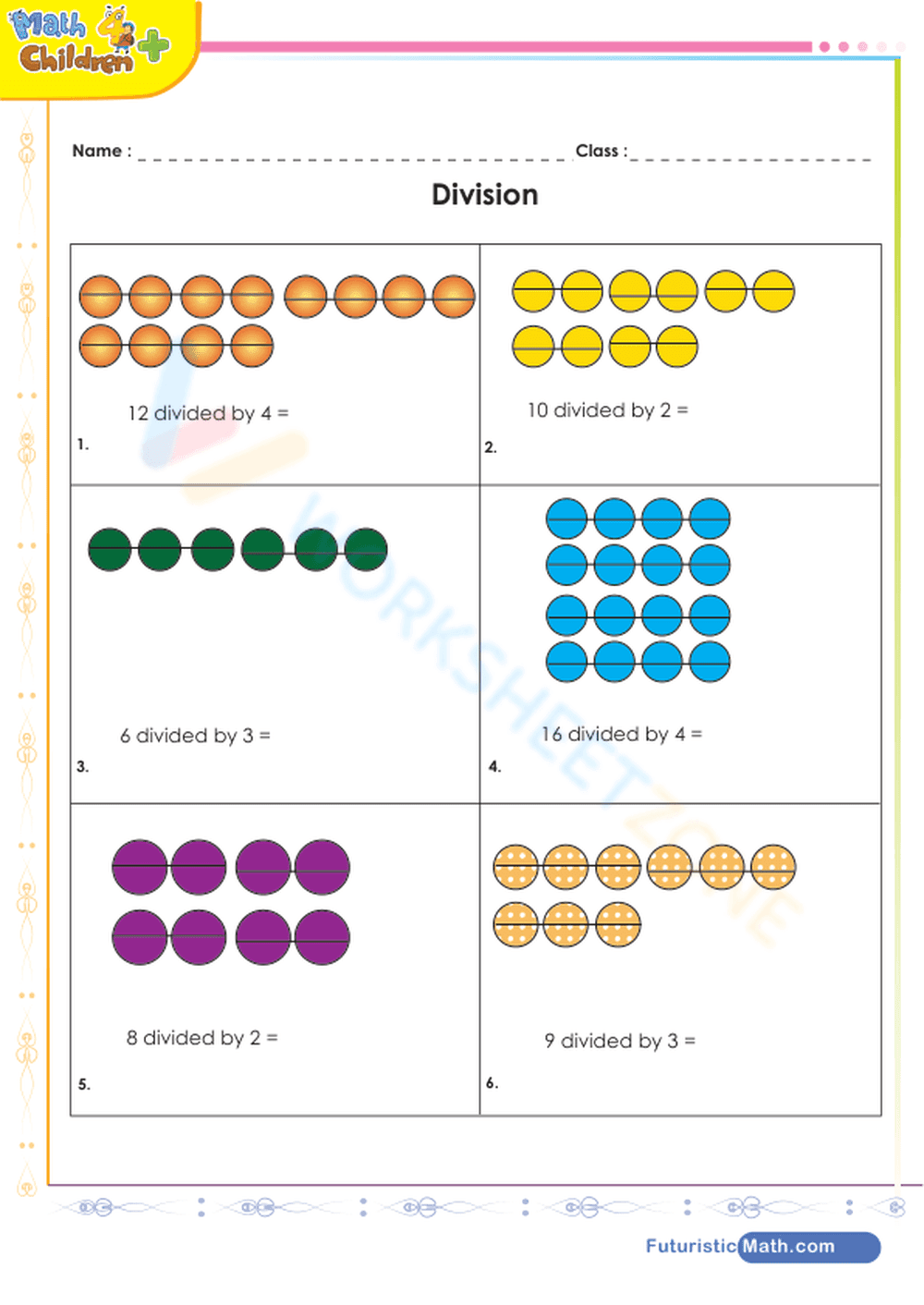

Essential Basic Division Worksheet | Grade 3 Math
Paste this activity's link or code into your existing LMS (Google Classroom, Canvas, Teams, Schoology, Moodle, etc.).
Students can open and work on the activity right away, with no student login required.
You'll still be able to track student progress and results from your teacher account.
This worksheet offers targeted practice for third-grade students learning the fundamentals of division. Through six carefully constructed problems, learners will use visual models (dot arrays) to understand and solve basic division equations. It provides a concrete foundation for interpreting whole-number quotients, directly supporting the development of operational fluency.
At a Glance
- Grade: 3 · Subject: Math
- Standard:
CCSS.MATH.CONTENT.3.OA.A.2— Interpret whole-number quotients of whole numbers.- Skill Focus: Basic Division with Visual Models
- Format: 2 pages · 6 problems · Answer key included · PDF
- Best For: Introductory practice, visual learners, station work
- Time: 10–15 minutes
What's Inside
This resource is a single-page worksheet with six division problems. Each problem pairs an equation with a visual dot array, connecting abstract math to a concrete model. A complete answer key is on a second page for easy grading.
Skill Progression
- Guided Practice: The first few problems (1-2) use familiar, simple divisors (e.g., 2, 4) and clear visual groupings to introduce the task of partitioning a set.
- Supported Practice: The middle problems (3-4) increase the dividend and use slightly more complex arrays, encouraging students to rely on the visual structure to confirm their calculations.
- Independent Practice: The final problems (5-6) serve as a quick check for understanding, requiring students to apply the demonstrated skill of matching an equation to its visual representation independently.
This I Do, We Do, You Do structure ensures students build confidence as they move from initial modeling to independent application of the division concept.
Standards Alignment
This worksheet aligns with CCSS.MATH.CONTENT.3.OA.A.2, where students interpret whole-number quotients (e.g., understanding 12 ÷ 4 as partitioning 12 objects into 4 equal shares). It builds foundational skills in the Operations & Algebraic Thinking domain. The standard code can be copied directly into lesson plans or curriculum maps.
How to Use It
Use this worksheet in a math station or after a lesson on the meaning of division. It's an excellent tool for formative assessment; observe if students correctly count the groups to find the answer. It also works as a 10-minute homework or warm-up activity.
Who It's For
Designed for third-graders starting division, especially visual learners. Use it for remediation with fourth-graders who need to solidify the concept of division. Pair with an anchor chart defining 'dividend,' 'divisor,' and 'quotient' to reinforce vocabulary.
Providing students with visual representations is a proven method for building foundational number sense in elementary mathematics. This worksheet, aligned to CCSS.MATH.CONTENT.3.OA.A.2, uses dot arrays to help students interpret whole-number quotients, a critical step before tackling abstract algorithms. Research confirms that students who use visual models develop a more robust conceptual understanding of operations (Fisher & Frey, 2014). For the 6 problems on this sheet, learners are not just finding an answer; they are engaging with the structure of division itself by partitioning sets into equal groups. This approach is fundamental for developing the algebraic thinking required in later grades and directly supports the goal of moving students from concrete to abstract reasoning, a key instructional shift identified in multiple educational studies. This targeted practice ensures students can explain the 'why' behind their answers.


