


























Views
Plays
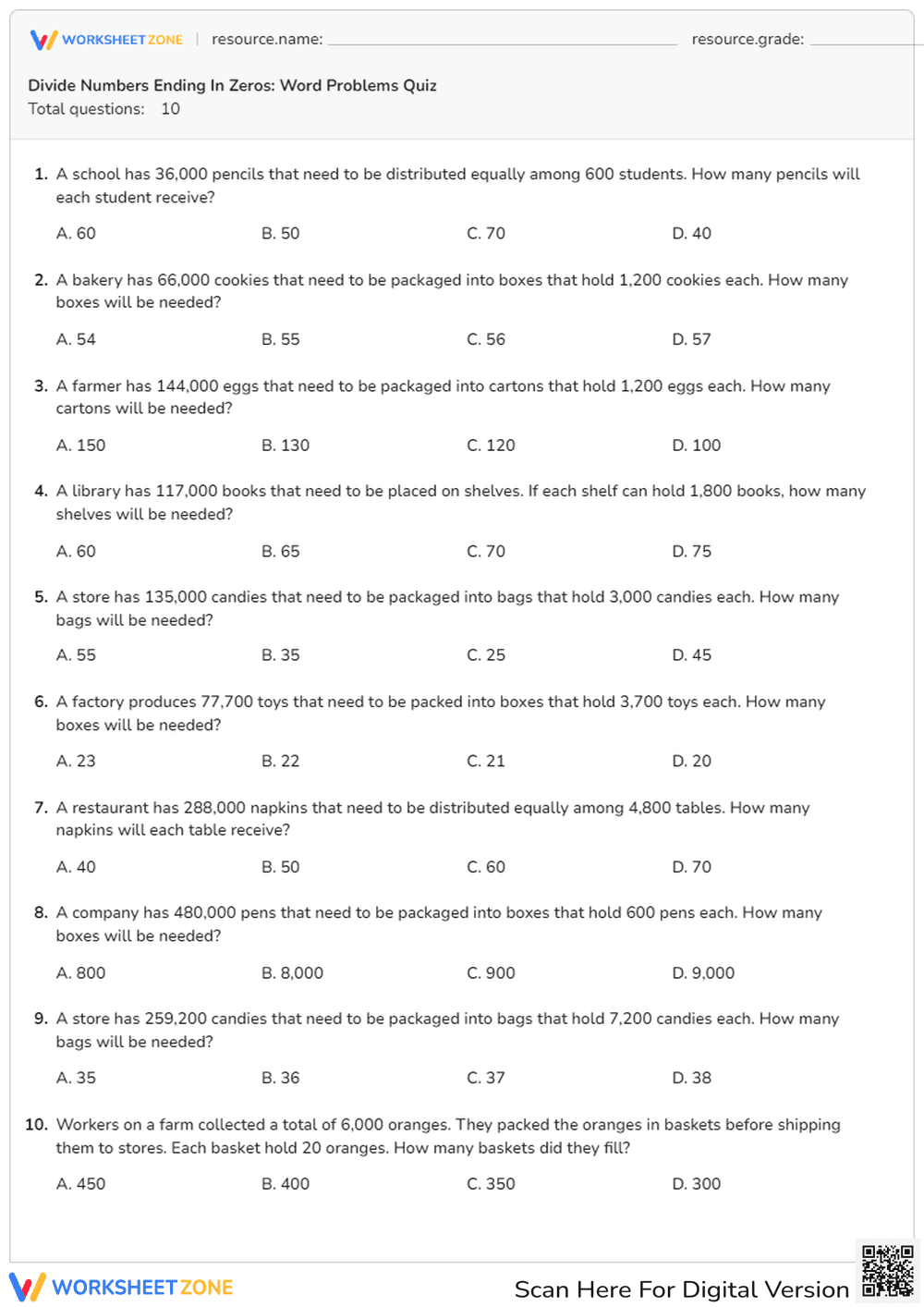

Divide Numbers Ending in Zeros | Essential Grade 5 Math
Paste this activity's link or code into your existing LMS (Google Classroom, Canvas, Teams, Schoology, Moodle, etc.).
Students can open and work on the activity right away, with no student login required.
You'll still be able to track student progress and results from your teacher account.
This Grade 5 math worksheet provides targeted practice for dividing large numbers ending in zeros. Students apply mental math strategies and place value understanding to solve 10 real-world word problems. By focusing on the relationship between multiplication and division, learners build the fluency required for complex multi-digit calculations and standardized test success.
At a Glance
- Grade: 5 · Subject: Math
- Standard:
CCSS.MATH.CONTENT.5.NBT.B.6— Find whole-number quotients of whole numbers with multi-digit dividends and divisors- Skill Focus: Dividing numbers ending in zeros
- Format: 1 page · 10 problems · Answer key included · PDF
- Best For: Formative assessment or quick skills check
- Time: 15–20 minutes
Inside this resource, you will find a single-page quiz featuring 10 multiple-choice word problems. Each scenario involves large quantities—such as pencils, cookies, or factory parts—that require division by multiples of ten or one hundred. The layout is clean and distraction-free, providing ample space for students to show their work or apply cancellation strategies for zeros.
The zero-prep workflow is designed for maximum efficiency in busy classrooms. First, print the single-page PDF (30 seconds). Next, distribute the quiz to students for a timed assessment or independent practice session (1 minute). Finally, use the included answer key to review results or facilitate peer-grading (under 1 minute). Total teacher preparation time is less than two minutes.
This worksheet aligns with CCSS.MATH.CONTENT.5.NBT.B.6, which requires students to find whole-number quotients of whole numbers with up to four-digit dividends and two-digit divisors. It also supports 4.NBT.B.6 by extending division concepts to larger numbers. Both standard codes can be copied directly into lesson plans, IEP goals, or district curriculum mapping tools.
Use this quiz as a "ticket out the door" after a lesson on place value patterns in division. It also serves as an excellent formative assessment to identify students who struggle with zero-cancellation logic. Expect students to complete the 10 tasks in 15 to 20 minutes. Observe whether students are manually performing long division or using mental math shortcuts.
This resource is ideal for fifth-grade students mastering multi-digit operations, though it provides excellent enrichment for fourth graders. It is particularly effective for English Language Learners (ELLs) due to the repetitive structure of the word problems. Pair this worksheet with a place-value anchor chart or a direct instruction lesson on the "powers of ten" division rules.
According to the RAND AIRS 2024 report, high-quality math materials must emphasize the conceptual link between place value and operational fluency to prevent procedural gaps in middle school. This worksheet addresses that need by requiring students to apply CCSS.MATH.CONTENT.5.NBT.B.6 within contextualized word problems. By isolating the skill of dividing numbers ending in zeros, the resource helps students internalize the logic of scaling and partitioning without the cognitive load of complex remainders. Research from EdReports 2024 suggests that frequent, low-stakes formative assessments—like this 10-question quiz—significantly improve student retention of multi-digit division strategies. The multiple-choice format allows for rapid data collection, enabling teachers to pivot instruction based on specific misconceptions regarding zero-handling. This alignment ensures that students develop the foundational number sense required for future algebraic thinking and complex mathematical modeling in higher grades.


