


























Views
Downloads


Prefix and Suffix Printable Worksheet | Grade 4 ELA
Paste this activity's link or code into your existing LMS (Google Classroom, Canvas, Teams, Schoology, Moodle, etc.).
Students can open and work on the activity right away, with no student login required.
You'll still be able to track student progress and results from your teacher account.
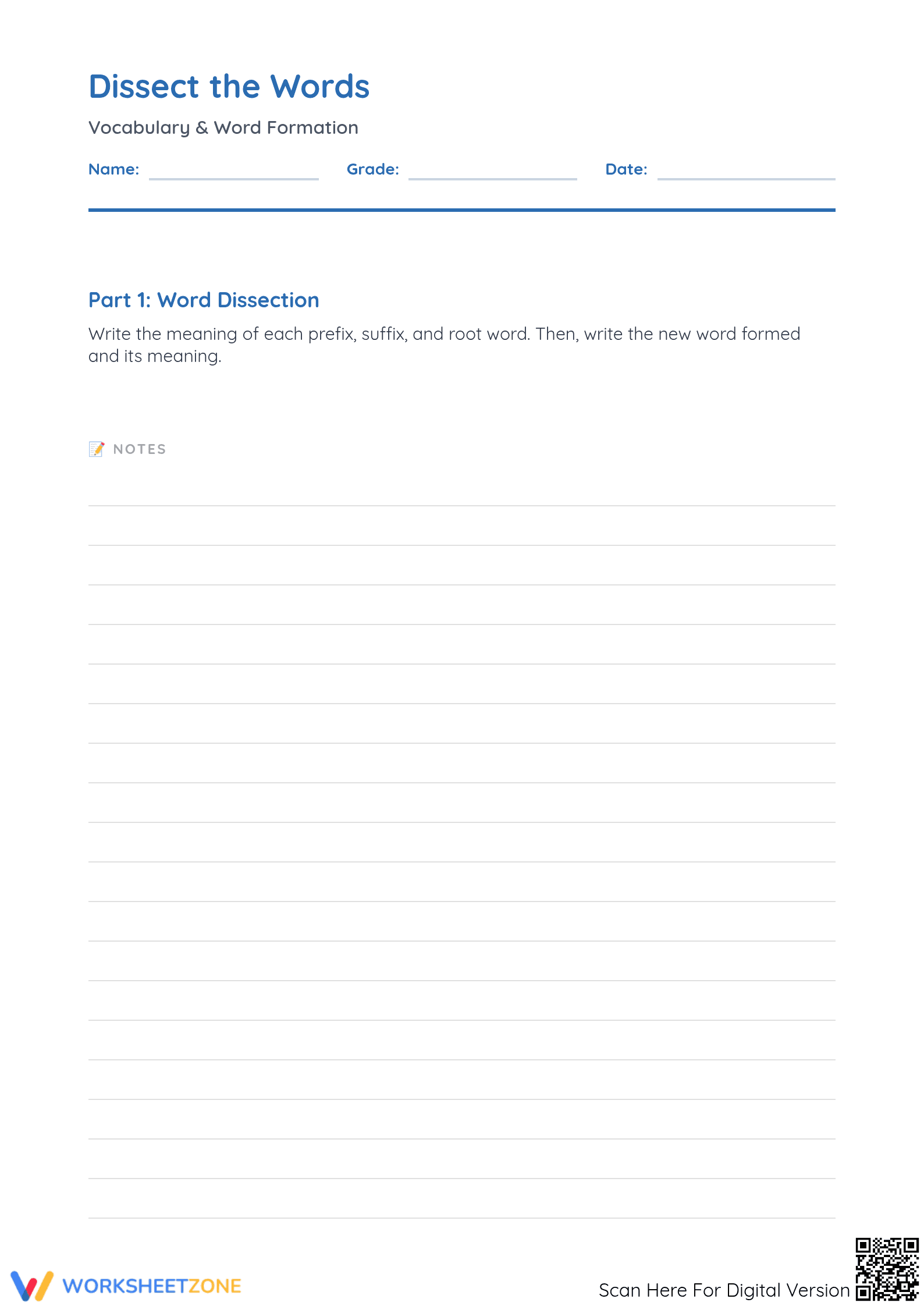
This printable vocabulary worksheet helps students decode complex words by breaking them down into prefixes, suffixes, and root words. By dissecting word parts, learners build essential morphological awareness to determine the meaning of unfamiliar vocabulary. This resource provides targeted practice to strengthen reading comprehension and spelling skills.
At a Glance
- Grade: 4 · Subject: ELA
- Standard:
CCSS.ELA-LITERACY.L.4.4.B— Use affixes and roots to determine word meanings- Skill Focus: Prefixes, Suffixes, and Root Words
- Format: 3 pages · 13 problems · Answer key included · PDF
- Best For: Independent practice and vocabulary building
- Time: 20–30 minutes
Inside this resource, educators will find a structured three-page activity designed to reinforce word formation. The first section features a graphic organizer where students analyze ten words, identifying the prefix or suffix, root word, and meanings of each component. The second section requires students to select three newly formed words and apply them in original sentences. A complete answer key is provided to ensure accurate grading.
- Guided practice: The worksheet begins with a clear, structured table format that isolates each word part, allowing students to focus on individual meanings before synthesizing them.
- Supported practice: Students complete ten dissection tasks, combining affixes like re-, un-, and -less with root words to define the newly created vocabulary terms.
- Independent practice: The final three problems require learners to construct original sentences, demonstrating comprehension of the words in context.
This intentional design follows a gradual-release model, moving from structured morphological analysis to independent application.
This resource is directly aligned to CCSS.ELA-LITERACY.L.4.4.B: Use common, grade-appropriate Greek and Latin affixes and roots as clues to the meaning of a word. It also supports foundational reading skills by reinforcing word recognition and decoding strategies. Both standard codes can be copied directly into lesson plans, IEP goals, or district curriculum mapping tools.
Teachers can utilize this worksheet during literacy centers or as a focused follow-up activity after direct instruction on morphology. It serves as an excellent formative assessment tool; while reviewing the sentence application section, teachers can easily observe whether students grasp the nuanced meaning changes caused by specific affixes. Expected completion time ranges from 20 to 30 minutes, making it ideal for morning work or independent study blocks.
This activity is primarily designed for fourth-grade students, though it serves as an effective review for fifth graders or a challenge for advanced third graders. The highly structured table format provides built-in scaffolding, making it accessible for English Language Learners and students requiring visual organization for vocabulary tasks. It pairs perfectly with an anchor chart detailing common prefixes and suffixes.
Developing morphological awareness is a critical component of reading comprehension and vocabulary acquisition in upper elementary grades. This resource aligns with CCSS.ELA-LITERACY.L.4.4.B, requiring students to use affixes and roots to determine word meanings. According to Fisher & Frey (2014), explicit instruction in word parts significantly improves students' ability to decode unfamiliar texts and enhances overall academic vocabulary across all subject areas. By systematically breaking down words into their constituent prefixes, roots, and suffixes, learners transition from rote memorization to active word problem-solving. This targeted practice ensures that students not only recognize common affixes but also deeply understand how these morphological units alter the grammatical function and definition of base words. Mastering these structural patterns ultimately fosters stronger, more independent readers who can confidently tackle complex texts.


