


























Views
Downloads
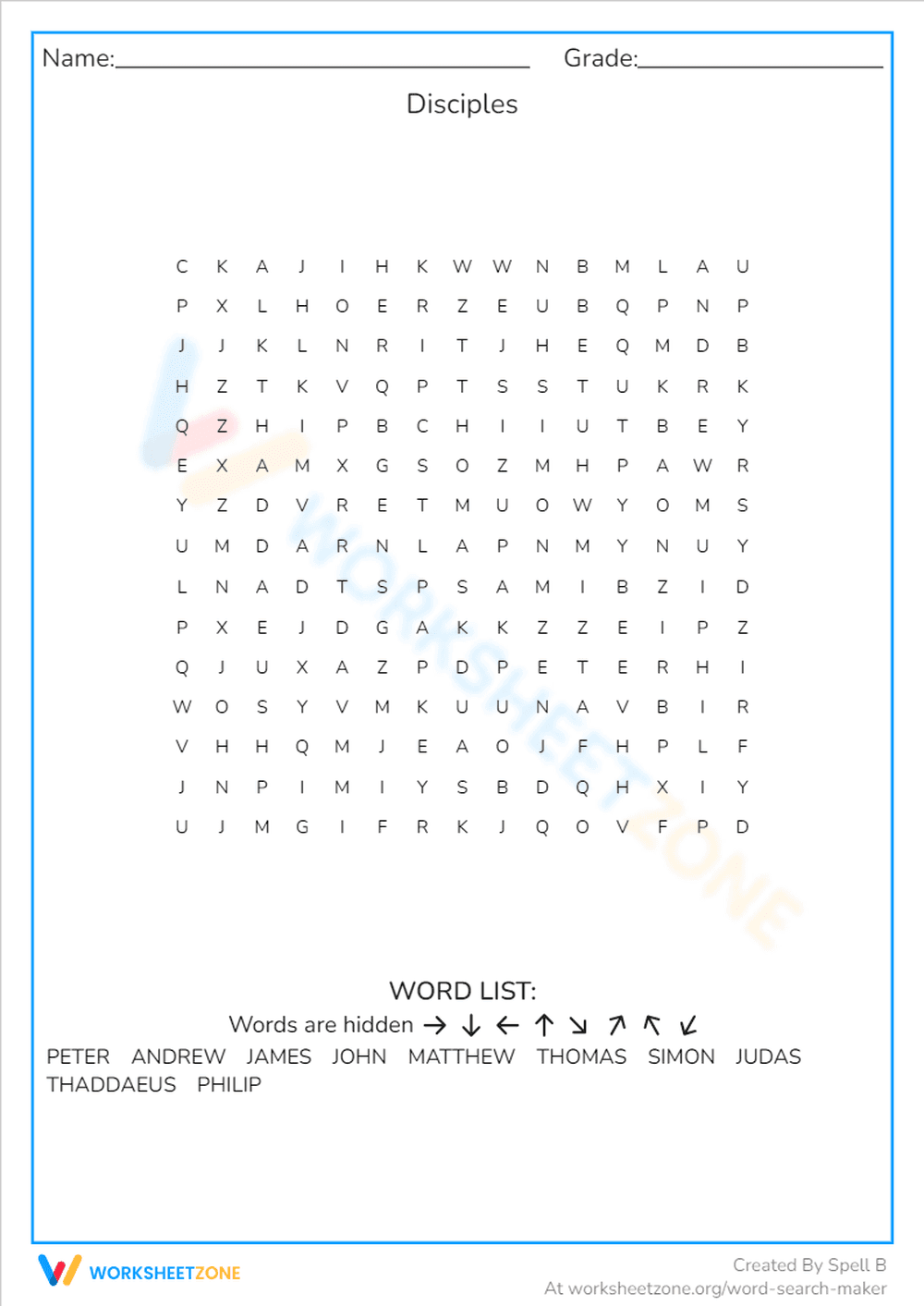

Disciples Word Search | Grade 1-3 Printable Worksheet
Paste this activity's link or code into your existing LMS (Google Classroom, Canvas, Teams, Schoology, Moodle, etc.).
Students can open and work on the activity right away, with no student login required.
You'll still be able to track student progress and results from your teacher account.
This Grade 1-3 Disciples word search worksheet helps students master the spelling of biblical names through an engaging puzzle format. By identifying 10 specific names in a grid, learners reinforce letter recognition and pattern matching skills. It is an ideal resource for Sunday school, religious education, or ELA vocabulary practice.
At a Glance
- Grade: 1-3 · Subject: ELA / Religious Ed
- Standard:
CCSS.ELA-LITERACY.L.2.2— Generalize learned spelling patterns when writing words- Skill Focus: Vocabulary & Spelling
- Format: 1 page · 10 problems · Answer key included · PDF
- Best For: Early finishers or sub plans
- Time: 15–20 minutes
This single-page PDF features a clear 15x15 letter grid containing 10 hidden names of the Disciples. The word list includes Peter, Andrew, James, John, Matthew, Thomas, Simon, Judas, Thaddaeus, and Philip. Words are hidden in multiple directions, including horizontal, vertical, and diagonal, providing a moderate challenge for primary students. A full answer key is provided for quick grading and student self-correction.
The workflow for this resource is designed for maximum efficiency. Teachers can print the single-page PDF in less than 30 seconds. Distribution to a full class takes approximately 1 minute. Reviewing the completed puzzles is instantaneous using the provided answer key. Total teacher preparation time is under 2 minutes, making it a perfect emergency sub plan or transition activity during busy school days.
The primary standard addressed is `CCSS.ELA-LITERACY.L.2.2`, which focuses on spelling patterns and word recognition. By scanning the grid for specific letter sequences, students practice visual discrimination and orthographic processing. This standard code can be copied directly into lesson plans, IEP goals, or district curriculum mapping tools to ensure instructional alignment.
Use this worksheet as a quiet-time activity after a lesson on biblical history or as a vocabulary reinforcement tool in ELA. It works best during the independent practice phase of a lesson. Teachers should observe if students are using systematic scanning (row by row) or random searching to assess visual processing skills. Completion typically takes 15 to 20 minutes depending on the student's grade level.
This resource is designed for students in Grades 1 through 3, including English Language Learners who benefit from visual word recognition. It pairs naturally with a short reading passage about the twelve disciples or an anchor chart listing the names. It is also suitable for homeschool environments and religious education programs looking for supplemental materials.
This worksheet aligns with CCSS.ELA-LITERACY.L.2.2 by requiring students to recognize and verify spelling patterns within a complex visual field. According to Fisher & Frey (2014), word-study activities like word searches support the gradual release of responsibility by allowing students to apply word-recognition skills independently after direct instruction. Research from the RAND AIRS 2024 report suggests that high-quality, low-stakes vocabulary practice contributes to overall literacy fluency in early elementary grades. By focusing on 10 specific names, the worksheet provides targeted practice that reinforces orthographic memory. This resource is a practical tool for educators seeking to integrate thematic content with foundational ELA standards. The inclusion of multi-directional word placement ensures that students in Grades 1, 2, and 3 are appropriately challenged while building confidence in their spelling abilities and attention to detail.


