


























Views
Downloads



Essential Counting Dimes Worksheet | Grade 3-6 Math
Paste this activity's link or code into your existing LMS (Google Classroom, Canvas, Teams, Schoology, Moodle, etc.).
Students can open and work on the activity right away, with no student login required.
You'll still be able to track student progress and results from your teacher account.
This comprehensive three-page math worksheet provides students with targeted practice in counting dimes, converting coin values into decimal notation, and solving real-world word problems. By focusing exclusively on the 10-cent coin, students build the necessary fluency to handle more complex multi-coin transactions and decimal place value concepts in higher mathematics.
At a Glance
- Grade: 3-6 · Subject: Math Currency
- Standard:
CCSS.MATH.CONTENT.2.MD.C.8— Solve word problems involving dollar bills, quarters, dimes, nickels, and pennies using symbols.- Skill Focus: Counting by tens and decimal conversion
- Format: 3 pages · 18 problems · Answer key included · PDF
- Best For: Independent practice or financial literacy units
- Time: 20–30 minutes
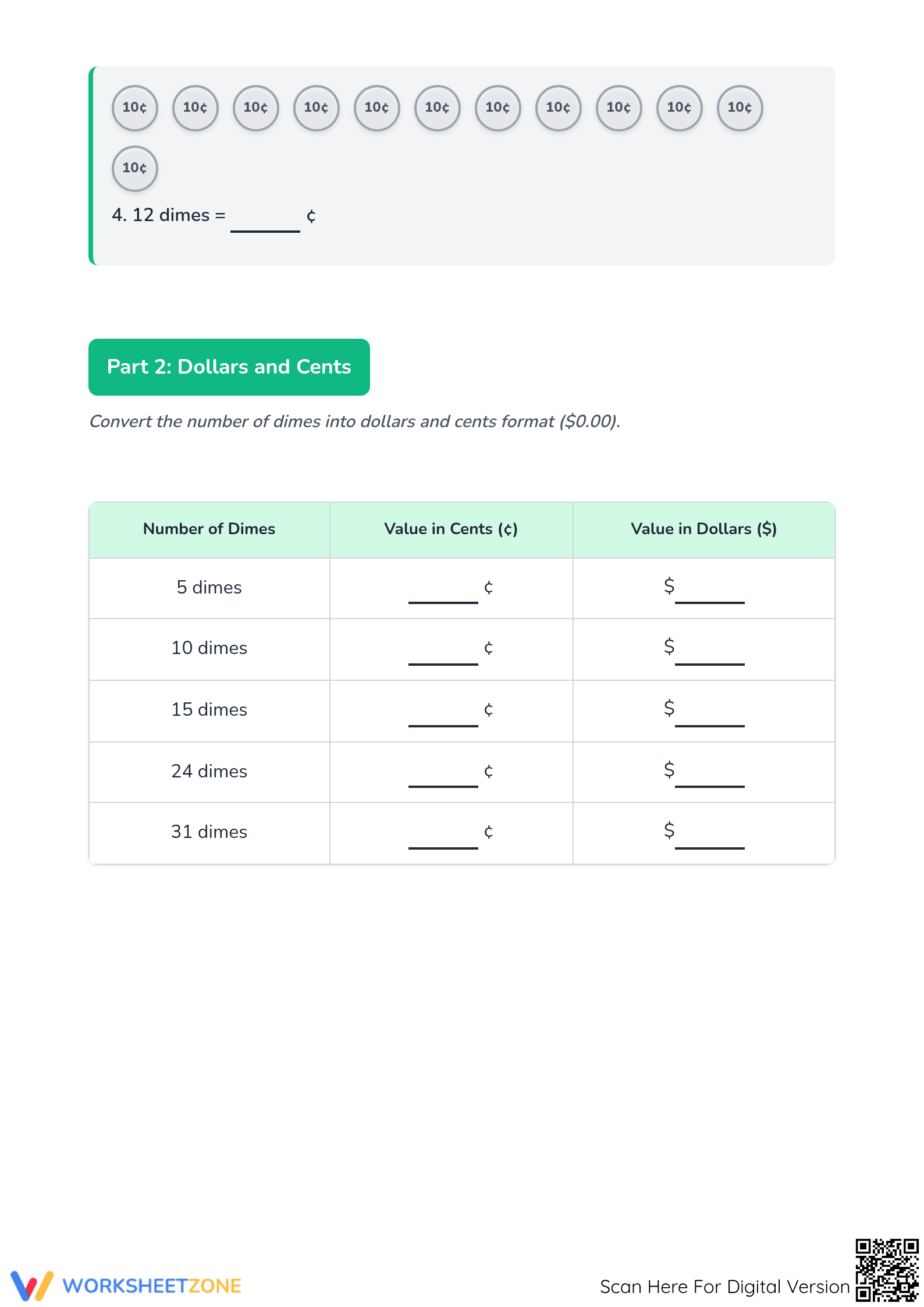
What's Inside: This resource is organized into three distinct instructional phases across three printable pages. Page one features visual counting exercises with clear coin graphics. Page two introduces a structured conversion table where students translate dime counts into both cent and dollar formats. Page three concludes with four rigorous word problems that require students to apply their knowledge to shopping and saving scenarios. A full answer key is provided for rapid grading.
Zero-Prep Workflow
- Print (1 minute): Select the specific pages needed for your lesson or print the entire 3-page packet for a complete sub plan.
- Distribute (1 minute): Hand out the worksheets; the clear headings and visual cues allow students to begin working with minimal teacher direction.
- Review (5 minutes): Use the included answer key to conduct a whole-class check or allow students to self-correct their conversion tables.
Standards Alignment: The primary focus is `CCSS.MATH.CONTENT.2.MD.C.8`, which requires students to solve word problems involving money. While introduced in earlier grades, this worksheet extends the concept for Grades 3-6 by emphasizing the decimal relationship between cents and dollars. Both standard codes can be copied directly into lesson plans, IEP goals, or district curriculum mapping tools.
How to Use It: This worksheet is ideal for the "independent practice" portion of a lesson on decimals or financial literacy. Teachers can use the conversion table on page two as a formative assessment tool; if a student struggles to move from 24 dimes to $2.40, it indicates a need for further instruction on place value. The expected completion time is 25 minutes for most intermediate elementary students.
Who It's For: This resource is designed for general education students in Grades 3-5, as well as Grade 6 students requiring intervention or life skills support. It pairs naturally with physical coin manipulatives or a classroom store simulation where students must calculate totals using only specific denominations.
According to the RAND AIRS 2024 report on mathematics instruction, scaffolded practice that transitions from visual representations to abstract word problems is critical for long-term retention of financial concepts. This worksheet follows that exact trajectory, moving from counting 10-cent icons to calculating notebook costs and piggy bank totals. By isolating the dime, students master the base-ten logic required for decimal fluency without the cognitive load of mixed-coin sets. The inclusion of 18 distinct tasks ensures that learners encounter enough repetition to achieve automaticity. Research from Fisher & Frey (2014) suggests that this type of structured, gradual-release independent work allows teachers to identify specific misconceptions in decimal placement before students move on to more complex multi-step financial modeling. This resource provides a reliable, evidence-based tool for reinforcing CCSS.MATH.CONTENT.2.MD.C.8 in diverse classroom settings.


