


























Views
Downloads
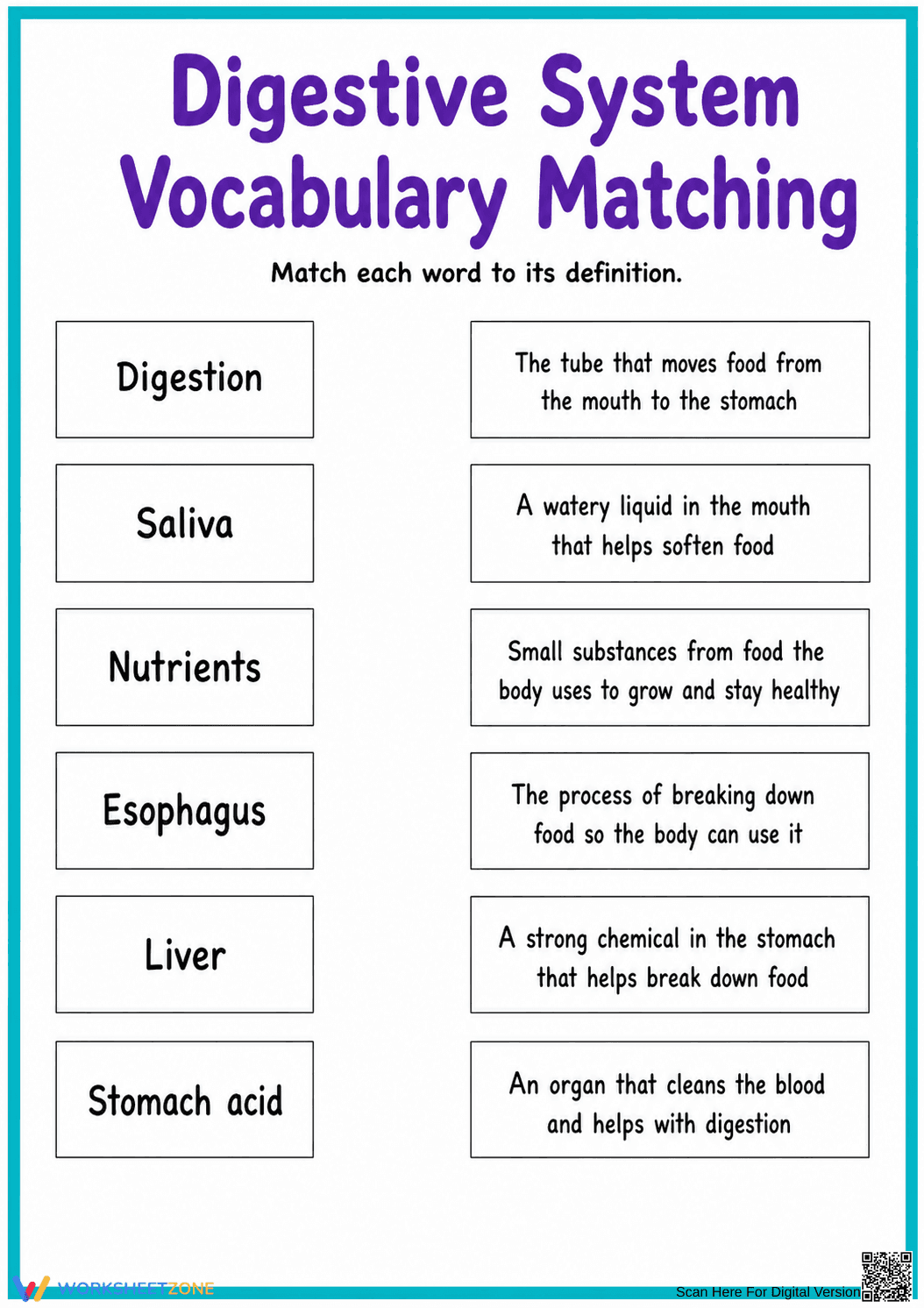

Essential Digestive System Vocabulary Worksheet | Grade 4
Paste this activity's link or code into your existing LMS (Google Classroom, Canvas, Teams, Schoology, Moodle, etc.).
Students can open and work on the activity right away, with no student login required.
You'll still be able to track student progress and results from your teacher account.
This Grade 4 digestive system vocabulary worksheet helps students master the fundamental terminology of human biology. By matching specific organs and substances to their physiological functions, learners develop the precise scientific language required to describe complex body processes. This resource ensures students can distinguish between mechanical and chemical digestion components.
At a Glance
- Grade: 4 · Subject: Science
- Standard:
4-LS1-1— Identify internal structures that function to support survival and growth- Skill Focus: Digestive system vocabulary
- Format: 1 page · 6 problems · Answer key included · PDF
- Best For: Quick vocabulary check or warm-up
- Time: 10–15 minutes
What's Inside
This single-page PDF features six high-frequency science terms: digestion, saliva, nutrients, esophagus, liver, and stomach acid. Each term is paired with a clear, age-appropriate definition in a clean matching layout. The worksheet includes a comprehensive answer key to facilitate quick grading or student self-correction during independent work sessions.
Zero-Prep Workflow
- Print: Generate the required number of copies for your class in under 30 seconds.
- Distribute: Hand out the worksheets as a "bell ringer" or transition activity to focus student attention.
- Review: Spend 60 seconds reviewing the six definitions as a whole-class check to clarify misconceptions about organ functions.
This streamlined process makes it an ideal emergency sub plan component or a fast-paced formative assessment tool.
Standards Alignment
This resource aligns with 4-LS1-1: "Construct an argument that plants and animals have internal and external structures that function to support survival, growth, behavior, and reproduction." By identifying the specific roles of internal structures like the esophagus and liver, students build the evidence base needed to explain how the digestive system supports overall health. This standard code can be copied directly into lesson plans, IEP goals, or district curriculum mapping tools.
How to Use It
Use this worksheet as a formative assessment after an introductory lecture on the human body. Observe students as they work; if a student struggles to match "nutrients" with "substances used to grow," it indicates a need for more concrete examples of food absorption. It also serves as an excellent exit ticket to gauge retention before moving to the next unit. Expected completion time is 10–15 minutes.
Who It's For
This worksheet is designed for Grade 3–5 science students, particularly those requiring clear, focused vocabulary support. It is highly effective for English Language Learners (ELLs) who benefit from the direct pairing of terms with simplified definitions. Pair this resource with a labeled digestive system anchor chart or a physical model of the human torso for maximum instructional impact.
According to the RAND AIRS 2024 report on science literacy, the explicit instruction of domain-specific vocabulary is a critical predictor of long-term comprehension in upper elementary biology. This worksheet targets the 4-LS1-1 standard by isolating six key terms—including esophagus and nutrients—to ensure students can accurately describe how internal structures support survival. Research from Fisher & Frey (2014) suggests that matching tasks provide the necessary scaffolding for students to move from basic recognition to conceptual application. By providing a clear, one-to-one correspondence between terms and definitions, this resource reduces cognitive load and allows students to focus on the biological relationships within the digestive system. This structured approach to vocabulary acquisition is essential for meeting NGSS requirements and preparing students for more complex physiological studies in middle school.


