




























Views
Downloads

Essential Name Tracing Worksheet | Grade K-1 Printable

Paste this activity's link or code into your existing LMS (Google Classroom, Canvas, Teams, Schoology, Moodle, etc.).
Students can open and work on the activity right away, with no student login required.
You'll still be able to track student progress and results from your teacher account.
Master letter formation and fine motor control with this focused handwriting resource. This worksheet provides structured name tracing practice to help early learners gain confidence in their penmanship. By repeating specific letter strokes, students develop the muscle memory required for legible writing in all future academic tasks.
At a Glance
- Grade: K-1 · Subject: Handwriting
- Standard:
CCSS.ELA-LITERACY.L.K.1.A— Print many upper- and lowercase letters with proper form- Skill Focus: Name tracing and letter formation
- Format: 2 pages · 7 tasks · No answer key needed · PDF
- Best For: Morning work or daily handwriting practice
- Time: 10–15 minutes
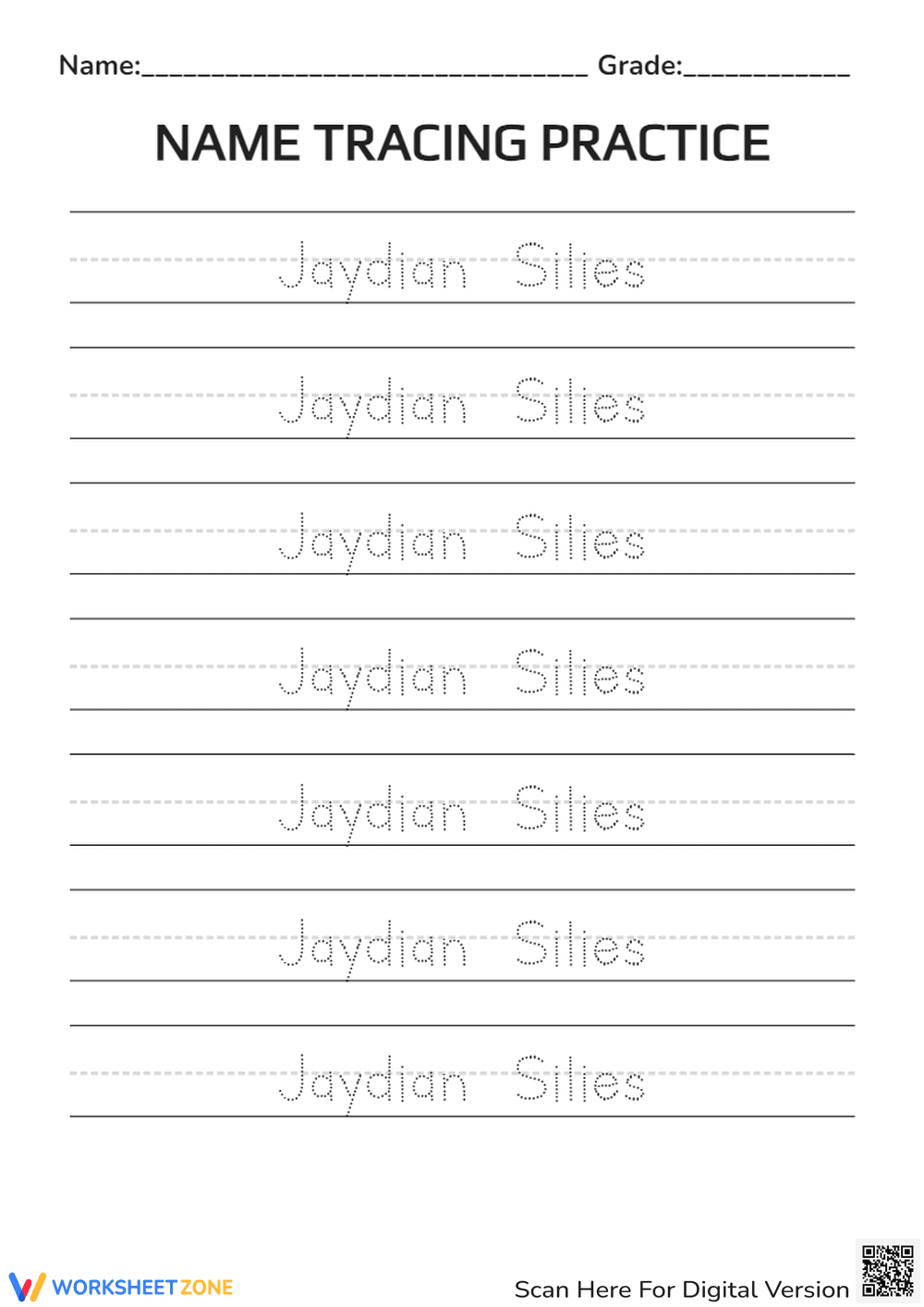
This 2-page PDF features a dedicated tracing sheet with seven lines of dotted-font text on primary-ruled lines. The second page provides a clean, blank primary-ruled template, allowing students to transition from guided tracing to independent free-writing. The layout uses standard dashed mid-lines to assist with proper letter height and placement.
Zero-Prep Workflow:
- Print: Select the pages needed and print in seconds (30 seconds).
- Distribute: Hand out to students during morning arrival or literacy centers (30 seconds).
- Review: Walk the room to provide immediate feedback on grip and stroke order (1 minute).
Total teacher prep time is under two minutes, making this an ideal solution for sub plans or sudden schedule changes.
Standards Alignment
This resource aligns with `CCSS.ELA-LITERACY.L.K.1.A`, which requires students to print many upper- and lowercase letters. It also supports fine motor development necessary for meeting early writing standards. Both standard codes can be copied directly into lesson plans, IEP goals, or district curriculum mapping tools.
How to Use It
Use this worksheet during the independent practice phase of a handwriting lesson. It is particularly effective as a bell-ringer activity to settle students at the start of the day. Teachers should observe student pencil grip and the direction of letter strokes to ensure they are forming letters from top to bottom. Completion typically takes 10 to 15 minutes.
Who It's For
Designed for Kindergarten and First Grade students who are beginning to master their names and basic letter forms. It is excellent for occupational therapy sessions or for students requiring extra fine motor support. Pair this with a letter formation anchor chart or a tactile sand-tracing activity for a multi-sensory approach.
According to the RAND AIRS 2024 report, consistent and repetitive motor practice is fundamental for early literacy development and cognitive mapping of letter shapes. This worksheet targets CCSS.ELA-LITERACY.L.K.1.A by providing 7 structured tracing opportunities followed by open-ended practice. Research from Fisher & Frey (2014) emphasizes the importance of the gradual release of responsibility; this resource facilitates that transition by moving from guided tracing to independent writing on the second page. By focusing on name tracing, students engage with high-frequency letters that hold personal significance, increasing engagement and retention. This printable PDF ensures that students meet foundational handwriting benchmarks while reducing teacher preparation time. The inclusion of primary-ruled lines supports the development of spatial awareness and proper letter sizing, which are critical precursors to fluent composition in later elementary grades.


