




























Views
Downloads
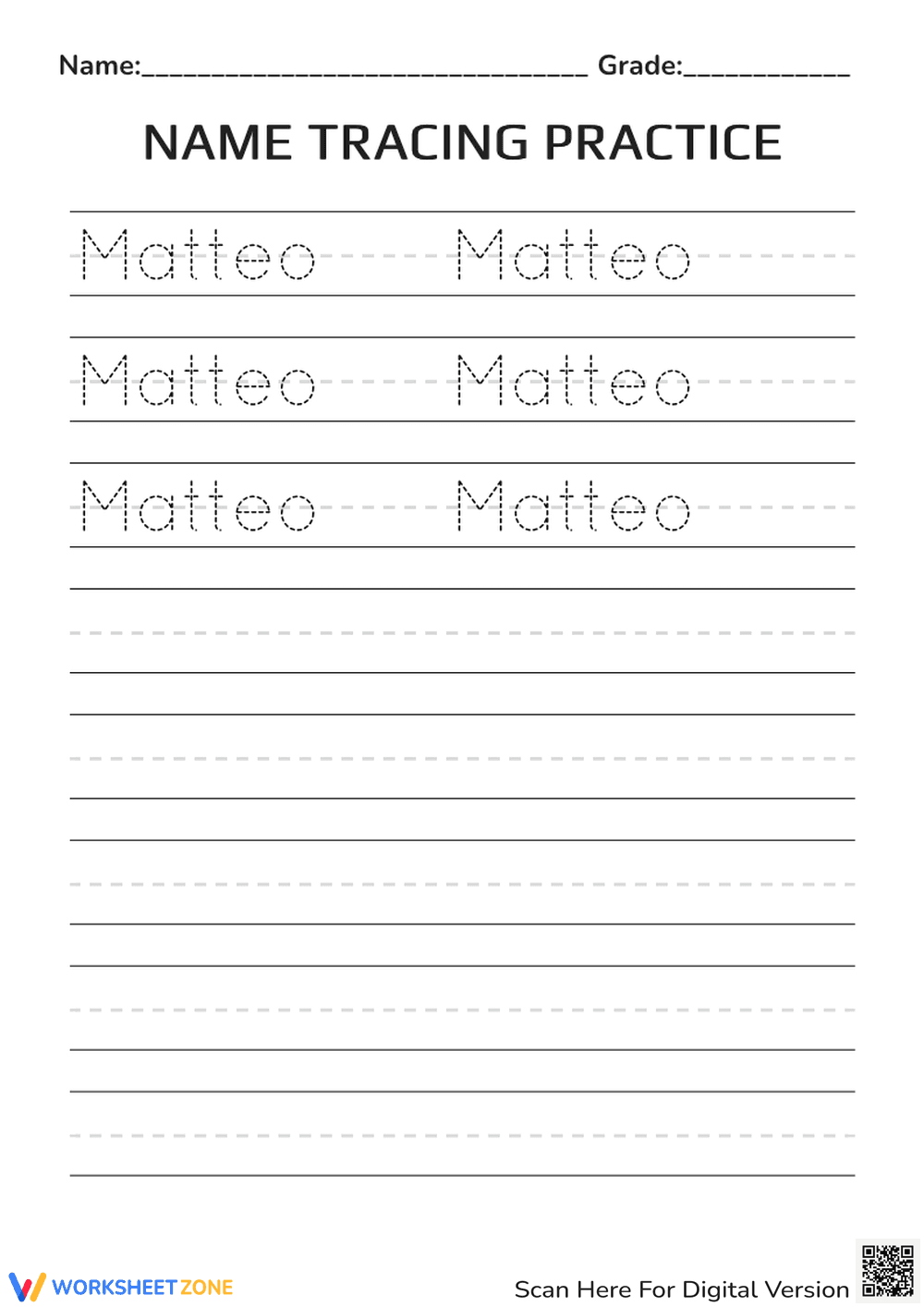

Grade K-1 Name Tracing — Printable No-Prep Worksheet

Paste this activity's link or code into your existing LMS (Google Classroom, Canvas, Teams, Schoology, Moodle, etc.).
Students can open and work on the activity right away, with no student login required.
You'll still be able to track student progress and results from your teacher account.
This foundational handwriting worksheet helps early learners master letter formation and fine motor control through targeted name tracing. By practicing the name "Matteo," students transition from guided tracing to independent writing, building muscle memory required for legible print in kindergarten and first grade.
At a Glance
- Grade: K-1 · Subject: Handwriting
- Standard:
CCSS.ELA-LITERACY.L.K.1.A— Print many upper- and lowercase letters- Skill Focus: Name tracing and letter formation
- Format: 1 page · 11 practice rows · No answer key needed · PDF
- Best For: Morning work and literacy centers
- Time: 10–15 minutes
This single-page resource features a structured progression for handwriting practice. The top half includes six dotted-line models of the name "Matteo" for guided tracing, ensuring students understand proper stroke sequence. The bottom half provides five blank primary-lined rows for independent freeform writing. Standard primary dashed lines help young writers properly size uppercase and lowercase letters.
Zero-Prep Workflow
- Print (1 minute): Download the PDF and print the desired number of copies. The black-and-white design ensures low ink consumption.
- Distribute (1 minute): Hand out the sheets during morning arrival or transition times. The instructions are self-explanatory for early readers.
- Review (1 minute): Quickly scan student work to check for proper pencil grip and correct letter sizing on the dashed lines.
Total teacher preparation requires under two minutes, making this ideal for sub plans, morning work, or literacy centers.
Standards Alignment
This activity aligns with CCSS.ELA-LITERACY.L.K.1.A: Print many upper- and lowercase letters. It also supports foundational print concepts by reinforcing left-to-right progression and proper spacing between letters. Both standard codes can be copied directly into lesson plans, IEP goals, or district curriculum mapping tools.
How to Use It
Deploy this worksheet as a targeted morning work activity to establish a calm, focused routine at the start of the school day. Alternatively, place it in a literacy center for independent practice while the teacher conducts small group reading instruction. As a formative assessment tip, observe students while they trace the first few models to ensure they are starting their letters from the top down rather than the bottom up. Expected completion time ranges from 10 to 15 minutes depending on the student's fine motor development.
Who It's For
This resource is designed for kindergarten and first-grade students developing their foundational handwriting skills. It serves as an excellent intervention tool for occupational therapy sessions or for students who need extra support with fine motor control. For differentiation, teachers can highlight the bottom baseline to help struggling writers anchor their letters. Pair this worksheet with a tactile letter-formation activity, such as tracing letters in sand or using playdough, to reinforce the physical mechanics of writing.
Developing automaticity in handwriting is a critical component of early literacy that directly impacts future writing fluency. This resource targets CCSS.ELA-LITERACY.L.K.1.A, requiring students to print many upper- and lowercase letters accurately. According to Fisher & Frey (2014), explicit instruction and repeated practice in letter formation allow young learners to free up working memory, which can then be applied to higher-order tasks like spelling and composition. By moving from dotted-line tracing to independent production on primary lines, this worksheet provides the exact scaffolding necessary to build that automaticity. Consistent practice with familiar words offers a meaningful context that keeps early learners engaged while they refine their fine motor control. This structured approach ensures students build the physical stamina required for extended writing tasks.


