


























Views
Downloads

Grade 1 Biomimicry — Printable No-Prep Worksheet
Paste this activity's link or code into your existing LMS (Google Classroom, Canvas, Teams, Schoology, Moodle, etc.).
Students can open and work on the activity right away, with no student login required.
You'll still be able to track student progress and results from your teacher account.
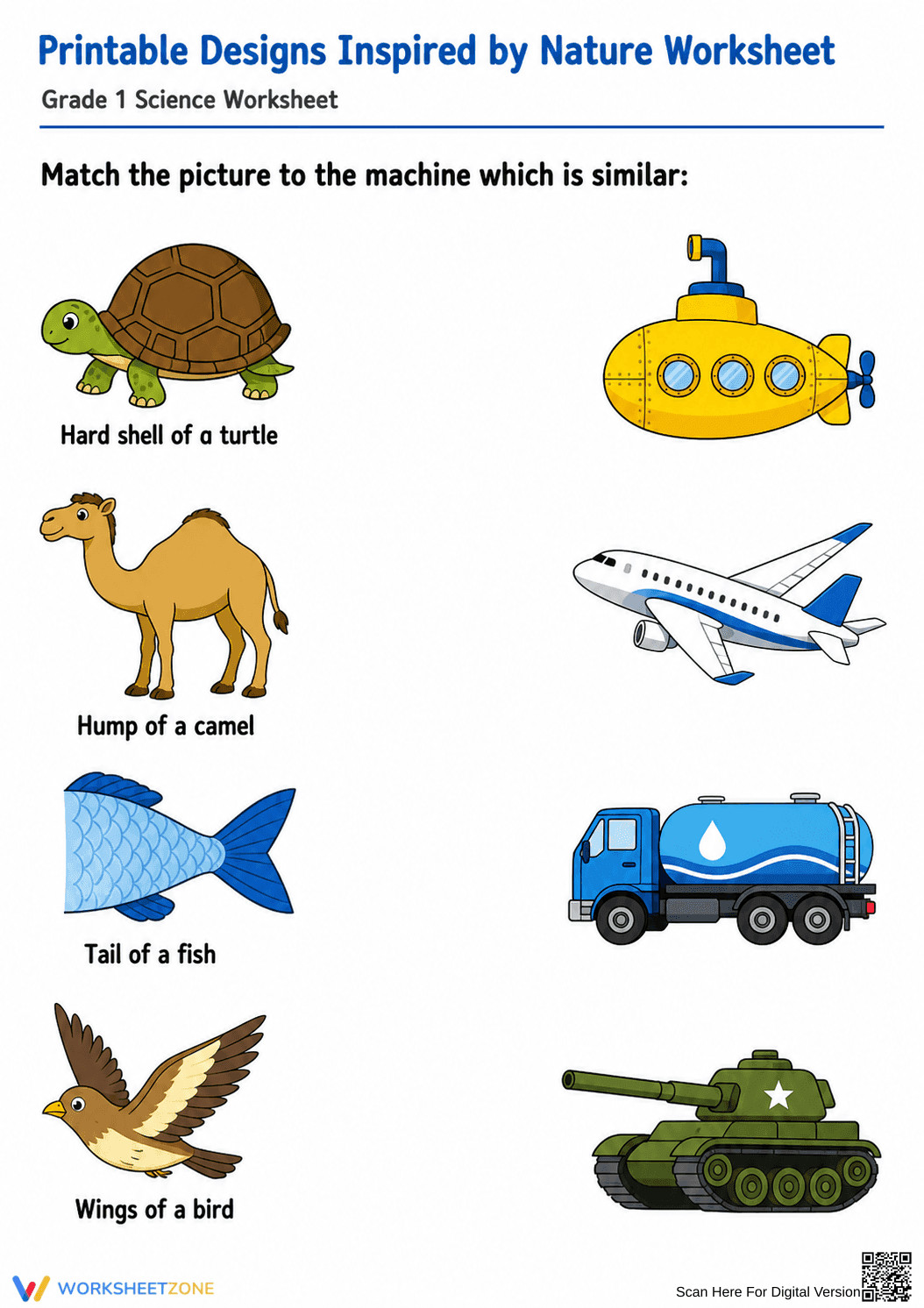
This Grade 1 science worksheet introduces the concept of biomimicry by having students match animal adaptations to human inventions. Students observe physical traits like a turtle's shell or a bird's wings to identify their functional counterparts in modern machines, building foundational scientific observation skills.
At a Glance
- Grade: 1 · Subject: Science
- Standard:
1-LS1-1— Mimic animal parts to solve human design problems- Skill Focus: Biomimicry and Functional Adaptation
- Format: 1 page · 4 problems · Answer key included · PDF
- Best For: Independent practice and science centers
- Time: 10–15 minutes
What's Inside
Inside this resource is a one-page matching activity featuring four distinct pairs of biological structures and human-engineered machines. The worksheet uses clear illustrations to compare the hard shell of a turtle, a camel's hump, a fish's tail, and bird wings to their mechanical analogues. Clear instructions ensure students can work independently to identify these functional relationships. A full answer key is included for easy grading.
Zero-Prep Workflow
This print-and-go resource requires under two minutes of teacher preparation. First, print the single-page PDF (30 seconds). Second, distribute the copies to your Grade 1 students for an immediate warm-up or independent practice session (10 minutes). Finally, review the connections as a group to spark a discussion about other nature-inspired designs (5 minutes). This is an ideal grab-and-go option for substitute folders.
Standards Alignment
Aligned to NGSS 1-LS1-1, students use this worksheet to analyze how human problems are solved by mimicking animal parts. The standard requires students to use materials to design a solution to a human problem by mimicking how plants and/or animals use their external parts to help them survive, grow, and meet their needs. Both standard codes can be copied directly into lesson plans, IEP goals, or district curriculum mapping tools.
How to Use It
Use this worksheet during the Explain or Elaborate phase of a 5E science lesson on animal adaptations. It serves as an excellent formative assessment to check if students understand the relationship between form and function. Teachers should observe whether students can articulate why a shell is like a tank versus just matching the pictures. Expected completion time is 10 to 15 minutes.
Who It's For
This worksheet is designed for Grade 1 students but is also suitable for Kindergarten enrichment or Grade 2 review. The visual nature of the matching tasks makes it a highly effective tool for English Language Learners (ELLs) and students with IEPs who benefit from reduced linguistic load. It pairs naturally with a classroom discussion on inventors or a read-aloud about bio-inspired engineering.
According to Fisher & Frey (2014), the use of visual analogies in early science education significantly enhances the retention of complex concepts like structural adaptation. By connecting the observable external parts of animals to familiar human machines, this worksheet fulfills the cognitive requirements of the NGSS 1-LS1-1 standard, where students mimic animal parts to solve human design problems. Students develop a robust mental framework for biomimicry that transcends simple identification, moving toward the foundational design thinking emphasized in modern elementary STEM curricula. This targeted resource provides the necessary instructional scaffolding for young learners to recognize that human innovation often relies heavily on biological precedents for efficiency, protection, and survival. This ensures that the worksheet functions not merely as a basic activity, but as a highly effective, research-backed tool for developing essential scientific literacy in the primary grades.


