


























Views
Downloads
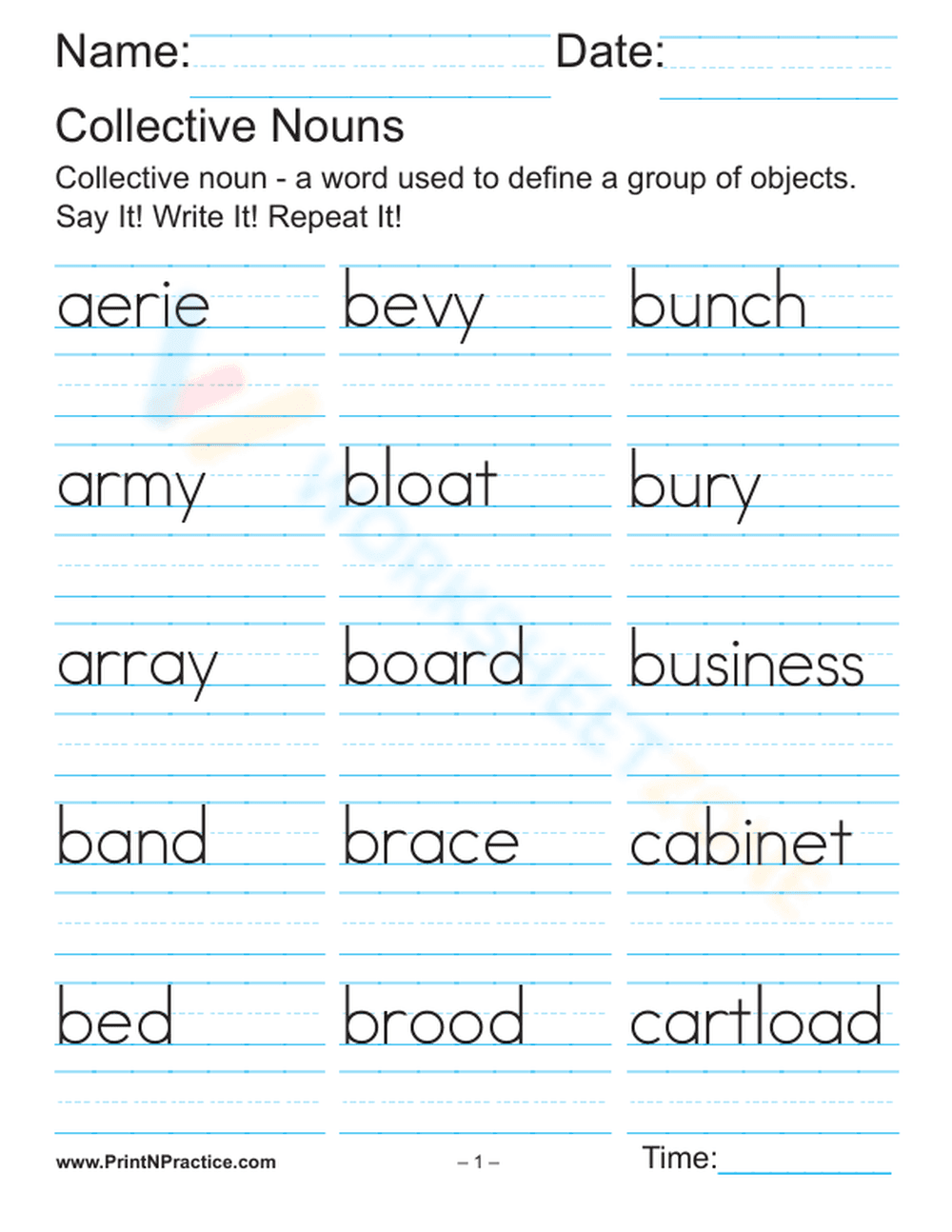

Collective Nouns Handwriting Worksheet | Grade 2 Essential
Paste this activity's link or code into your existing LMS (Google Classroom, Canvas, Teams, Schoology, Moodle, etc.).
Students can open and work on the activity right away, with no student login required.
You'll still be able to track student progress and results from your teacher account.
This Grade 2 collective nouns worksheet provides students with a structured way to improve penmanship while expanding their grammatical vocabulary. By tracing 15 unique collective nouns, learners reinforce the connection between group names and their specific objects. This resource ensures students master both fine motor control and essential language conventions in one session.
At a Glance
- Grade: 2 · Subject: ELA
- Standard:
CCSS.ELA-LITERACY.L.2.1.A— Use collective nouns (e.g., group of people, animals, or things)- Skill Focus: Handwriting and Vocabulary
- Format: 1 page · 15 problems · Answer key not required · PDF
- Best For: Morning work or literacy centers
- Time: 10–15 minutes
A clear definition of collective nouns at the top grounds student understanding. Below the header, students find 15 sophisticated vocabulary words—including aerie, bevy, and brood—arranged in a clean three-column layout. Each word is presented in a light-gray dashed font on primary-ruled lines, providing the necessary scaffolding for consistent letter height and spacing during the tracing process.
This resource is designed for immediate classroom implementation with a total teacher prep time of under 2 minutes. First, print the required copies for your roster. Second, distribute the sheets during your ELA block; the "Say It! Write It! Repeat It!" instructions allow students to work independently. Finally, review the completed sheets to check for letter formation accuracy and vocabulary retention. It is an ideal sub plan addition.
The primary focus is `CCSS.ELA-LITERACY.L.2.1.A`, which requires students to use collective nouns correctly. By engaging with specific terms like army or cabinet, students move beyond generic labels to more precise academic language. This alignment supports broader language standards regarding conventions of standard English. Both standard codes can be copied directly into lesson plans, IEP goals, or district curriculum mapping tools.
Use this worksheet as a formative assessment during a unit on nouns. Observe students as they trace to identify those struggling with specific letter descenders or spacing. It also serves as an excellent early finisher task or a quiet activity for a substitute teacher folder. Expect most Grade 2 students to complete the tracing and oral repetition in approximately 12 minutes.
This worksheet is ideal for second-grade students, though it provides valuable vocabulary enrichment for third graders or English Language Learners (ELLs) who need exposure to idiomatic group names. Pair this with a picture book about animal groups or a collective noun anchor chart to deepen the conceptual connection between the words and the groups they represent.
Research by Fisher & Frey (2014) emphasizes the importance of the gradual release of responsibility, where structured tracing acts as a scaffolded bridge toward independent writing. This worksheet aligns with that model by providing clear visual guides for 15 specific collective nouns, ensuring students internalize the spelling and formation of complex vocabulary. According to the CCSS.ELA-LITERACY.L.2.1.A standard, mastering collective nouns is a foundational step in developing sophisticated sentence structures. By integrating handwriting with vocabulary acquisition, this resource addresses multiple cognitive domains simultaneously. Educational analysis suggests that repetitive tracing of high-interest words improves both orthographic mapping and fine motor automaticity. This printable tool offers a practical, evidence-based approach to literacy instruction that fits easily into any elementary curriculum. Teachers can rely on this resource to provide consistent, high-quality practice that meets national standards for Grade 2 language arts.


