


























Views
Downloads
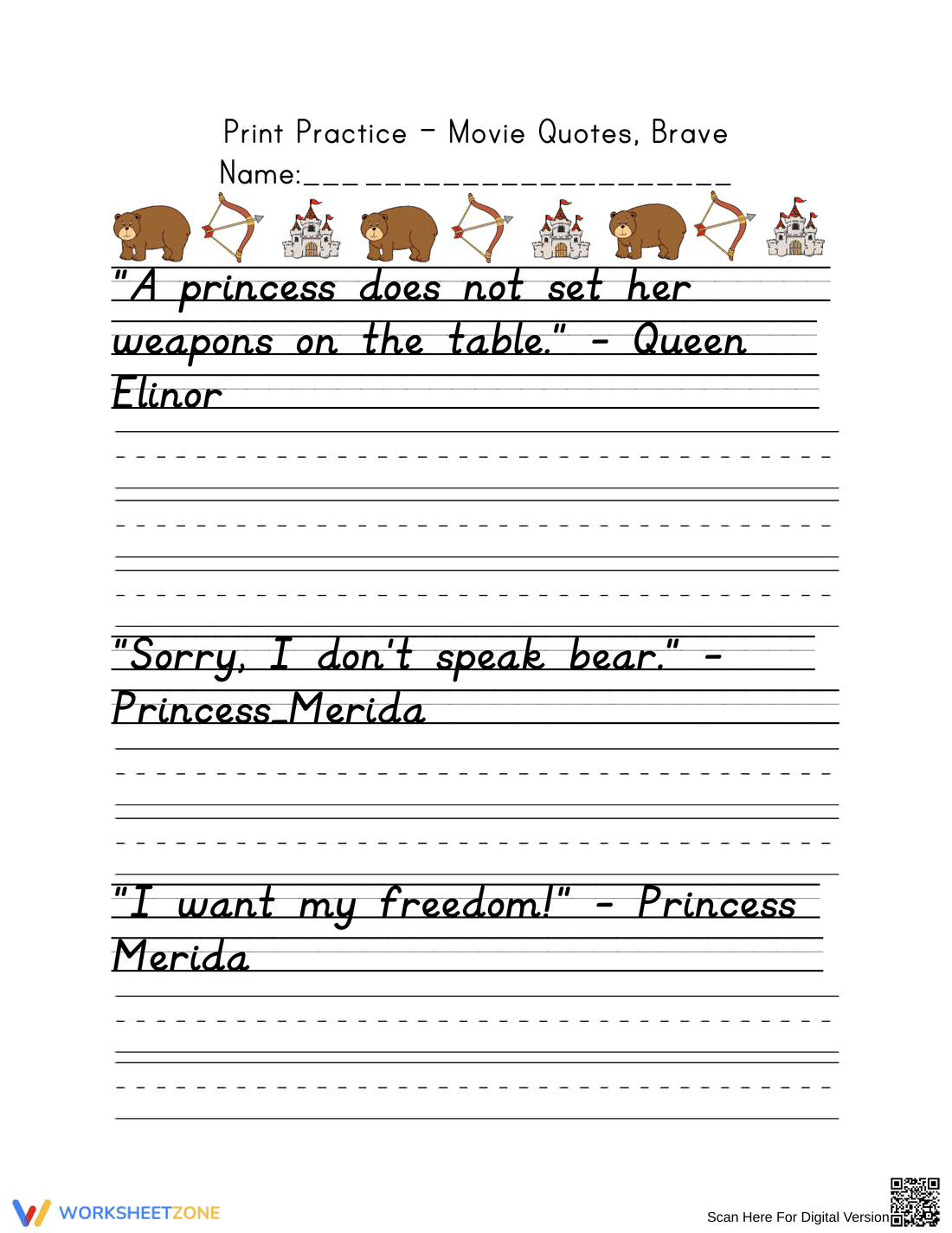

Essential D'Nealian Handwriting: Brave Movie Quotes
Paste this activity's link or code into your existing LMS (Google Classroom, Canvas, Teams, Schoology, Moodle, etc.).
Students can open and work on the activity right away, with no student login required.
You'll still be able to track student progress and results from your teacher account.
This Grade 3 and Grade 4 handwriting resource provides a high-interest way for students to refine their D'Nealian penmanship. By using memorable dialogue from the movie Brave, students remain engaged while practicing letter formation, spacing, and punctuation. This worksheet ensures that handwriting practice feels like a reward, leading to better legibility and fine motor control.
At a Glance
- Grade: 3-4 · Subject: Handwriting
- Standard:
CCSS.ELA-LITERACY.L.3.1— Demonstrate command of the conventions of standard English grammar and usage when writing- Skill Focus: D'Nealian sentence legibility
- Format: 1 page · 3 tasks · No-prep · PDF
- Best For: Morning work or early finishers
- Time: 10–15 minutes
Inside this single-page PDF, you will find three distinct quotes from the film Brave, featuring characters like Princess Merida and Queen Elinor. Each quote is presented in a clear D'Nealian font with appropriate slant and tail characteristics. Below each model sentence, students are provided with primary-ruled dashed lines to facilitate accurate letter height and consistent spacing. The layout is clean and uncluttered, preventing visual overwhelm for students.
The zero-prep workflow for this resource is designed for the busy educator. First, print the single-page PDF in under 30 seconds. Second, distribute the sheets to students during a transition period or as a focused handwriting block. Third, review the work by checking for proper letter connections and baseline adherence. Total teacher preparation time is under 2 minutes, making this an ideal solution for unexpected schedule changes or sub plans.
This worksheet aligns with `CCSS.ELA-LITERACY.L.3.1`, which requires students to demonstrate command of the conventions of standard English grammar and usage when writing. While handwriting is often seen as a foundational skill, maintaining legibility in the upper elementary grades is critical for effective communication. This resource also supports Grade 4 standards by reinforcing the mechanics of sentence structure and punctuation. Both standard codes can be copied directly into lesson plans, IEP goals, or district curriculum mapping tools.
Use this worksheet as a "Bell Ringer" activity to settle the class at the start of the day. The familiar movie theme provides a calm, engaging entry point into academic work. Alternatively, use it as a formative assessment tool for fine motor development. Observe students as they write to identify those struggling with pencil grip or letter slant. Completion typically takes 10 to 15 minutes, depending on the student's focus on precision.
This resource is specifically designed for third and fourth-grade students who have moved beyond basic alphabet tracing but still require structured practice to maintain D'Nealian standards. It is particularly effective for students who are motivated by popular media. Pair this worksheet with a short character analysis lesson or a themed anchor chart about courage to create a cohesive thematic unit.
Research by Fisher & Frey (2014) emphasizes the importance of purposeful practice in the gradual release of responsibility model. Handwriting, though often overlooked in the digital age, remains a vital cognitive link to literacy development. According to the NAEP, students who demonstrate fluent handwriting often perform better on complex writing tasks because they can devote more cognitive resources to content rather than mechanics. This worksheet addresses CCSS.ELA-LITERACY.L.3.1 by providing 3 specific opportunities for students to practice sentence-level conventions in a D'Nealian style. By integrating high-interest movie quotes, the resource increases student stamina and engagement. Consistent use of such structured practice helps bridge the gap between isolated letter formation and fluid, legible composition. This standalone resource is an effective tool for maintaining mechanical standards in the Grade 3-4 classroom.


