


























Views
Downloads

CVC Spelling Worksheet — Printable Grade K ELA
Paste this activity's link or code into your existing LMS (Google Classroom, Canvas, Teams, Schoology, Moodle, etc.).
Students can open and work on the activity right away, with no student login required.
You'll still be able to track student progress and results from your teacher account.
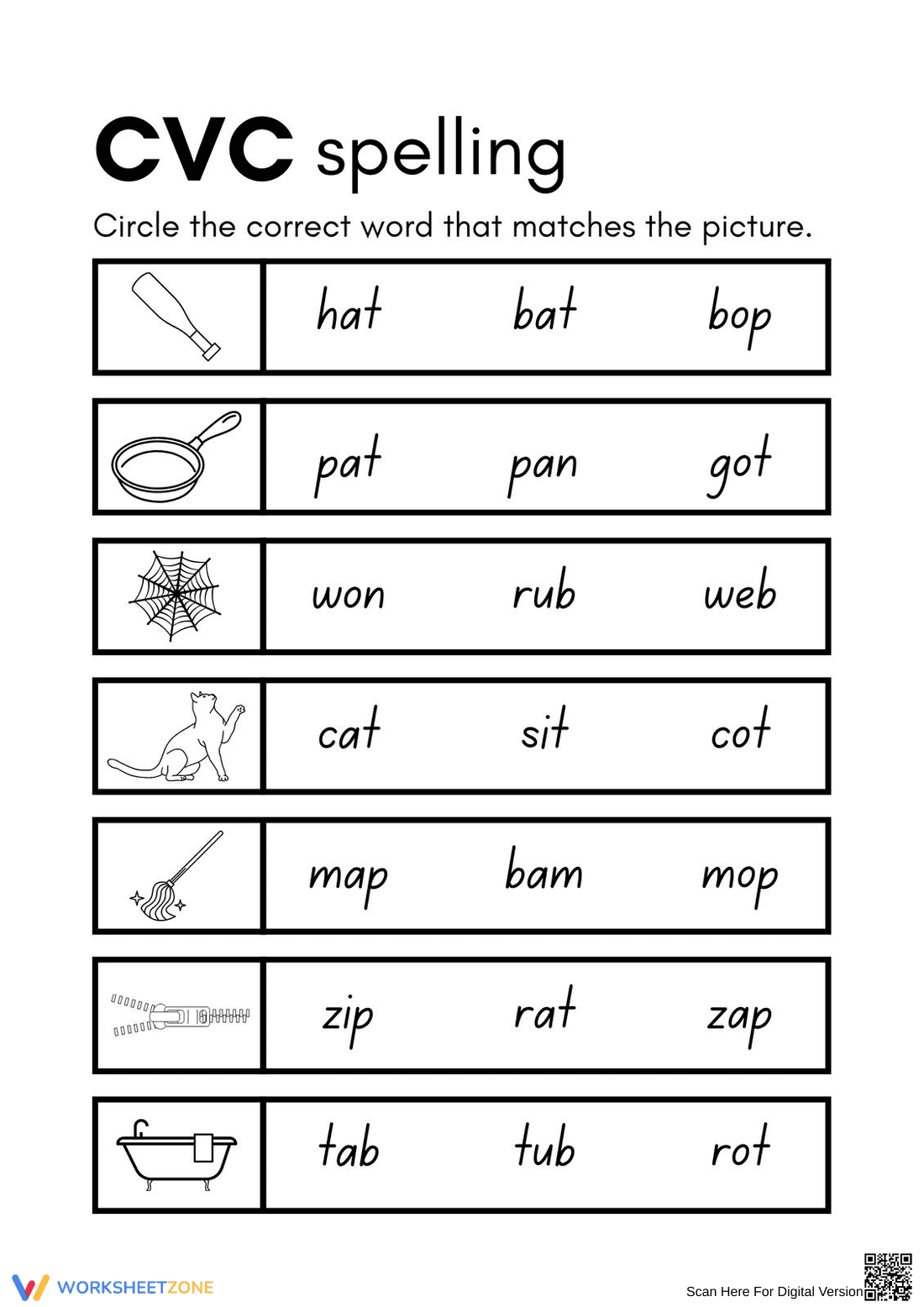
This foundational CVC spelling worksheet helps early readers connect visual cues with phonetic decoding. By matching familiar pictures to the correct consonant-vowel-consonant word, students actively practice blending sounds and isolating phonemes. This targeted exercise builds essential reading fluency and phonemic awareness for young learners.
At a Glance
- Grade: K · Subject: ELA
- Standard:
CCSS.ELA-LITERACY.RF.K.3— Apply phonics and word analysis skills to decode words- Skill Focus: CVC Word Recognition
- Format: 1 page · 7 problems · PDF
- Best For: Independent practice or morning work
- Time: 10–15 minutes
This single-page resource features seven distinct picture-matching tasks designed to reinforce early phonics skills. Each problem presents a clear, recognizable illustration—such as a bat, pan, or web—alongside three phonetically similar CVC word options. Students must carefully read each option and circle the word that accurately represents the image. The clean layout minimizes visual clutter, ensuring students remain focused on decoding rather than navigating complex instructions.
Zero-Prep Workflow
This resource requires minimal teacher setup.
- Print (1 min): Download the PDF and print. The black-and-white design is ink-friendly.
- Distribute (1 min): Hand out during literacy centers. Instructions are intuitive for kindergarteners.
- Review (2 mins): Check responses as a class. Total teacher prep time is under two minutes, perfect for a sub plan.
Standards Alignment
This activity aligns to CCSS.ELA-LITERACY.RF.K.3, requiring students to apply phonics skills to decode words. By distinguishing between similar CVC words, students demonstrate mastery of letter-sound correspondences. Both standard codes can be copied directly into lesson plans, IEP goals, or district curriculum mapping tools.
How to Use It
Deploy this worksheet during independent centers after explicit instruction on short vowels. It serves as a formative assessment; observe if students guess based on initial consonants or blend all phonemes. Alternatively, use it for small group intervention. Students typically finish within 10 to 15 minutes.
Who It's For
This worksheet is primarily designed for kindergarten students mastering their initial phonics skills, but it is also highly effective for first-grade students who require foundational reading intervention. For differentiation, teachers can prompt advanced students to write a sentence using one of the circled words on the back of the page. Pair this activity with a tactile phonics lesson, such as building words with magnetic letters, to solidify the connection between physical spelling and written decoding.
Mastering consonant-vowel-consonant structures is a critical milestone in early literacy development. According to Fisher & Frey (2014), providing students with targeted, structured practice in decoding familiar word patterns significantly accelerates reading fluency and overall text comprehension. This specific worksheet directly supports CCSS.ELA-LITERACY.RF.K.3 by requiring young learners to apply phonics and word analysis skills to decode words accurately in context. When students engage in tasks that demand careful visual discrimination between phonetically similar words—such as distinguishing "cat" from "cot" or "zip" from "zap"—they actively strengthen their orthographic mapping capabilities. This plain-English skill of matching visual picture representations to decoded text ensures that abstract phonics instruction translates into practical, everyday reading ability. By integrating this evidence-based practice into daily classroom routines, educators can reliably build the foundational skills necessary for long-term academic success in both reading and writing.


