


























Views
Downloads
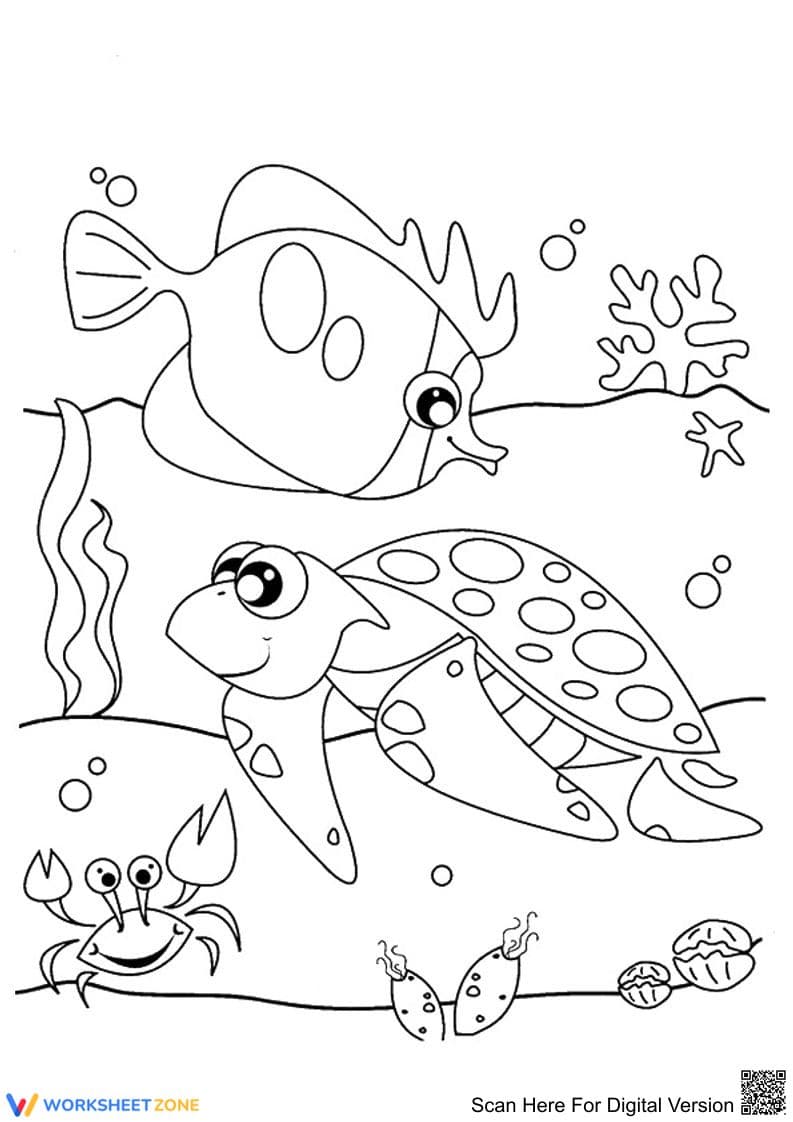

Cute Ocean Animals Coloring Page | Essential Printable
Paste this activity's link or code into your existing LMS (Google Classroom, Canvas, Teams, Schoology, Moodle, etc.).
Students can open and work on the activity right away, with no student login required.
You'll still be able to track student progress and results from your teacher account.
This printable ocean animals coloring page provides students with a creative way to explore marine life while developing essential fine motor control. By engaging with detailed illustrations of a sea turtle, fish, and crab, learners strengthen their hand-eye coordination and artistic expression. It is a perfect supplement for early childhood science or literacy units.
At a Glance
- Grade: K-5 · Subject: Arts & English
- Standard:
CCSS.ELA-LITERACY.L.K.6— Use words and phrases acquired through conversations and reading- Skill Focus: Fine motor skills & vocabulary
- Format: 1 page · 1 task · No answer key · PDF
- Best For: Morning work or early finishers
- Time: 15–20 minutes
Inside this resource, you will find a high-quality, single-page PDF featuring a charming underwater scene. The illustration includes a large sea turtle, a friendly fish, a small crab, and various seabed elements like coral and shells. The clean line art ensures that students of all ages can successfully color within the lines using crayons, markers, or colored pencils.
The zero-prep workflow for this resource is designed for maximum efficiency in busy classrooms. First, print the single-page PDF (30 seconds). Next, distribute the sheets to your students along with their preferred coloring tools (1 minute). Finally, review the animal names as a group to reinforce vocabulary (1 minute). Total teacher preparation time is under 3 minutes, making it an ideal sub plan addition.
This worksheet aligns with `CCSS.ELA-LITERACY.L.K.6`, which focuses on acquiring and using appropriate vocabulary. While coloring, students can identify and name the specific marine creatures, bridging the gap between visual art and language development. This standard code can be copied directly into lesson plans, IEP goals, or district curriculum mapping tools.
Use this worksheet during a "Life Under the Sea" science unit to introduce marine biology concepts. It also serves as an excellent formative assessment tool; observe how students grip their coloring utensils to gauge fine motor development. The expected completion time is 15 to 20 minutes, depending on the level of detail the student chooses to apply.
This resource is designed for students in Kindergarten through Grade 5, with a primary focus on early elementary learners. It is particularly effective for English Language Learners (ELLs) who benefit from visual aids when learning new nouns. Pair this coloring page with a non-fiction picture book about the ocean or an anchor chart featuring sea creature labels.
Research from Fisher & Frey (2014) emphasizes the importance of integrating visual arts with literacy to support cognitive development in early learners. This ocean animals coloring page directly supports CCSS.ELA-LITERACY.L.K.6 by providing a concrete visual context for vocabulary acquisition. Engaging in coloring activities is not merely a recreational task; it is a foundational exercise in fine motor precision and spatial awareness. According to the NAEP, students who participate in integrated arts activities often demonstrate higher engagement levels in core subjects. By identifying the sea turtle, crab, and fish, students move from passive observation to active identification. This 1-page printable offers a low-stakes environment for students to practice focus and persistence. It serves as a versatile tool for teachers looking to bridge the gap between creative expression and academic standards in a high-quality, accessible format.


