




























Views
Downloads
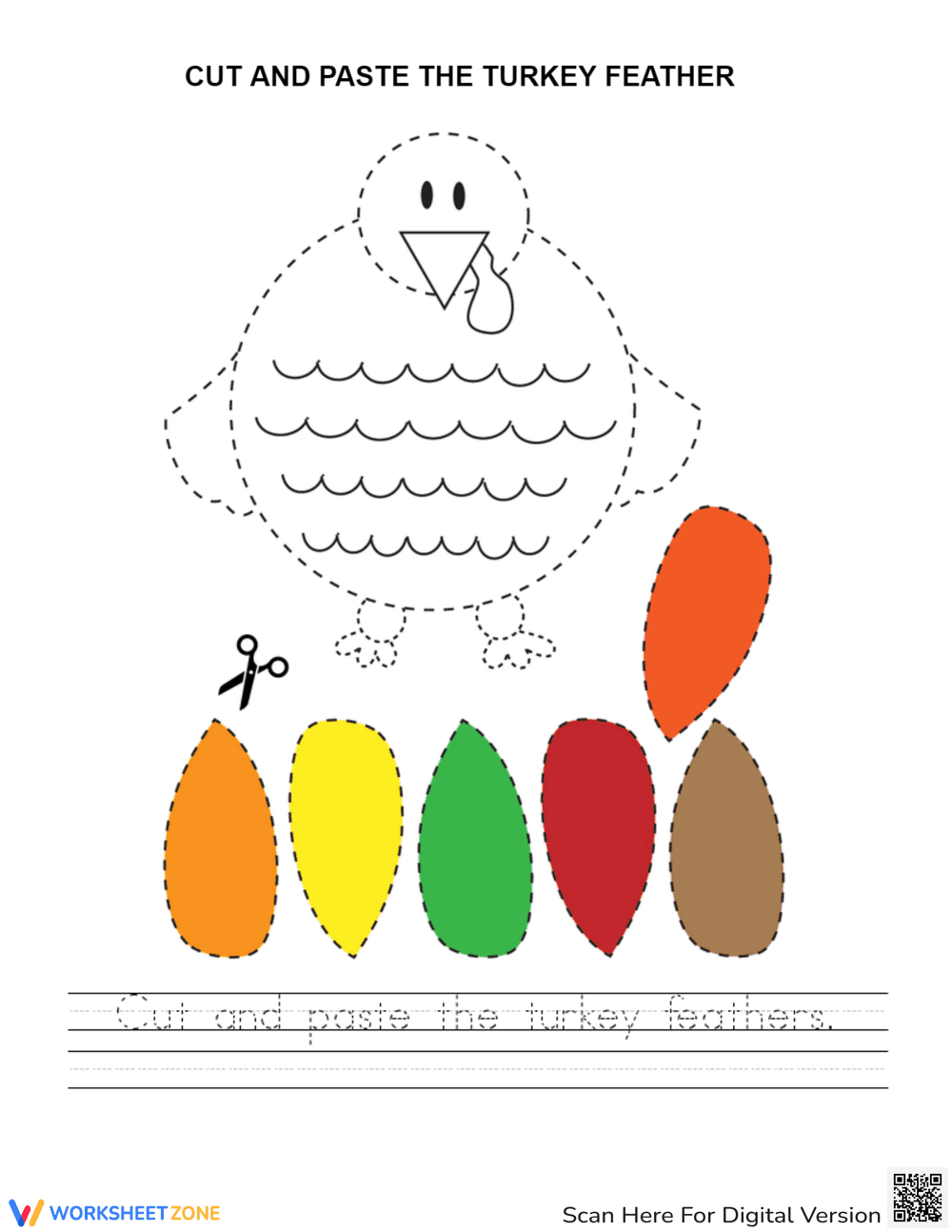

Turkey Cut and Paste Worksheet | Essential Grade K-2

Paste this activity's link or code into your existing LMS (Google Classroom, Canvas, Teams, Schoology, Moodle, etc.).
Students can open and work on the activity right away, with no student login required.
You'll still be able to track student progress and results from your teacher account.
This Kindergarten through Grade 2 Thanksgiving activity helps young learners develop essential fine motor control through a festive holiday theme. By combining scissor skills, spatial reasoning, and handwriting practice, students create a complete turkey while reinforcing their ability to follow multi-step directions. It provides a structured yet creative outlet for seasonal classroom celebrations.
At a Glance
- Grade: K-2 · Subject: Arts & Crafts
- Standard:
CCSS.ELA-LITERACY.L.K.1.A— Print many upper- and lowercase letters and develop fine motor control- Skill Focus: Scissor skills and tracing
- Format: 1 page · 8 tasks · Answer key not required · PDF
- Best For: Thanksgiving centers and morning work
- Time: 15–20 minutes
This single-page PDF features a large, dotted-line turkey outline designed for tracing practice. Below the main image, students find six colorful feathers—orange, yellow, green, red, and brown—ready for cutting. The bottom of the page includes a dedicated primary-lined section where students trace the sentence "Cut and paste the turkey feathers," integrating literacy with manual dexterity.
The zero-prep workflow for this resource is designed for maximum efficiency during busy holiday weeks. First, print the required number of copies for your group, which takes less than one minute. Next, distribute the sheets along with scissors, glue sticks, and pencils. Finally, review the completed turkeys as a formative check for grip and cutting accuracy. Total teacher preparation time is under 2 minutes, making it an ideal sub plan or transition activity.
The primary alignment for this resource is `CCSS.ELA-LITERACY.L.K.1.A`, which focuses on the physical act of writing and letter formation. While the activity is artistic, the tracing component directly supports the standard's requirement for students to produce legible print. Both standard codes can be copied directly into lesson plans, IEP goals, or district curriculum mapping tools.
Use this worksheet as a quiet morning work activity during the week of Thanksgiving to settle students as they arrive. It also functions effectively as a fine motor station in a rotational center model. Teachers should observe how students hold their scissors and provide immediate feedback on their "thumb-up" cutting technique. Completion typically takes 15 to 20 minutes depending on the student's individual skill level.
This resource is ideal for Kindergarteners and First Graders who are still mastering bilateral coordination. It serves as an excellent Tier 1 intervention for students receiving occupational therapy support. Pair this worksheet with a read-aloud about Thanksgiving traditions or a simple anchor chart showing the parts of a turkey to build background knowledge and vocabulary.
Research from Fisher & Frey (2014) emphasizes the importance of integrating fine motor tasks with literacy to support early cognitive development. This worksheet addresses CCSS.ELA-LITERACY.L.K.1.A by requiring students to trace complex shapes and specific sentence structures, which builds the muscular endurance necessary for sustained writing tasks. According to the RAND AIRS 2024 report on early childhood education, multi-sensory activities that combine cutting, pasting, and tracing lead to higher engagement levels in Title I classrooms compared to purely digital alternatives. By engaging in these 8 specific tasks, students practice the gradual release of responsibility through guided tracing and independent cutting. This resource provides a measurable way for educators to track progress in manual dexterity and letter formation, ensuring that students meet foundational benchmarks before transitioning to more complex compositional writing in later primary grades.


