




























Views
Downloads

Printable Cursive Writing Test: Grade 2 Review

Paste this activity's link or code into your existing LMS (Google Classroom, Canvas, Teams, Schoology, Moodle, etc.).
Students can open and work on the activity right away, with no student login required.
You'll still be able to track student progress and results from your teacher account.
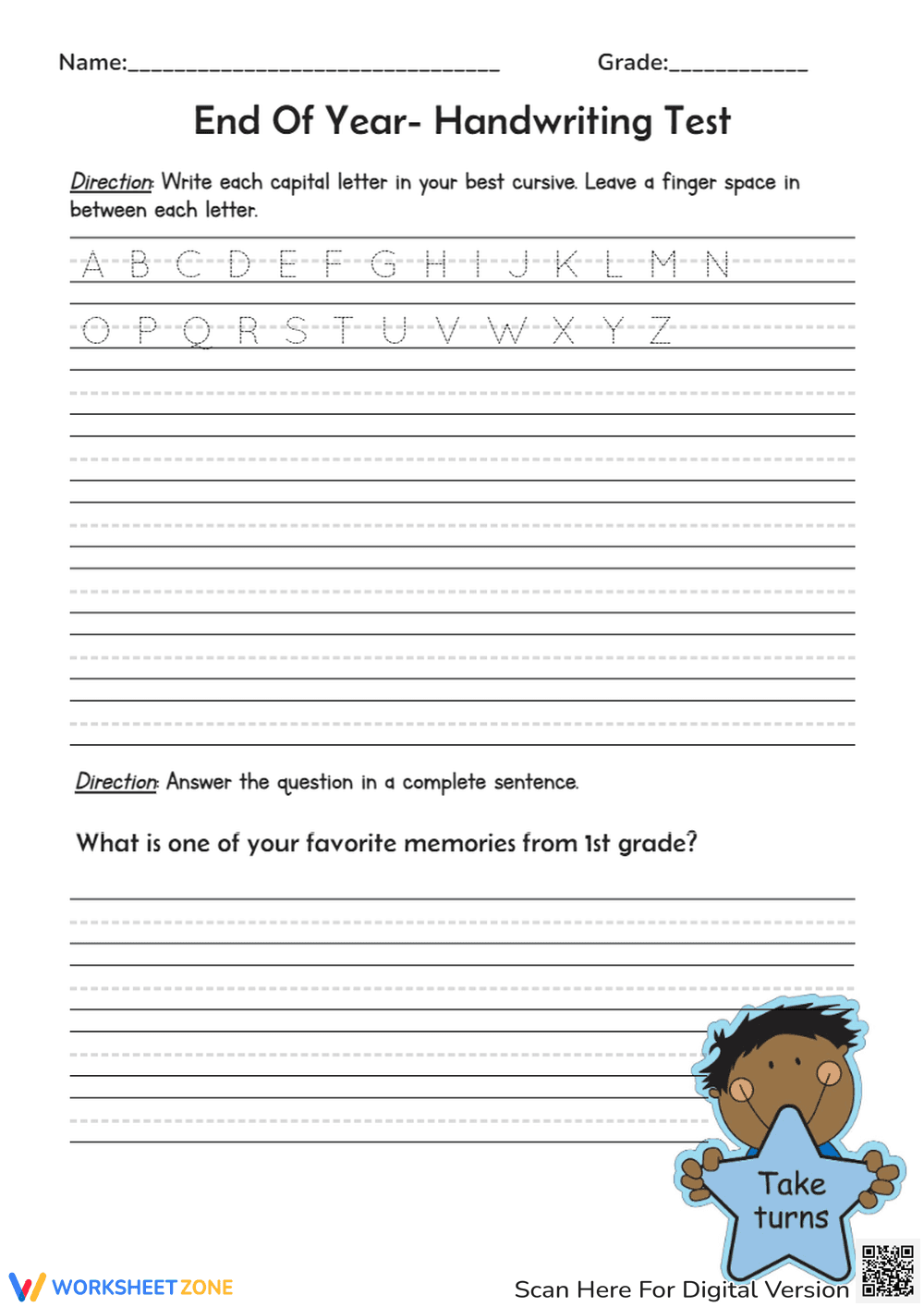
Assess student cursive proficiency at the end of the school year with this handwriting test. Students trace and write uppercase letters before completing a reflective sentence prompt. This resource measures letter formation and spacing, providing evidence of fine motor development.
At a Glance
- Grade: Grade 2 · Subject: Handwriting
- Standard:
CCSS.ELA-LITERACY.L.2.1— Demonstrate command of the conventions of standard English grammar and usage when writing- Skill Focus: Cursive capital letters and sentence writing
- Format: 1 page · 27 problems · Answer key not applicable · PDF
- Best For: End-of-year summative assessment and handwriting review
- Time: 15–20 minutes
This single-page assessment contains two sections to evaluate cursive skills. The top portion features a capital letter tracing guide for letters A through Z, followed by blank lined rows for independent writing. The bottom portion presents a reflection prompt asking students to write about a favorite memory in a complete sentence.
This zero-prep worksheet streamlines classroom assessment with a simple three-step workflow. First, print the single-page PDF document, taking less than 1 minute. Second, distribute the sheets and read the directions, requiring about 1 minute of setup. Third, review the completed handwriting samples to evaluate letter formation, taking 1 minute per student. The entire process requires under 2 minutes of active teacher preparation, making it ideal for substitute plans.
Standards Alignment
This worksheet aligns with CCSS.ELA-LITERACY.L.2.1, requiring students to demonstrate command of standard English conventions when writing. By practicing letter formation and writing complete sentences, students build the mechanics necessary for fluent expression. Both standard codes can be copied directly into lesson plans or IEP goals.
How to Use It
Use this worksheet as a summative assessment at the end of a cursive unit. Alternatively, administer it during the final week of school as a reflective activity. Observe student pencil grip and stroke direction to identify individuals needing targeted intervention. Students typically complete the tasks within 15 to 20 minutes.
Who It's For
This resource is designed for first and second-grade students transitioning to cursive writing. It serves as an excellent tool for general education classrooms, occupational therapy, and home-school practice. Pair this worksheet with a cursive alphabet anchor chart to provide visual support for students who need extra guidance.
According to research from Fisher & Frey (2014), structured tracing exercises provide the necessary scaffolding for young learners to transition successfully to independent writing tasks. This worksheet applies these principles by pairing guided tracing of capital letters with an open-ended sentence prompt. By aligning with the standards of CCSS.ELA-LITERACY.L.2.1, the resource ensures that students practice fine motor control while developing standard English writing conventions. Systematic handwriting instruction supports cognitive automaticity, allowing students to focus more energy on composition and reading comprehension. Utilizing this 1-page assessment helps educators gather actionable data on letter formation, spacing, and alignment. This evidence-based approach to handwriting practice ensures that students build the muscle memory and mechanical skills required for academic success in later grades. Furthermore, early mastery of cursive writing has been linked to improved spelling accuracy and word recognition skills.


