




























Views
Downloads
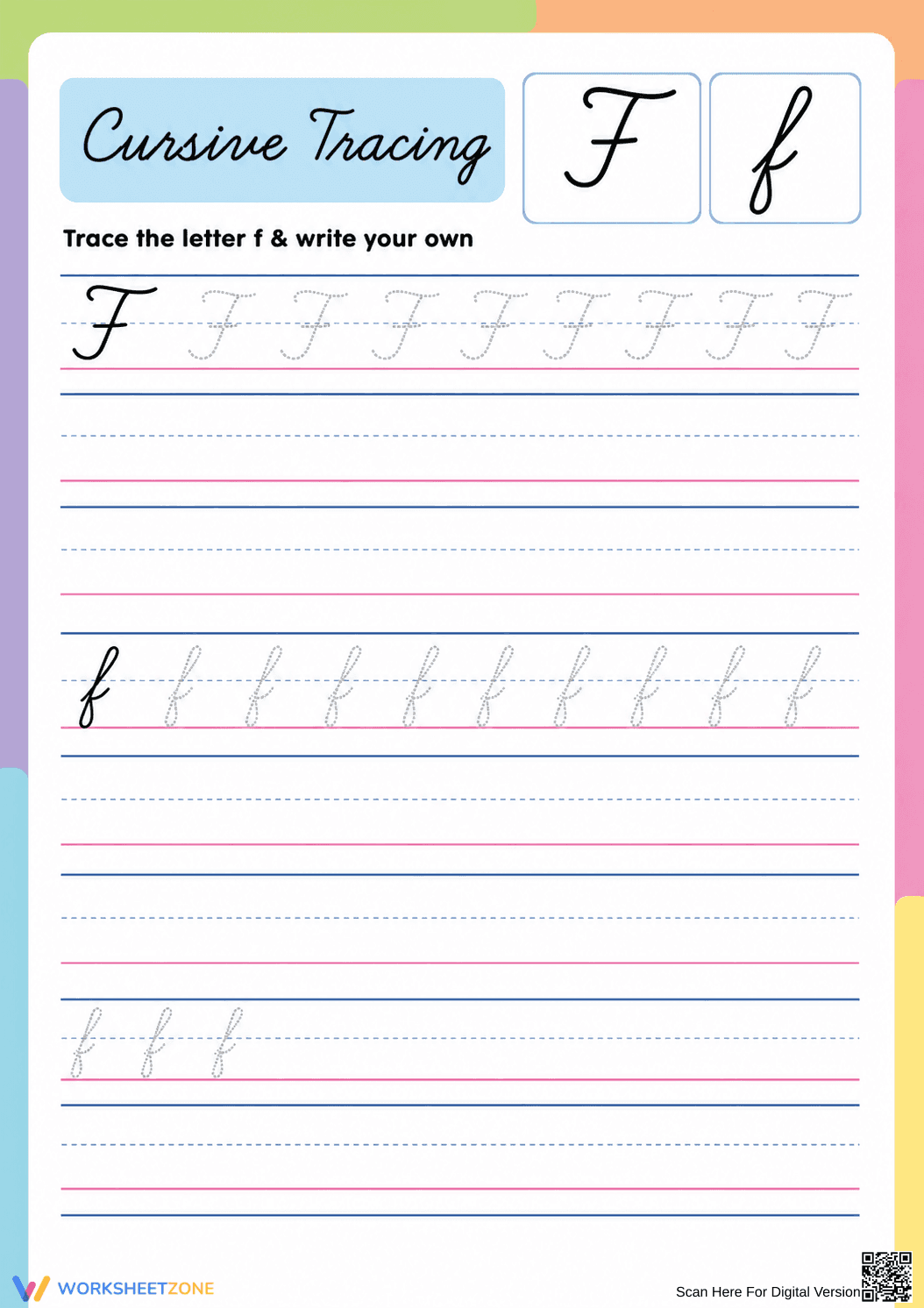

Cursive Letter F Tracing Worksheet | Grade 2 Essential

Paste this activity's link or code into your existing LMS (Google Classroom, Canvas, Teams, Schoology, Moodle, etc.).
Students can open and work on the activity right away, with no student login required.
You'll still be able to track student progress and results from your teacher account.
Master the elegant curves of the cursive letter F with this focused handwriting practice page. Students develop fine motor control and letter recognition by transitioning from guided tracing to independent writing. This resource ensures students understand the specific stroke sequence required for both uppercase and lowercase cursive forms.
At a Glance
- Grade: 2 · Subject: ELA
- Standard:
CCSS.ELA-LITERACY.L.2.1— Demonstrate command of the conventions of standard English grammar and usage when writing.- Skill Focus: Cursive Letter F Formation
- Format: 1 page · 20+ tasks · No answer key needed · PDF
- Best For: Daily handwriting practice and motor skills
- Time: 10–15 minutes
This single-page PDF features a clean, distraction-free layout designed for early learners. It includes one row dedicated to uppercase cursive 'F' and one row for lowercase 'f', each beginning with a bold exemplar followed by dashed tracing guides. The bottom half of the page provides empty primary-ruled lines, allowing students to practice their spacing and slant without assistance.
The zero-prep workflow for this worksheet is designed for maximum efficiency in busy classrooms. First, print the required number of copies (30 seconds). Second, distribute the sheets during your handwriting block or as a morning arrival activity (1 minute). Finally, walk the room to provide immediate corrective feedback on grip and stroke direction (5-10 minutes). This resource is an ideal sub-plan addition because it requires no prior instruction.
This worksheet aligns with `CCSS.ELA-LITERACY.L.2.1`, which requires students to demonstrate command of the conventions of standard English grammar and usage when writing. While cursive is often a state-level requirement, it supports the broader goal of legible and fluid written communication. This standard code can be copied directly into lesson plans, IEP goals, or district curriculum mapping tools.
Use this worksheet as a formative assessment tool after a short demonstration of the letter F on the whiteboard. Observe students to ensure they are starting their strokes at the correct baseline or midline point. It also serves as an excellent quiet-time activity for students who finish their primary ELA assignments early, providing meaningful practice that builds muscle memory.
This resource is primarily designed for Grade 2 students beginning their cursive journey, though it is suitable for Grade 1 students showing advanced fine motor readiness. It pairs naturally with a cursive alphabet anchor chart or a tactile salt-tray tracing activity. For students struggling with slant, consider taping the paper at a slight angle to the desk.
Research from RAND AIRS 2024 indicates that explicit handwriting instruction, including cursive, significantly correlates with improved orthographic coding and word-reading development in primary grades. By focusing on the specific motor patterns of the letter F, students reduce the cognitive load required for letter production, eventually freeing mental resources for higher-order composition tasks. The structured transition from tracing to independent production follows the gradual release of responsibility model, which is proven to increase student confidence and accuracy. This worksheet provides the necessary repetition to move letter formation from conscious effort to automaticity. Educators can utilize this data-backed approach to justify the inclusion of handwriting in a comprehensive literacy block, ensuring that students meet foundational writing standards while developing the physical stamina needed for longer writing assignments.


