




























Views
Downloads
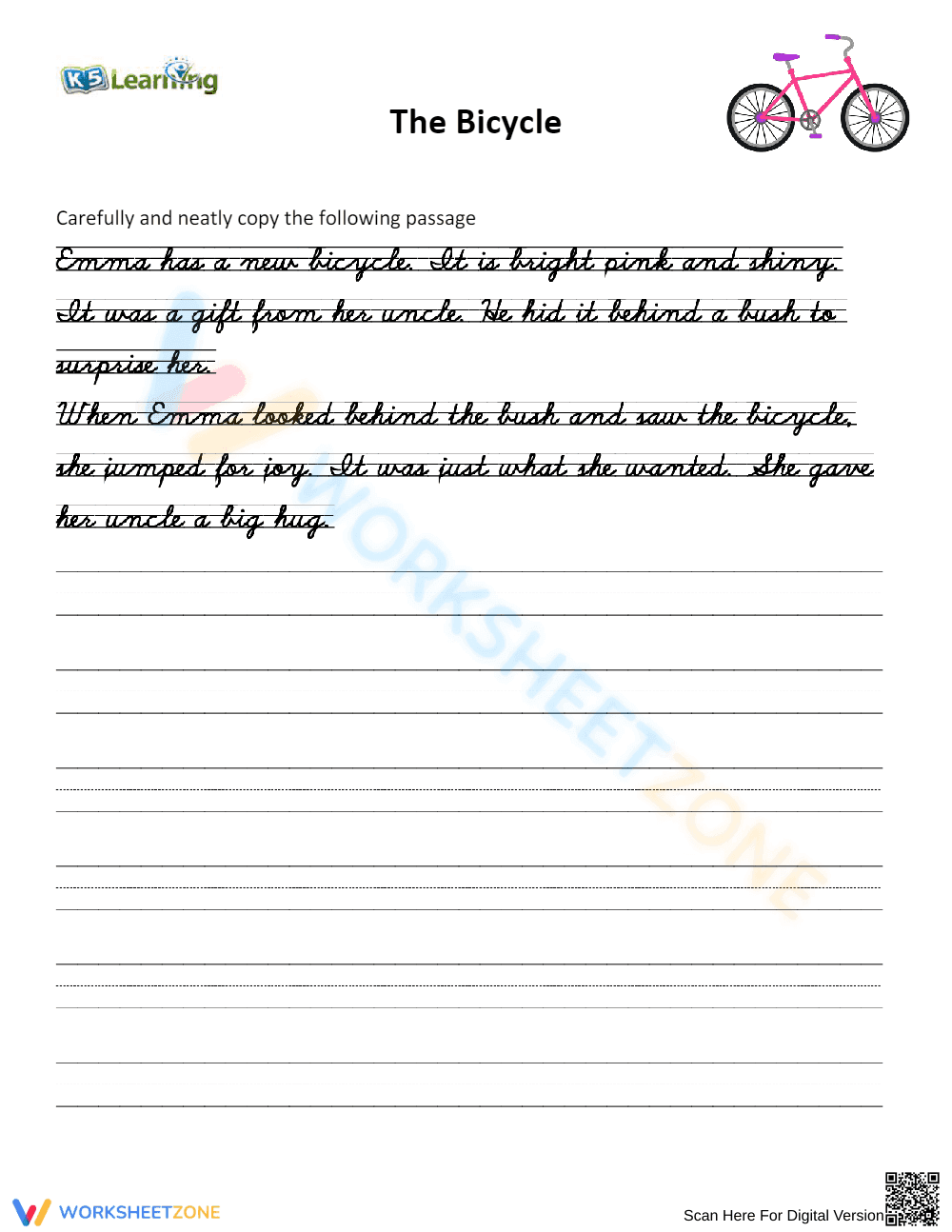

Cursive Handwriting Paragraph | Grade 4-5 Printable

Paste this activity's link or code into your existing LMS (Google Classroom, Canvas, Teams, Schoology, Moodle, etc.).
Students can open and work on the activity right away, with no student login required.
You'll still be able to track student progress and results from your teacher account.
This Grade 4 and 5 cursive handwriting worksheet provides a structured environment for students to refine their penmanship through paragraph transcription. By copying The Bicycle story, learners focus on letter connections, slant, and spacing while engaging with a narrative text. This exercise bridges the gap between isolated letter practice and fluent, legible writing.
At a Glance
- Grade: 4-5 · Subject: Handwriting
- Standard:
CCSS.ELA-LITERACY.L.4.1— Demonstrate command of the conventions of standard English when writing- Skill Focus: Cursive Paragraph Transcription
- Format: 1 page · 5 sentences · No-prep · PDF
- Best For: Morning work or handwriting centers
- Time: 10–15 minutes
Inside this resource, you will find a single-page layout featuring a short, engaging story titled "The Bicycle" written in a clear cursive font. Below the model text, ample lined space is provided for students to replicate the passage. The lines include a dashed midline to help students maintain consistent letter height and proper descender placement.
The zero-prep workflow is designed for immediate classroom implementation. First, print the single-page PDF in under 30 seconds. Second, distribute the sheets to students during a transition or designated writing block. Third, review the completed work for letter formation and spacing accuracy in less than 1 minute per student. This makes it an ideal choice for substitute folders or bell-ringer activities.
This worksheet aligns with `CCSS.ELA-LITERACY.L.4.1`, which requires students to demonstrate command of the conventions of standard English when writing. While cursive is often a state-specific requirement, this task supports general writing fluency and fine motor control. Both standard codes can be copied directly into lesson plans, IEP goals, or district curriculum mapping tools.
Use this worksheet as a formative assessment tool following a unit on cursive letter formation. Observe students as they write to identify common errors in specific connections or inconsistent slanting. It also serves as an excellent quiet-time activity for students who finish primary assignments early, requiring approximately 12 minutes for careful completion.
This resource is tailored for upper elementary students in grades 4 and 5 who have mastered individual cursive letters and are ready for connected text. It is particularly beneficial for students needing additional fine motor practice. Pair this with a cursive anchor chart or a short reading comprehension lesson about transportation history.
Research from Fisher & Frey (2014) emphasizes that the gradual release of responsibility in writing requires consistent, low-stakes practice to move from guided to independent fluency. This cursive worksheet facilitates that transition by providing a clear model for transcription. According to the RAND AIRS 2024 report, handwriting remains a critical component of literacy development, as the physical act of writing by hand stimulates brain regions associated with memory and language acquisition. By focusing on `CCSS.ELA-LITERACY.L.4.1`, this resource ensures that students are not just learning a decorative skill but are reinforcing the conventions of standard English. The 5-sentence paragraph structure is specifically designed to build stamina without overwhelming the learner, making it a scientifically sound choice for daily penmanship maintenance in the modern classroom.


