


























Views
Plays
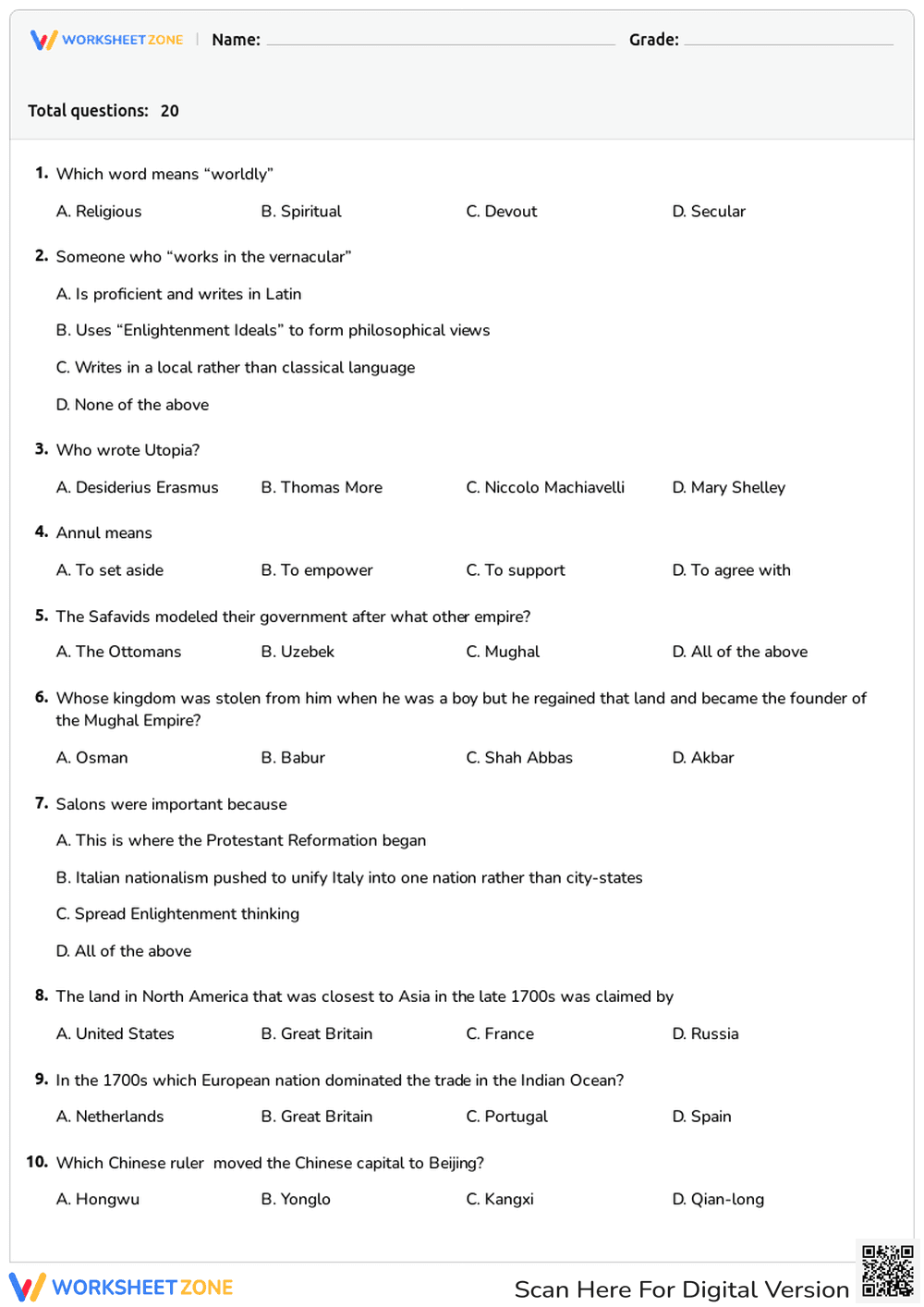
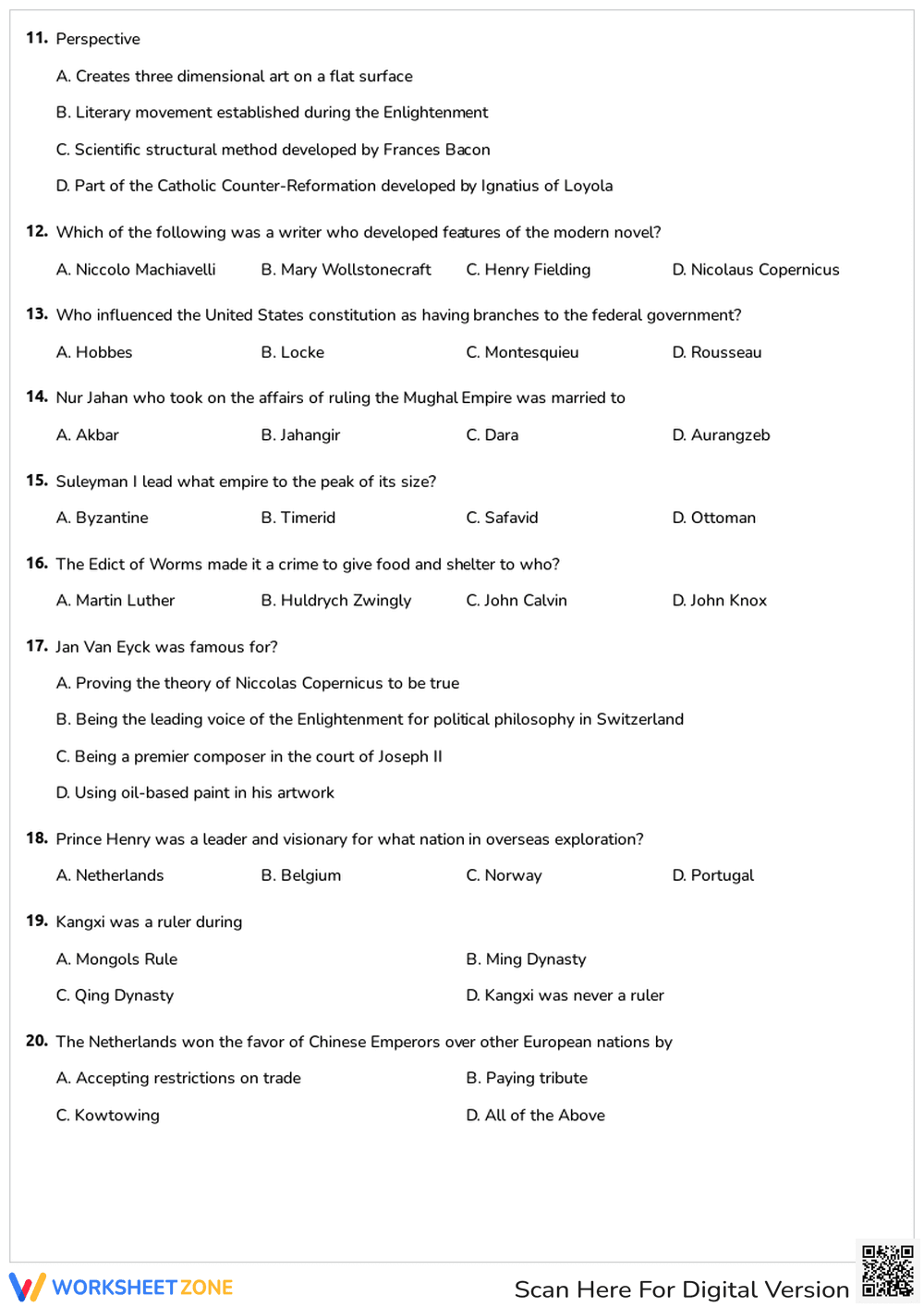

Grade 9 World History Quiz — Printable No-Prep Worksheet
Paste this activity's link or code into your existing LMS (Google Classroom, Canvas, Teams, Schoology, Moodle, etc.).
Students can open and work on the activity right away, with no student login required.
You'll still be able to track student progress and results from your teacher account.
This ready-to-use World History quiz helps students demonstrate their understanding of major historical eras, including the Renaissance, Reformation, and Enlightenment. By answering targeted multiple-choice questions, learners will recall key figures, define essential historical vocabulary, and identify the global impacts of major empires and trade networks.
At a Glance
- Grade: 9 · Subject: Social Studies
- Standard:
CCSS.ELA-LITERACY.RH.9-10.4— Determine the meaning of historical words and phrases- Skill Focus: Historical Knowledge & Vocabulary
- Format: 2 pages · 20 problems · PDF
- Best For: End-of-unit assessment or review
- Time: 20–30 minutes
Inside this comprehensive assessment, educators will find a two-page multiple-choice quiz featuring 20 distinct questions. The task types range from defining critical historical terms like "secular" and "vernacular" to identifying the achievements of significant historical figures such as Thomas More, Babur, and Suleyman. The straightforward layout ensures students can navigate the assessment independently without confusion.
Zero-Prep Workflow
- Print (1 minute): Simply download the PDF and print copies for your roster. The black-and-white design is highly printer-friendly.
- Distribute (1 minute): Hand out the two-page assessment at the start of class or leave it in a visible spot for a substitute teacher.
- Review (5 minutes): Collect the quizzes and grade them rapidly using the multiple-choice format, allowing for immediate feedback.
Total teacher prep time is under two minutes, making this an ideal resource for emergency sub plans or quick formative checks.
Standards Alignment
This resource is aligned to CCSS.ELA-LITERACY.RH.9-10.4: Determine the meaning of words and phrases as they are used in a text, including vocabulary describing political, social, or economic aspects of history/social science. The questions require students to contextualize terms and historical concepts accurately. Both standard codes can be copied directly into lesson plans, IEP goals, or district curriculum mapping tools.
How to Use It
Deploy this quiz after direct instruction on the Renaissance and early global empires as a summative unit test. Alternatively, use it as a pre-assessment before beginning a comprehensive review of the 15th to 18th centuries to gauge baseline knowledge. Expected completion time is 20 to 30 minutes. As a formative assessment observation tip, note which specific eras (e.g., the Reformation vs. the Mughal Empire) students struggle with most to guide your subsequent reteaching sessions.
Who It's For
This worksheet is designed primarily for 8th and 9th-grade general education history students. For learners needing differentiation, educators can cross out one or two incorrect multiple-choice options to reduce the cognitive load. It pairs perfectly with a direct instruction lesson on the Enlightenment or a gallery walk covering early modern global trade networks.
Assessing historical comprehension through structured questioning is a fundamental component of effective social studies instruction. This resource aligns with CCSS.ELA-LITERACY.RH.9-10.4, requiring students to determine the meaning of historical words and phrases within their proper context. According to a recent EdReports 2024 analysis, high-quality instructional materials in history must provide frequent, low-stakes opportunities for students to retrieve and apply content knowledge. By engaging with these 20 targeted questions, learners reinforce their understanding of complex global interactions, from the spread of Enlightenment ideals to the economic strategies of the Ming Dynasty. Regular retrieval practice not only solidifies foundational vocabulary but also builds the necessary background knowledge for advanced historical analysis and document-based writing in later grades.


