




























Views
Downloads


Printable Writing Ideas Bank Worksheet | Grade 4-5 Aligned

Paste this activity's link or code into your existing LMS (Google Classroom, Canvas, Teams, Schoology, Moodle, etc.).
Students can open and work on the activity right away, with no student login required.
You'll still be able to track student progress and results from your teacher account.
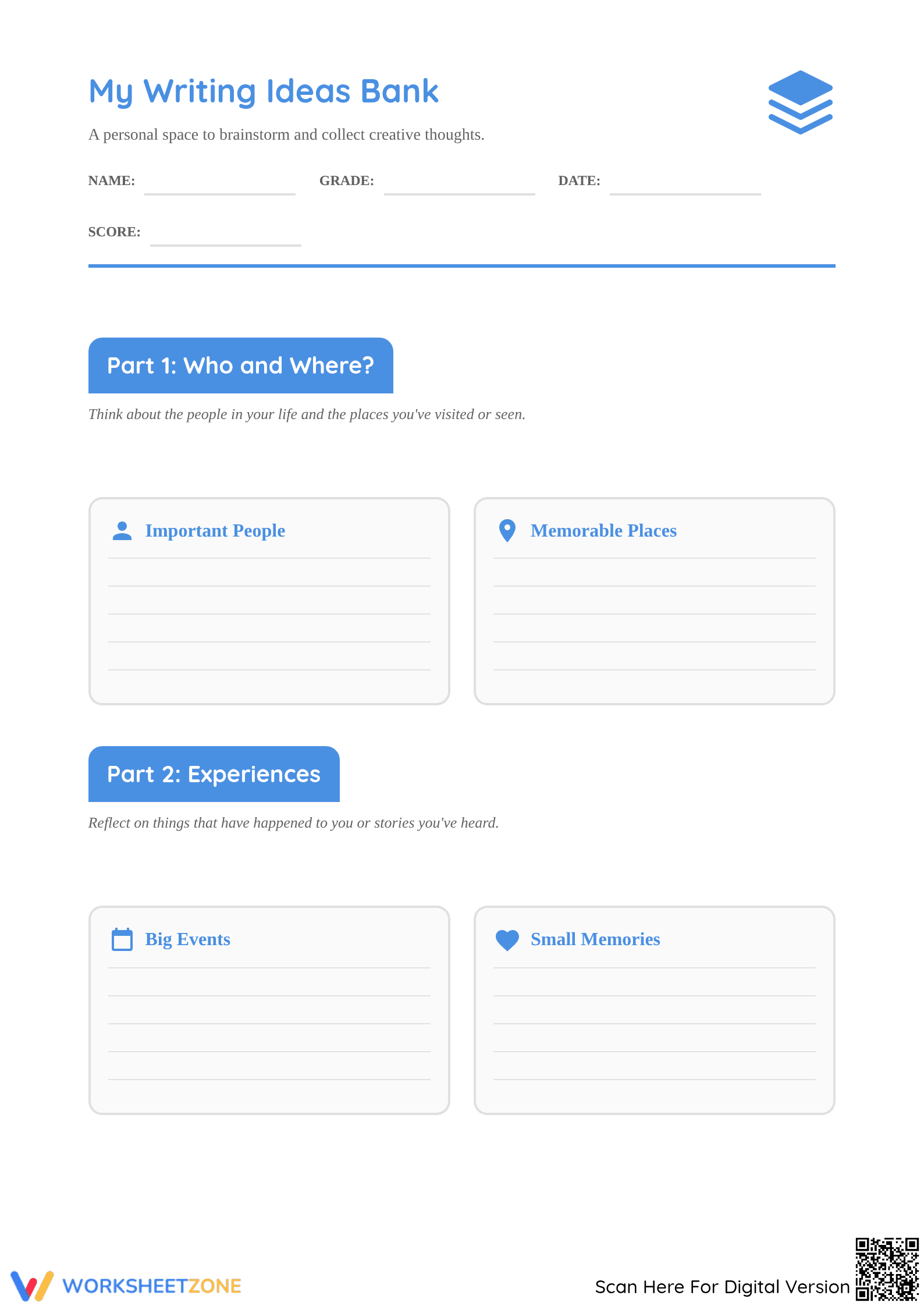
This essential creative writing brainstorming tool helps upper elementary students generate a robust list of story prompts and personal narratives. By providing structured categories for people, places, and experiences, the worksheet empowers young writers to overcome blank-page anxiety and develop a personal library of inspiration they can access for any narrative assignment.
At a Glance
- Grade: 4–5 · Subject: English Language Arts
- Standard:
CCSS.ELA-LITERACY.W.4.5— Plan and develop writing by brainstorming narrative elements and story ideas- Skill Focus: Narrative Brainstorming & Planning
- Format: 2 pages · 7 tasks · Answer key not applicable · PDF
- Best For: Writing workshop kick-off and narrative planning
- Time: 20–30 minutes
What's Inside
This two-page PDF features seven distinct brainstorming zones. The first page captures concrete reality through "Important People," "Memorable Places," "Big Events," and "Small Memories." The second page explores imagination with "Things I Love" and speculative "What If..." scenarios. The document concludes with a "Top Pick" task where students commit to one primary idea by crafting a catchy story title.
Zero-Prep Workflow
Teachers can implement this resource in under two minutes. First, print the double-sided document for each student. Next, distribute the sheets during a writing workshop and explain that brainstorming has no "wrong" answers. Finally, review the "Top Pick" titles to gauge student interest for the drafting phase. This workflow is perfectly suited for substitute plans or emergency writing prompts.
Standards Alignment
The primary alignment is `CCSS.ELA-LITERACY.W.4.5`, focusing on developing writing by planning narrative seeds. It also supports `CCSS.ELA-LITERACY.W.5.3` by providing the foundational characters, settings, and events necessary for complex narratives. Both standard codes can be copied directly into lesson plans, IEP goals, or district curriculum mapping tools.
How to Use It
Use this worksheet as an anchor during the first week of a narrative unit. Allow students thirty minutes to fill their bank; this ensures a reservoir of ideas for later drafting. Alternatively, use it for formative assessment by observing which students struggle with "Small Memories" versus imaginative prompts, helping you identify those needing more personal-narrative support.
Who It's For
This resource is designed for Grade 4 and 5 students transitioning into complex narrative writing, particularly reluctant writers who struggle to find a starting point. The structured categories provide scaffolded prompts without being restrictive. It pairs naturally with a mentor text read-aloud or a "Story Arc" anchor chart.
Research from the NAEP 2024 writing frameworks emphasizes that successful student writers engage in deliberate pre-writing strategies to establish a clear purpose. According to Fisher & Frey (2014), the use of structured brainstorming tools like this CCSS.ELA-LITERACY.W.4.5 aligned ideas bank provides a crucial scaffold that moves students from passive prompt-followers to active story-architects. By categorizing personal experiences and imaginative "What If" scenarios, students develop the metacognitive skills required to identify high-interest topics before committing to drafting. This systematic approach to idea generation is a proven method for reducing the cognitive load associated with early-stage writing tasks. Educators who implement these structured planning tools often observe an increase in the complexity of student narratives, as the foundational elements of setting and character are established during the initial brainstorming phase.


