


























Views
Downloads

Printable Creating Compound Words Worksheet | Grade 1 ELA
Paste this activity's link or code into your existing LMS (Google Classroom, Canvas, Teams, Schoology, Moodle, etc.).
Students can open and work on the activity right away, with no student login required.
You'll still be able to track student progress and results from your teacher account.
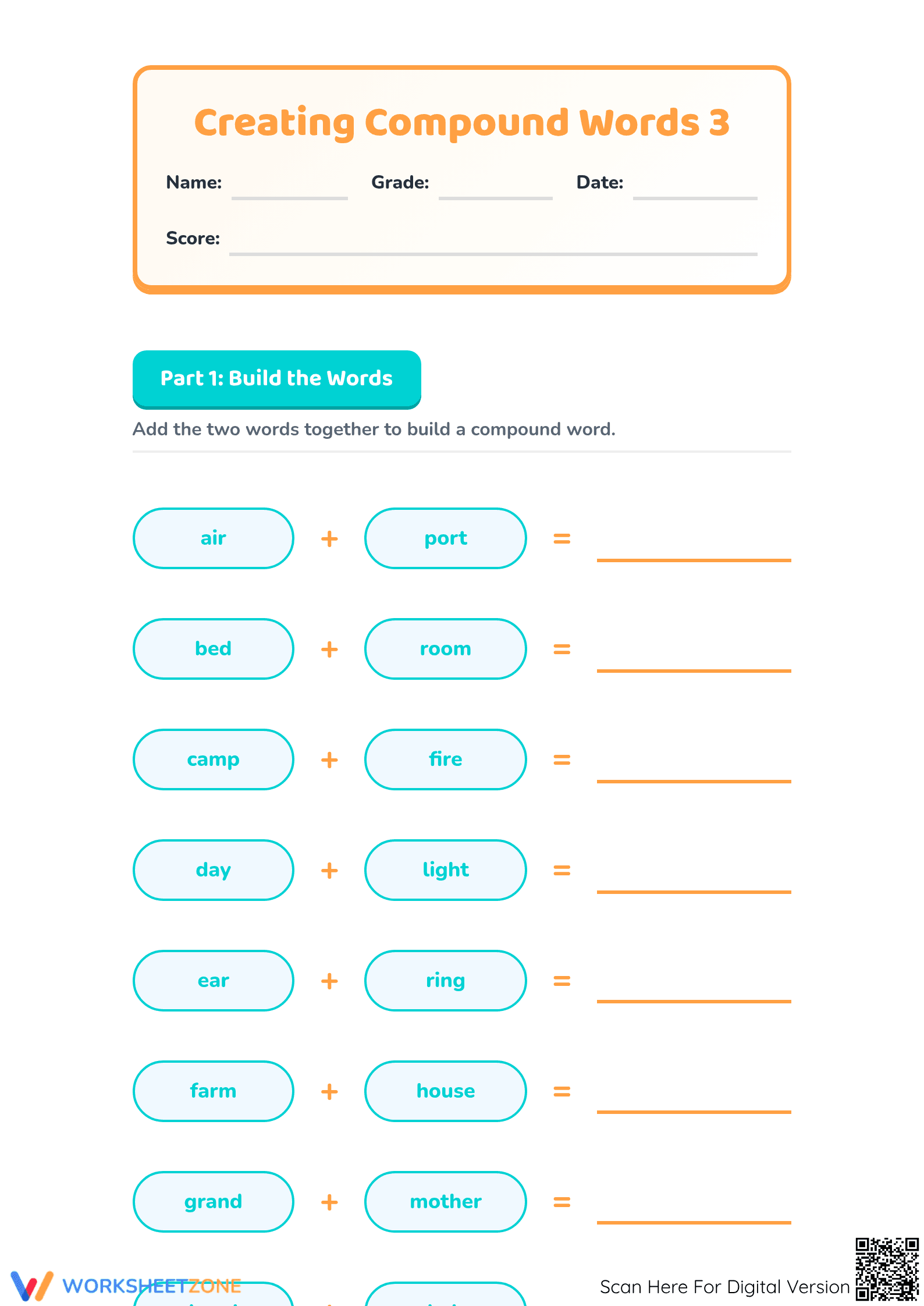
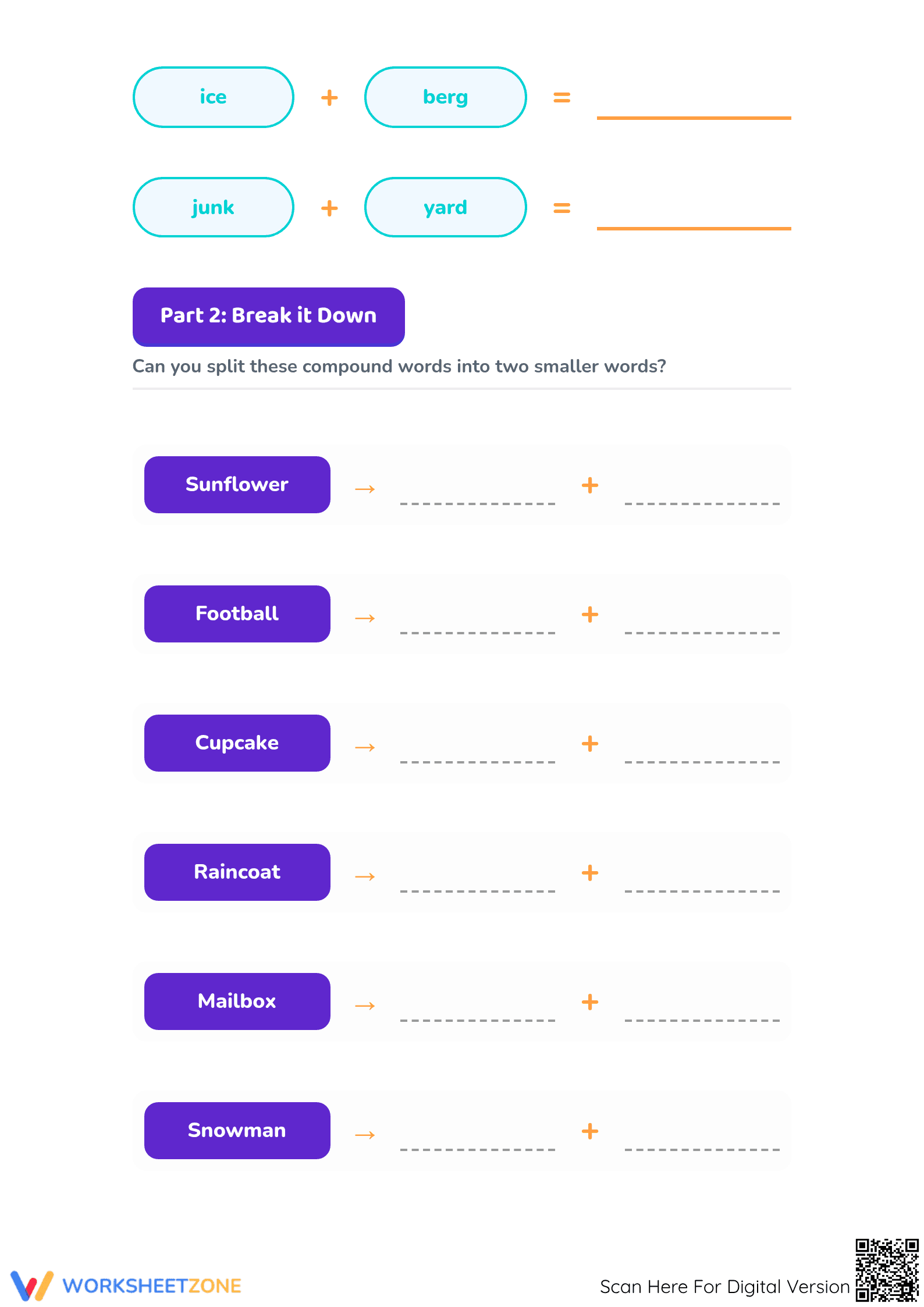
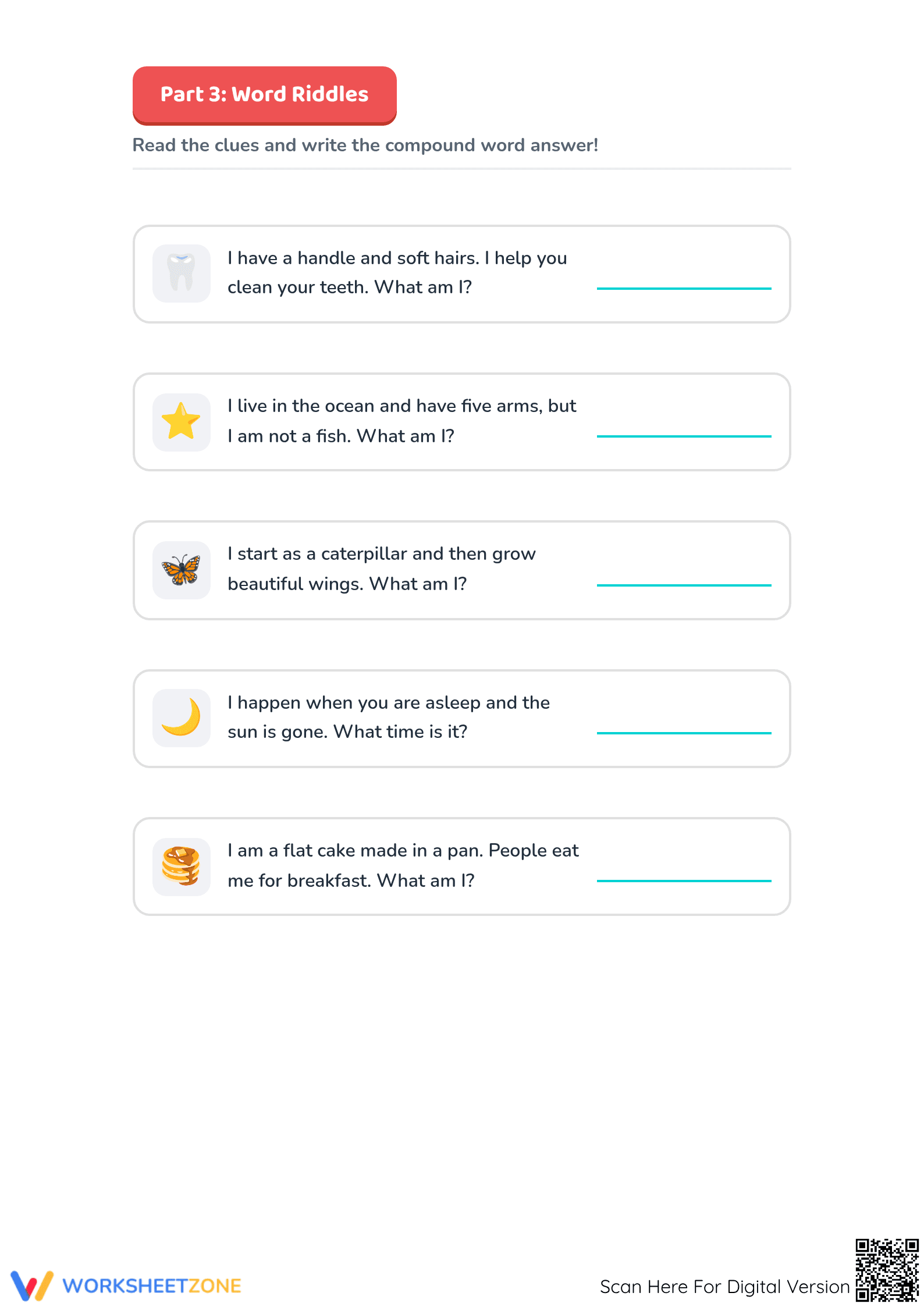
Strengthen your students' morphological awareness with this comprehensive three-page compound word collection. This worksheet helps Grade 1 learners master the concept of combining two distinct words to create a new meaning. By engaging in building, breaking, and solving riddles, students develop the foundational vocabulary skills necessary for fluent reading and clear communication.
At a Glance
- Grade: 1 · Subject: English Language Arts (ELA)
- Standard:
CCSS.ELA-LITERACY.L.1.6— Use words and phrases acquired through reading and responding to texts- Skill Focus: Compounding and Decomposing Words
- Format: 3 pages · 20 problems · Answer key included · PDF
- Best For: Early literacy centers and vocabulary building
- Time: 25–35 minutes
What's Inside
This resource features three distinct parts designed to provide a well-rounded understanding of compound words. The packet includes 9 "Build the Words" addition problems, 6 "Break it Down" decomposition tasks, and 5 engaging "Word Riddles" that require students to infer compound words from clues. The clear layout and visual icons make this three-page PDF easy for young learners to follow independently.
Zero-Prep Workflow
The workflow for this resource is designed for maximum efficiency in busy classrooms. Step 1: Print the three-page PDF (30 seconds). Step 2: Distribute the packets to students for independent or small-group work (1 minute). Step 3: Review the answers using the provided key for immediate formative assessment (30 seconds). With a total teacher prep time of under 2 minutes, this resource is perfect for substitute plans or emergency sub folders.
Standards Alignment
This worksheet is aligned to CCSS.ELA-LITERACY.L.1.6: "Use words and phrases acquired through conversations, reading and being read to, and responding to texts." By focusing on how individual words merge to form new meanings, it also supports the conceptual groundwork for Grade 2 standards regarding word prediction. The standard code can be copied directly into lesson plans, IEP goals, or district curriculum mapping tools.
How to Use It
This resource is ideal for literacy centers or as a formative assessment after initial vocabulary instruction. Teachers can observe how students handle the "Break it Down" section to gauge their understanding of word parts. Use the riddles as a whole-group closing activity to promote collaborative problem-solving. The expected completion time for the entire packet is approximately 30 minutes.
Who It's For
Designed for Grade 1 learners, this worksheet also supports English Language Learners (ELLs) in expanding their Tier 2 vocabulary through clear examples. It pairs perfectly with anchor charts that illustrate common compound word combinations during whole-group instruction. Students struggling with phonics will find the visual segmentation of words helpful for improving their blending skills.
According to the Fisher & Frey (2014) framework for vocabulary development, morphological awareness—specifically the ability to manipulate compound words—serves as a critical bridge between decoding and semantic comprehension in early literacy. This Grade 1 ELA resource facilitates this transition by requiring students to synthesize meanings from individual word parts to form complex lexical units. Aligned to CCSS.ELA-LITERACY.L.1.6, the worksheet utilizes three distinct cognitive tasks: additive synthesis in Part 1, analytical decomposition in Part 2, and context-driven inference in Part 3. Research indicates that students who explicitly practice these compound word structures show significant gains in word recognition speed and reading fluency. The inclusion of an answer key ensures immediate feedback, a vital component of the gradual release of responsibility. This structured approach provides the necessary scaffold for Grade 1 learners to master lexical compounding, ultimately strengthening their foundational reading skills for more complex informational texts.


