


























Views
Downloads



Essential Create Proportions Worksheet | Grade 6-8 Math
Paste this activity's link or code into your existing LMS (Google Classroom, Canvas, Teams, Schoology, Moodle, etc.).
Students can open and work on the activity right away, with no student login required.
You'll still be able to track student progress and results from your teacher account.
Proportional reasoning is the foundation of algebraic thinking. This worksheet helps students master the relationship between ratios through a multi-step progression. Students move from identifying valid number sets to solving complex real-world word problems, ensuring a complete grasp of proportional relationships in various mathematical and practical formats.
At a Glance
- Grade: 6–9 · Subject: Math
- Standard:
CCSS.MATH.CONTENT.7.RP.A.2— Recognize and represent proportional relationships between quantities in mathematical and real-world contexts- Skill Focus: Creating and Solving Proportions
- Format: 4 pages · 41 problems · Answer key included · PDF
- Best For: Independent practice and homework assignments
- Time: 45–60 minutes
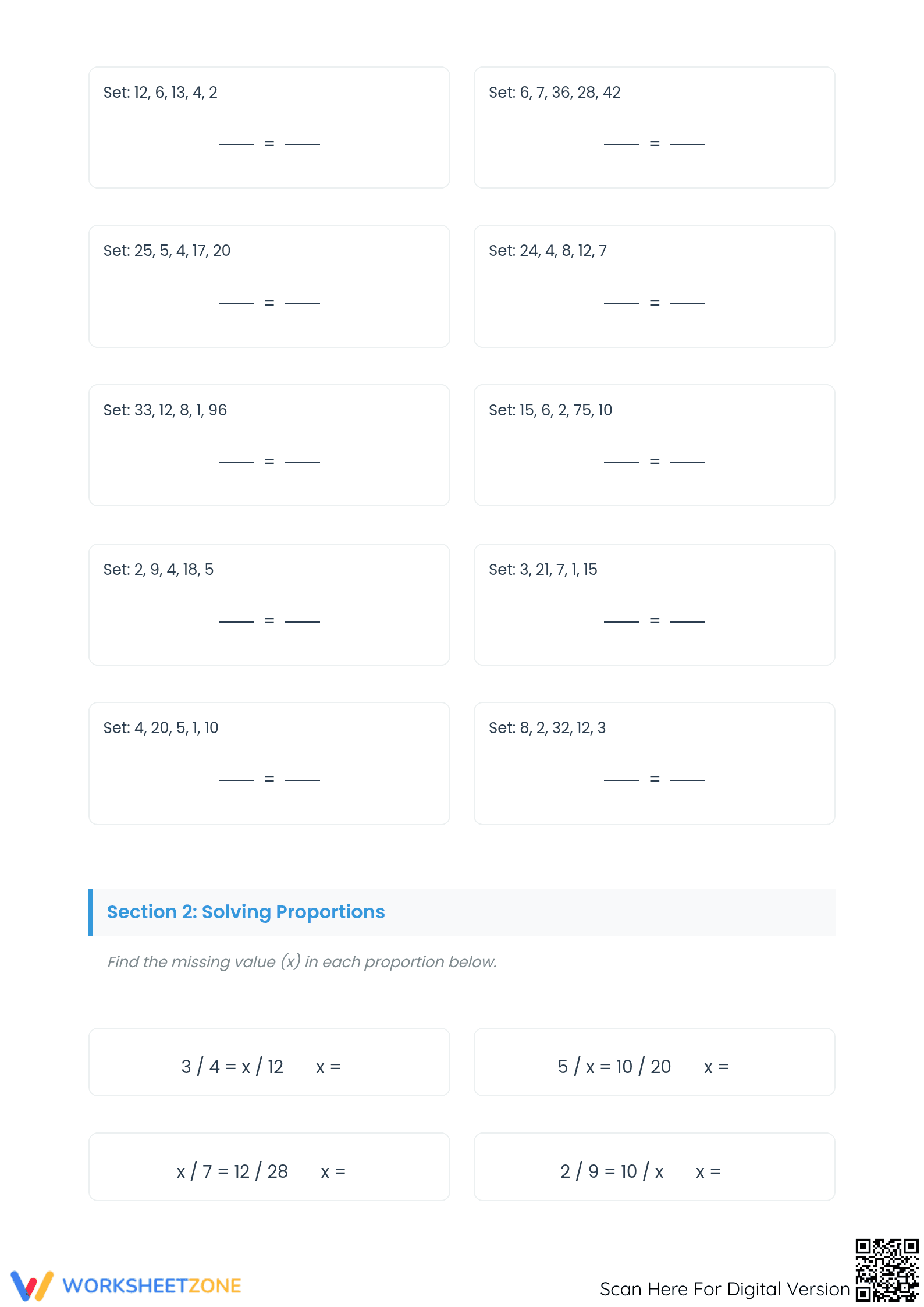
This 4-page PDF contains 41 distinct tasks organized into four focused sections. It includes 20 proportion-building exercises, 8 algebraic solving tasks, 8 verification problems, and 5 real-world applications. A full answer key is provided for immediate feedback, making it suitable for both classroom instruction and independent study at home.
Skill Progression
- Guided practice: Section 1 provides students with sets of five numbers, requiring them to analyze numerical relationships and construct 20 valid proportions using exactly four numbers.
- Supported practice: Sections 2 and 3 transition into computational fluency, solving for unknown variables and verifying ratio equivalence across 16 targeted mathematical problems.
- Independent practice: The final section presents 5 word problems that require students to translate textual scenarios into mathematical proportions without any provided scaffolds or visual cues.
The gradual-release model ensures students build confidence through numerical manipulation before tackling complex word problems.
Standards Alignment
The primary standard CCSS.MATH.CONTENT.7.RP.A.2 requires students to "Recognize and represent proportional relationships between quantities." This resource also supports CCSS.MATH.CONTENT.6.RP.A.3 by applying ratio reasoning to solve real-world problems. Both standard codes can be copied directly into lesson plans, IEP goals, or district curriculum mapping tools.
How to Use It
Use this during the independent practice phase of a lesson on proportions to provide comprehensive reinforcement. Alternatively, assign it as a formative assessment after teaching cross-multiplication. Observe how students select numbers in Section 1 to gauge their mental math and ratio fluency. Expected completion time for the full set is 50 minutes.
Who It's For
Ideal for middle school students in Grades 6 through 9 who are building core algebraic skills. It provides necessary scaffolding for students new to the concept while offering rigorous word problems for advanced learners. Pair this with a ratio anchor chart or a direct instruction lesson for maximum instructional impact.
According to the RAND AIRS 2024 report, mathematical fluency requires a careful balance between procedural calculation and contextual application. This worksheet fulfills that requirement by presenting 41 targeted tasks that move students from numerical manipulation to real-world problem solving. By focusing on the standard CCSS.MATH.CONTENT.7.RP.A.2, students learn to identify proportional relationships in abstract and concrete scenarios. Research from Fisher & Frey (2014) suggests that a gradual-release model, as seen in the progression from creating to solving proportions here, significantly improves student outcomes in middle school mathematics. The inclusion of a comprehensive answer key further supports self-directed learning and immediate feedback loops. This resource provides a robust framework for mastering ratios, a critical precursor to success in high school algebra. Educators can rely on this aligned material to meet district curriculum goals and prepare students for high-stakes assessments as highlighted in EdReports 2024.


