


























Views
Downloads

Essential Proportions Worksheet | Grade 7 Math Practice
Paste this activity's link or code into your existing LMS (Google Classroom, Canvas, Teams, Schoology, Moodle, etc.).
Students can open and work on the activity right away, with no student login required.
You'll still be able to track student progress and results from your teacher account.
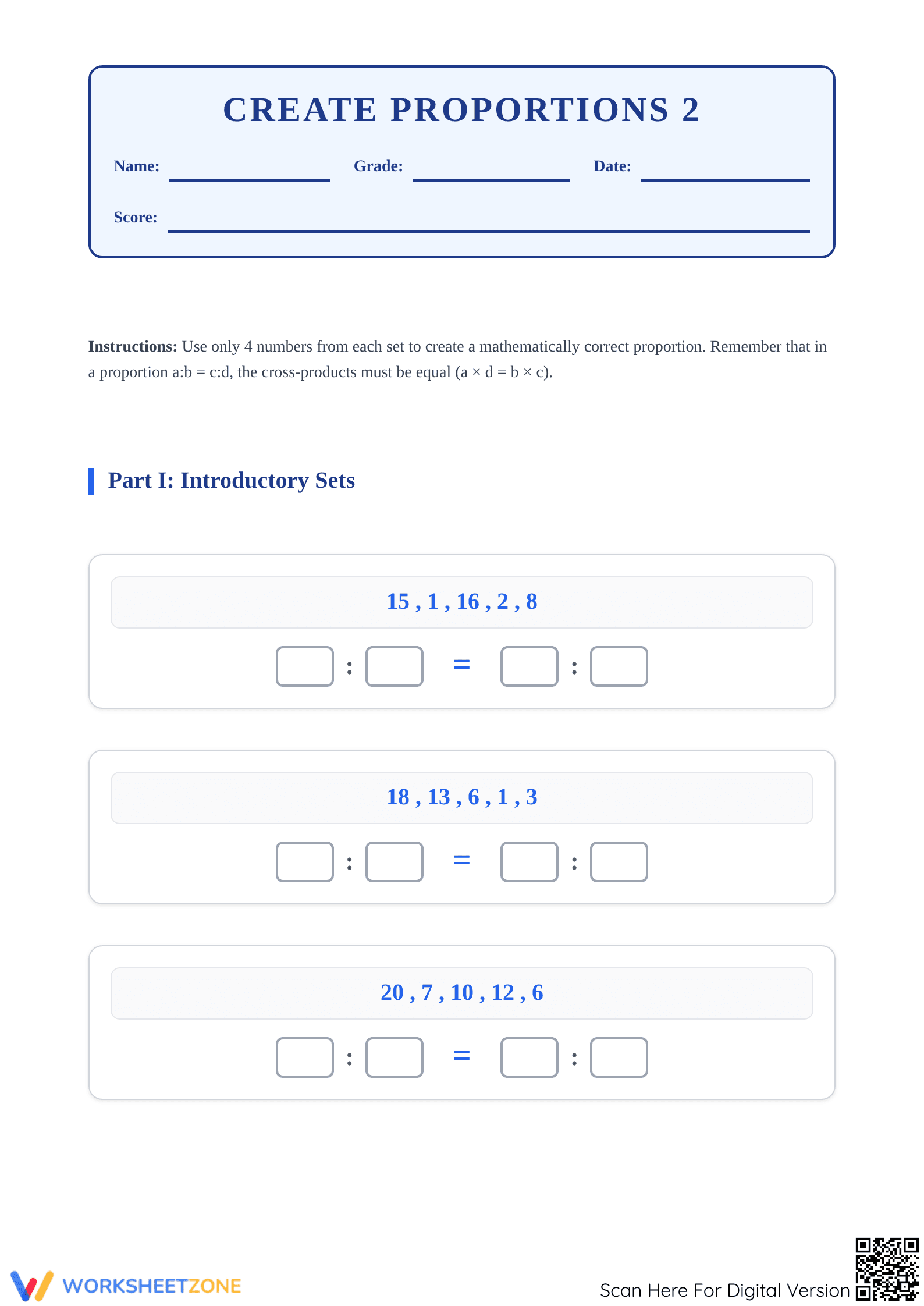
Mastering the concept of proportional relationships is a fundamental milestone in middle school mathematics. This worksheet provides a rigorous path for students to practice constructing valid proportions from given sets of integers. By applying the cross-product property, learners transition from basic recognition to active creation of mathematical equivalencies.
At a Glance
- Grade: 7 · Subject: Math
- Standard:
7.RP.A.2— Identify and represent proportional relationships between various quantities- Skill Focus: Cross-product property and proportion construction
- Format: 5 pages · 23 problems · Answer key included · PDF
- Best For: Independent practice and formative assessment
- Time: 35–45 minutes
What's Inside
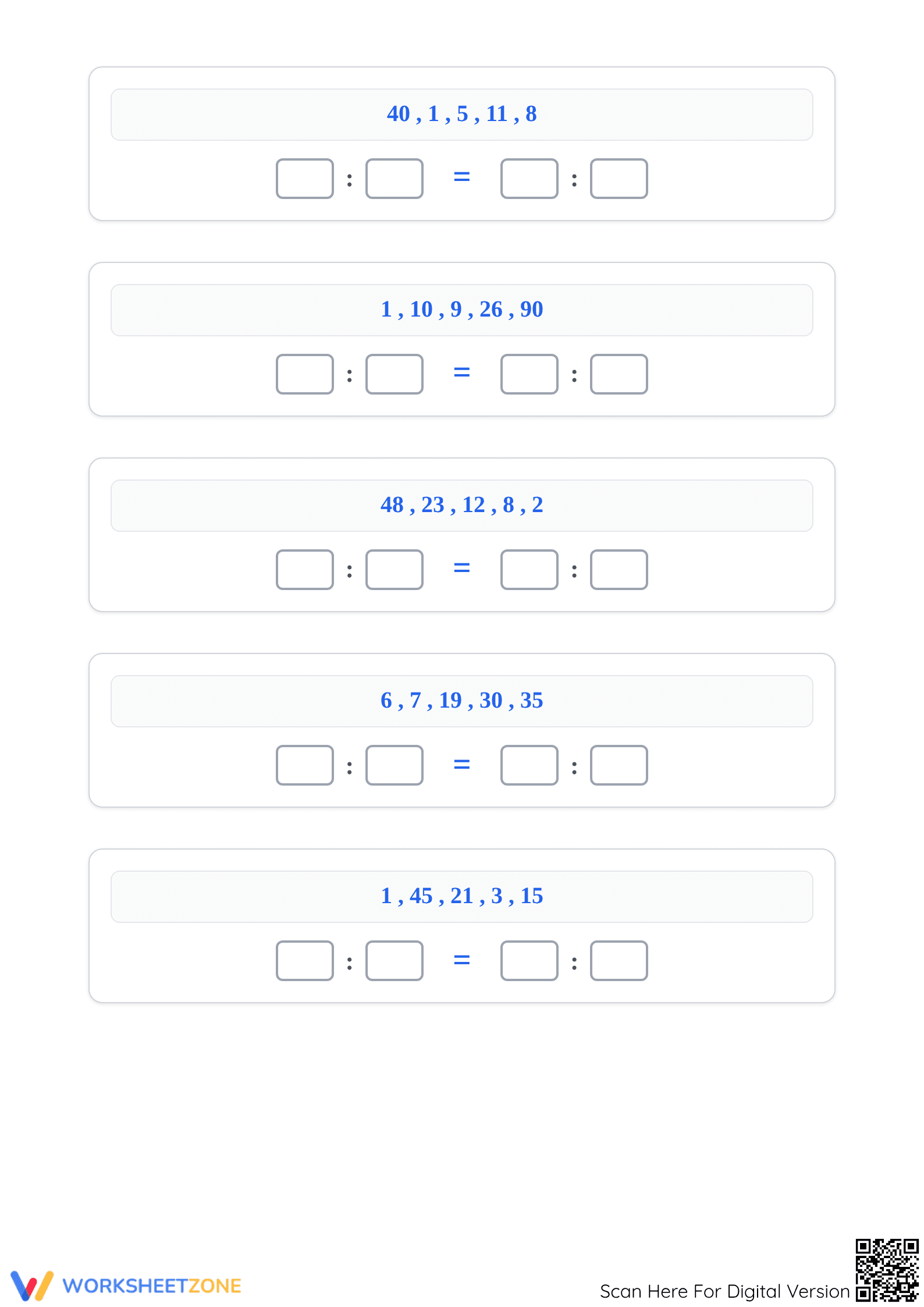
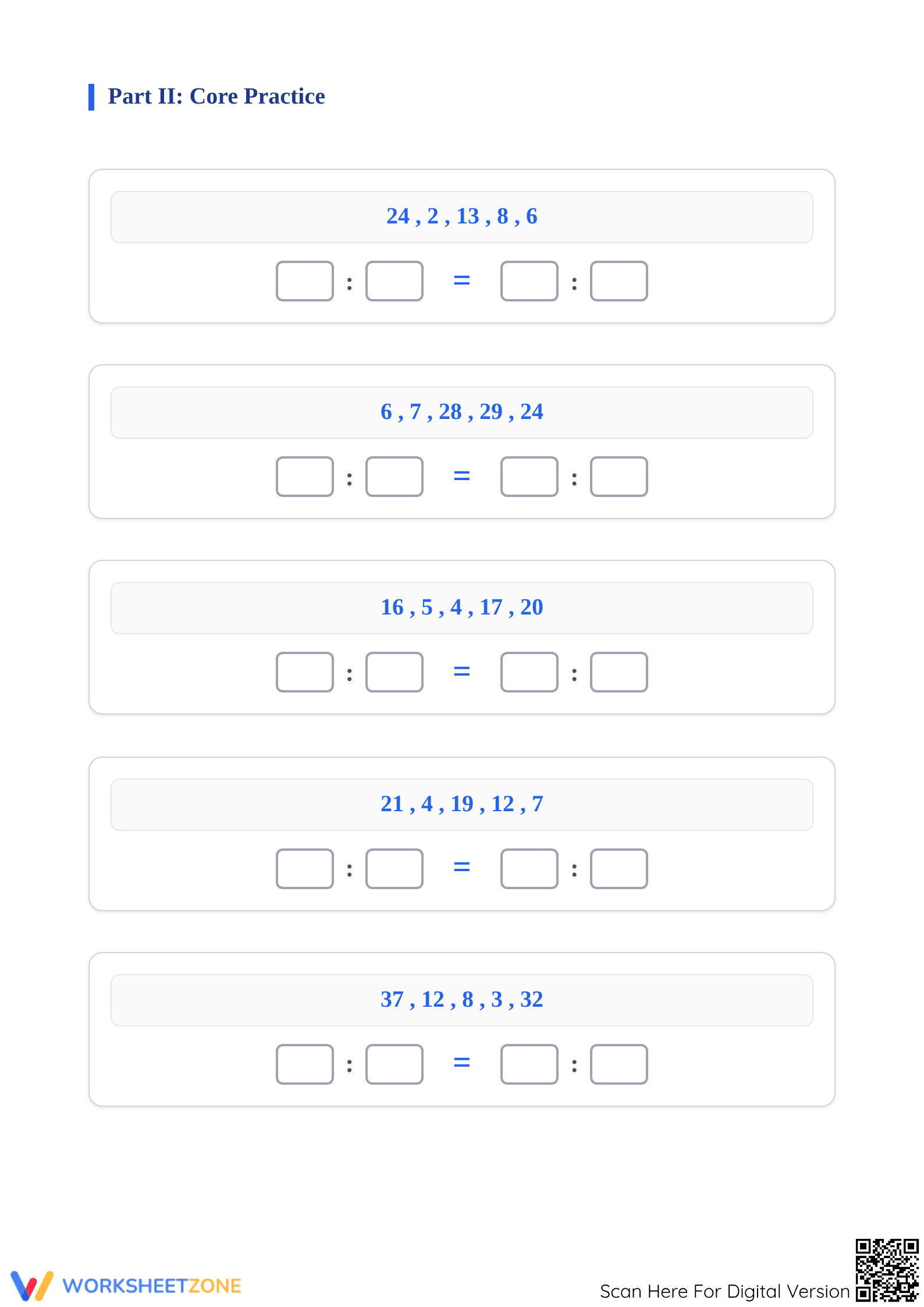
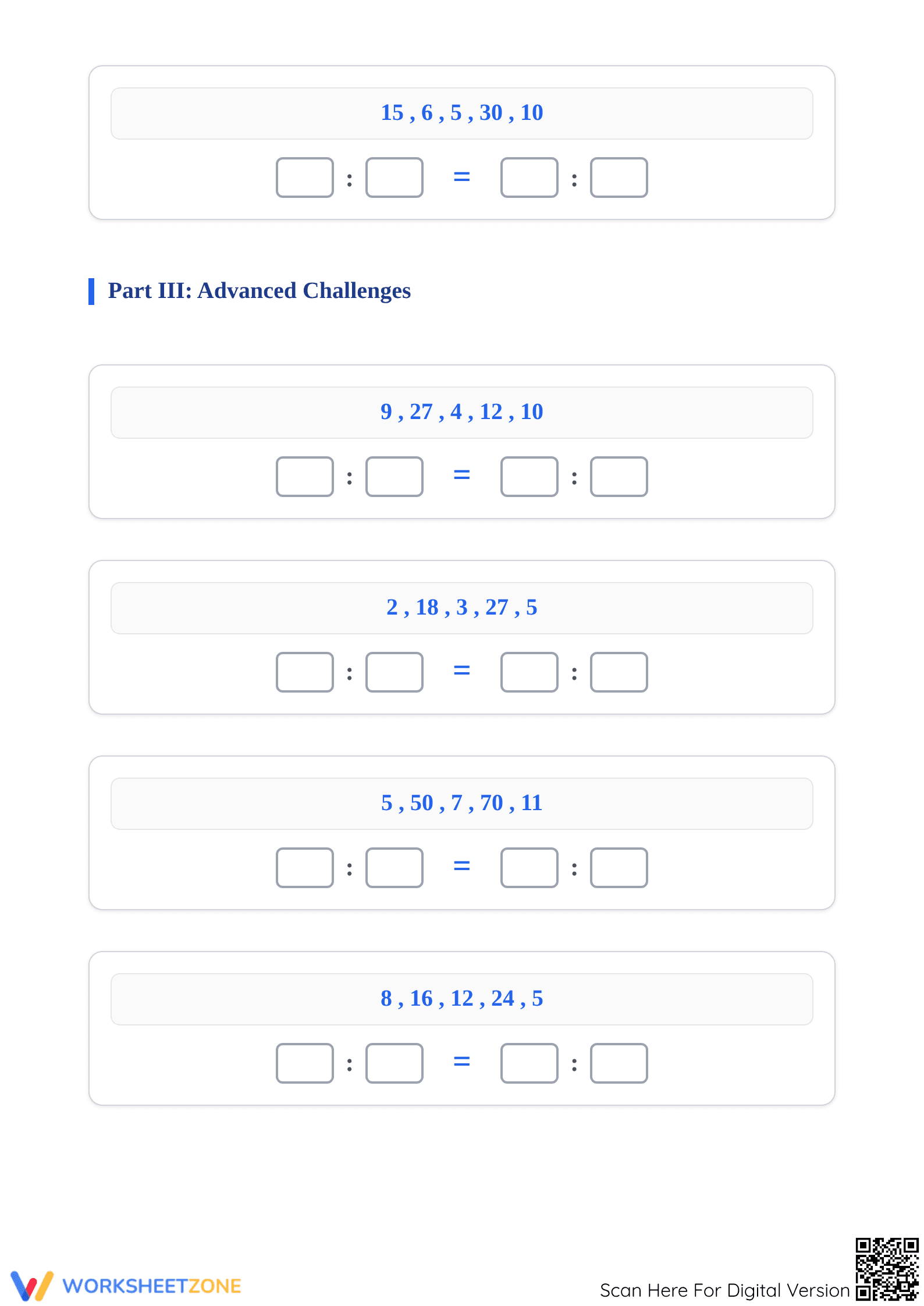
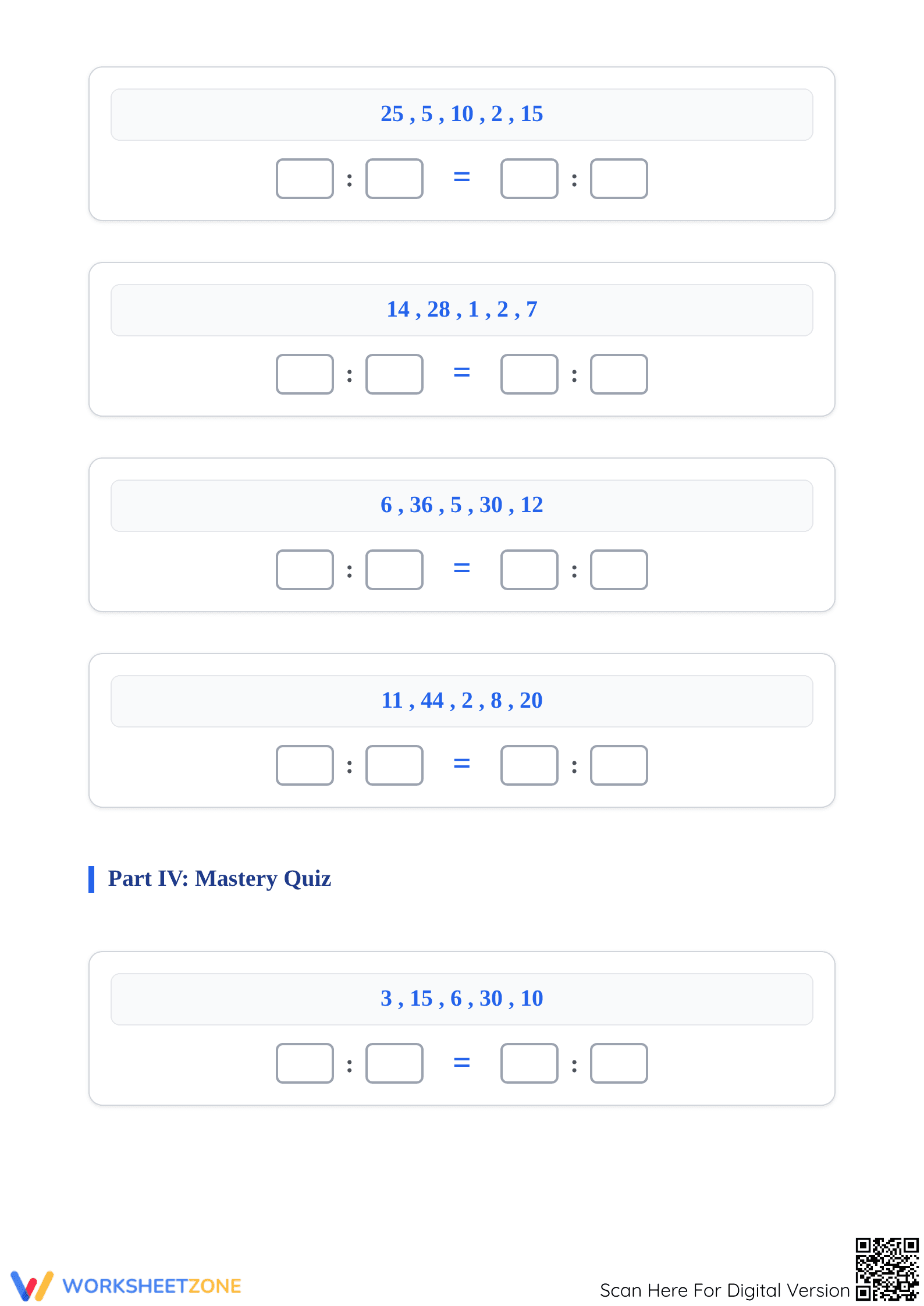
This five-page resource is organized into four sections guiding students through a logical learning arc. It contains 23 unique sets where students must select four numbers to form a valid ratio equation. The layout includes spacious boxes, score tracking on page one, and a complete answer key for rapid verification by teachers, parents, or students.
Skill Progression
The worksheet utilizes a scaffolded approach to ensure student success and confidence throughout the activity.
- Guided practice: Introductory sets use smaller integers for mental verification of cross-products and basic ratio understanding.
- Supported practice: Core and advanced challenges introduce larger factors, requiring consistent application of the cross-multiplication rule.
- Independent practice: The mastery quiz serves as a final check to ensure students can identify relationships without section-level prompts.
This follows the gradual-release model, moving from basic introductory sets to a final mastery check.
Standards Alignment
The primary focus is standard `CCSS.MATH.CONTENT.7.RP.A.2`, requiring students to represent proportional relationships by equations. Learners analyze numerical data to determine if a constant of proportionality exists and represent it correctly. This standard code can be copied directly into lesson plans, IEP goals, or district curriculum mapping tools to track student progress.
How to Use It
Deploy this worksheet during the independent practice phase of a lesson on ratios. It works exceptionally well as a post-instruction verification tool for the cross-product property. Teachers can use the introductory sets as a quick exit ticket check, observing if students correctly pair terms before assigning the full 5-page packet for homework or in-class reinforcement.
Who It's For
This resource is designed for Grade 7 students but is effective for Grade 6 enrichment or Grade 8 intervention. It provides the structure for students who struggle with abstract algebraic concepts by grounding proportions in concrete manipulation. It pairs perfectly with an anchor chart detailing ratio relationships or a direct instruction lesson on mathematical equivalency.
Effective mathematics instruction requires a balance of conceptual understanding and procedural fluency, as highlighted in the EdReports 2024 analysis of middle school curriculum. This worksheet addresses the procedural aspect of standard 7.RP.A.2 by requiring students to apply the cross-product property to verify relationships. Research by Fisher & Frey (2014) emphasizes that deliberate practice with immediate feedback—provided here by the answer key—is essential for moving mathematical skills into long-term memory. By presenting students with sets of five numbers rather than four, this resource adds a layer of error analysis that standard problems lack. The structured progression through 23 tasks ensures that students develop a deep understanding of how ratios behave. This resource serves as a reliable tool for data-driven instruction, allowing educators to identify exactly where students may struggle with calculation versus the underlying logic of proportional equality.


