


























Views
Downloads


Printable Crack the Code & Sudoku Logic Puzzles | Grade 4
Paste this activity's link or code into your existing LMS (Google Classroom, Canvas, Teams, Schoology, Moodle, etc.).
Students can open and work on the activity right away, with no student login required.
You'll still be able to track student progress and results from your teacher account.
This multi-page logic packet challenges students to apply critical thinking and deductive reasoning through a variety of engaging abstract puzzles. By deciphering codes, solving complex grids, and correcting mathematical equations, learners strengthen their mental agility and perseverance. It is an ideal resource for reinforcing mathematical practices in a non-traditional, highly motivating format.
At a Glance
- Grade: 4 · Subject: Math & Logic
- Standard:
CCSS.MATH.PRACTICE.MP1— Make sense of problems and persevere in solving them- Skill Focus: Pattern recognition, deductive logic, and Roman numerals
- Format: 3 pages · 8 tasks · Answer key included · PDF
- Best For: Early finishers, sub plans, and morning work
- Time: 25–40 minutes
What's Inside
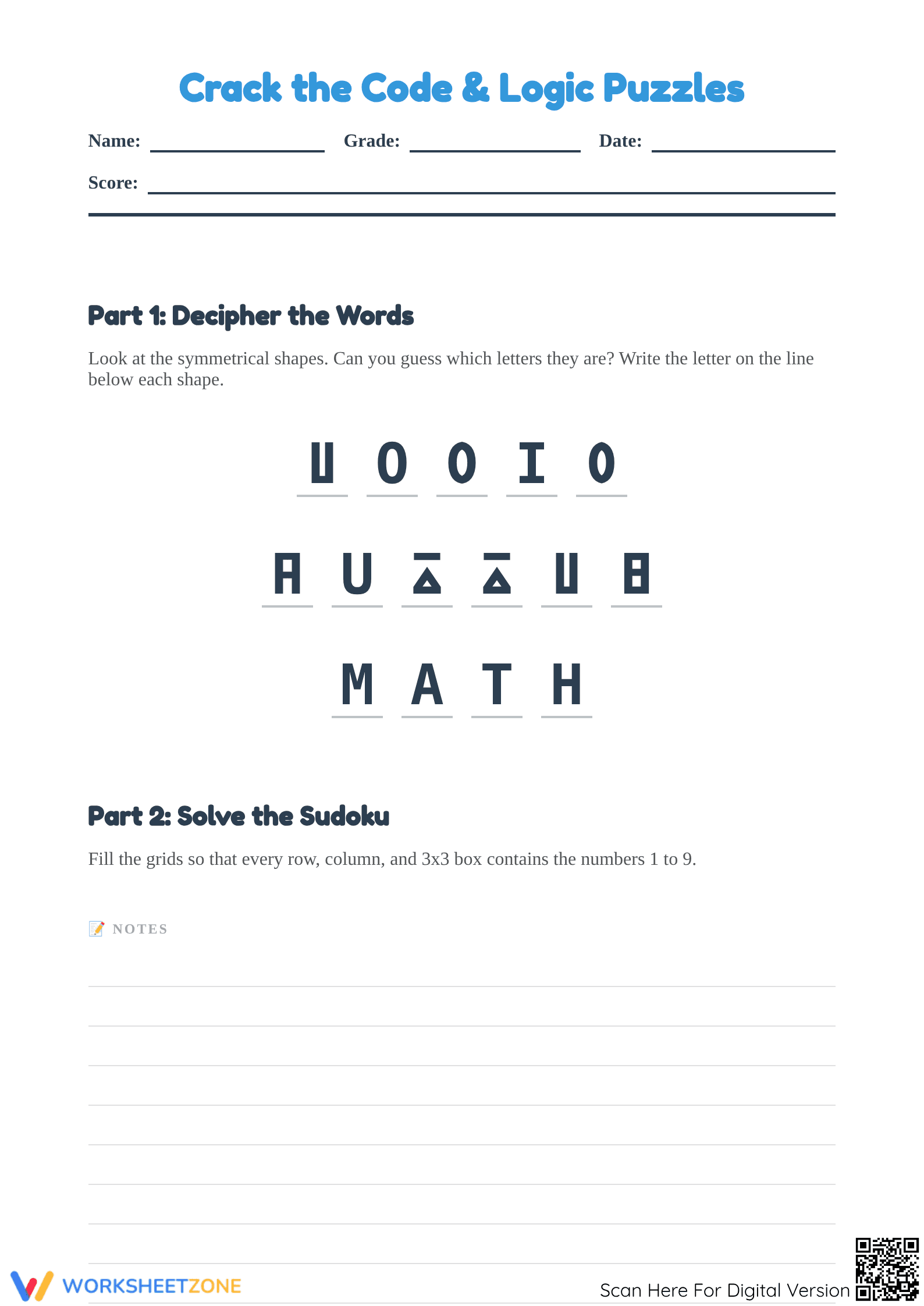
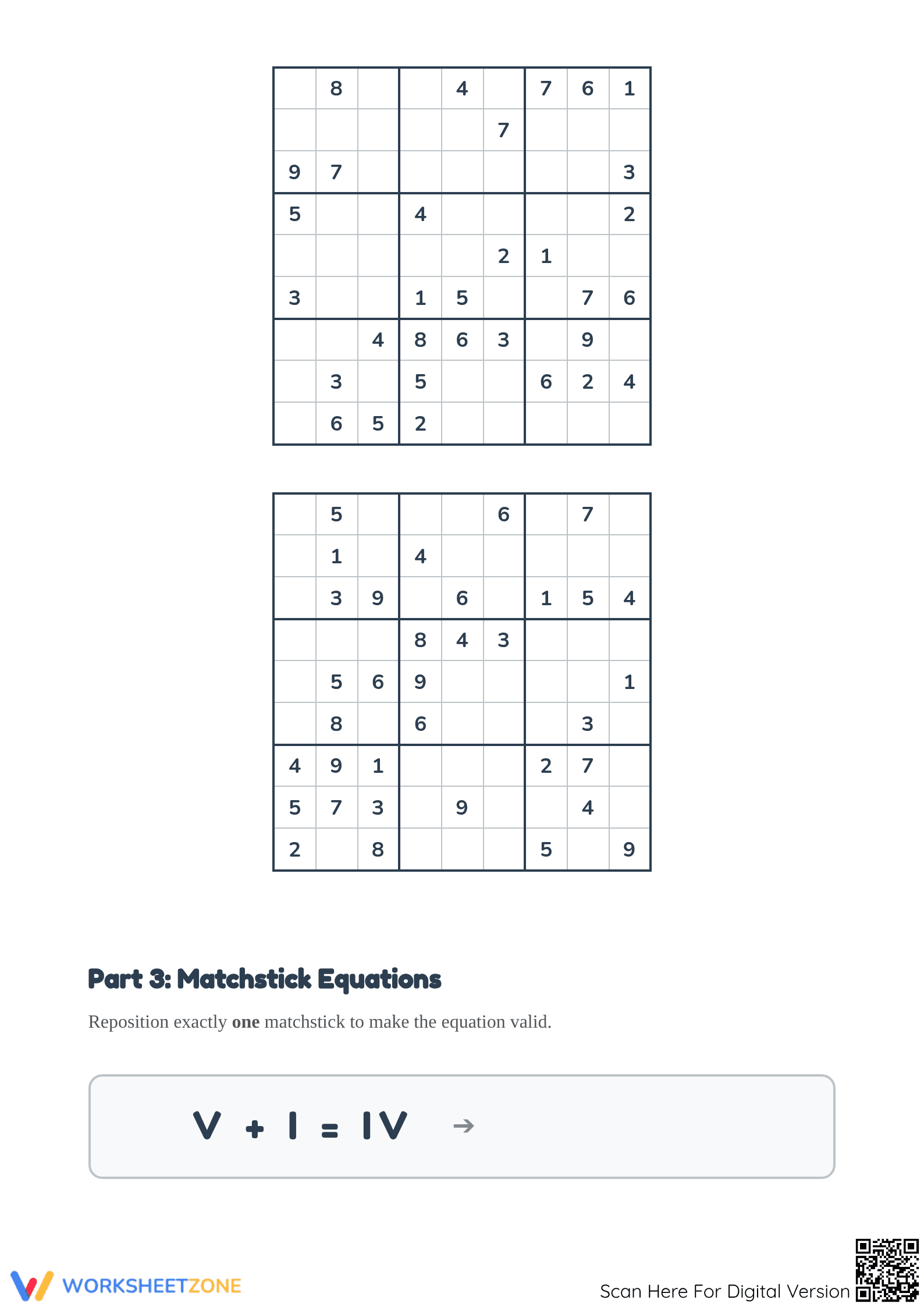
The three-page PDF contains three distinct puzzle categories designed to keep students engaged while building cognitive stamina. Part one features symmetrical shape decoding to reveal hidden words through visual analysis. Part two provides two full 9x9 Sudoku grids for number placement practice. Part three presents four matchstick-style Roman numeral equations that require single-move corrections to achieve mathematical validity. A comprehensive answer key ensures efficient grading.
Zero-Prep Workflow
Implementation is straightforward and takes less than two minutes total for the instructor. Step 1: Print the 3-page packet for your class (60 seconds). Step 2: Distribute to students for independent or partner work (30 seconds). Step 3: Review solutions using the provided visual answer key for immediate feedback or self-grading (30 seconds). This "print-and-go" design makes it a reliable choice for unexpected sub days.
Standards Alignment
This resource is aligned primarily to CCSS.MATH.PRACTICE.MP1, which requires students to analyze givens, constraints, relationships, and goals. The Roman numeral matchstick section also supports number system awareness and algebraic thinking. Both standard codes can be copied directly into lesson plans, IEP goals, or district curriculum mapping tools to document the use of standards-based logic enrichment activities.
How to Use It
Use this as a "Brain Break" during transitions or as a challenge packet for students who finish core math assignments early. For formative assessment, observe if students use systematic elimination in the Sudoku grids or logical trial-and-error for the matchstick puzzles. Most Grade 4 students will take approximately 35 minutes for full completion, making it a perfect tool for bridging gaps between lessons.
Who It's For
Designed for Grade 3-5 students who enjoy intellectual challenges and puzzle-solving. It is particularly effective for gifted and talented (GATE) students or those needing visual-spatial differentiation. Pair this with a direct instruction lesson on Roman numeral history or as a fun reward after a rigorous standardized testing session to allow students to flex their critical thinking muscles.
This Grade 4 logic and pattern recognition resource centers on CCSS.MATH.PRACTICE.MP1, requiring students to make sense of problems and persevere in solving them. Research from the RAND AIRS 2024 report highlights that integrating non-routine logic puzzles, such as Sudoku and matchstick equations, significantly boosts student engagement and cognitive flexibility compared to repetitive drill-and-kill worksheets. By transitioning from visual shape decoding to abstract number placement and Roman numeral manipulation, the material follows a structured scaffold that builds stamina in problem-solving. This approach aligns with Fisher & Frey (2014) regarding the importance of productive struggle in developing mathematical agency. Educators can utilize these eight distinct tasks to assess student persistence and strategy development in real-time. The inclusion of three full pages of varied content ensures that the resource provides substantial, high-quality practice suitable for classroom environments where zero-prep, high-impact materials are essential for effective instructional management.


