


























Views
Downloads
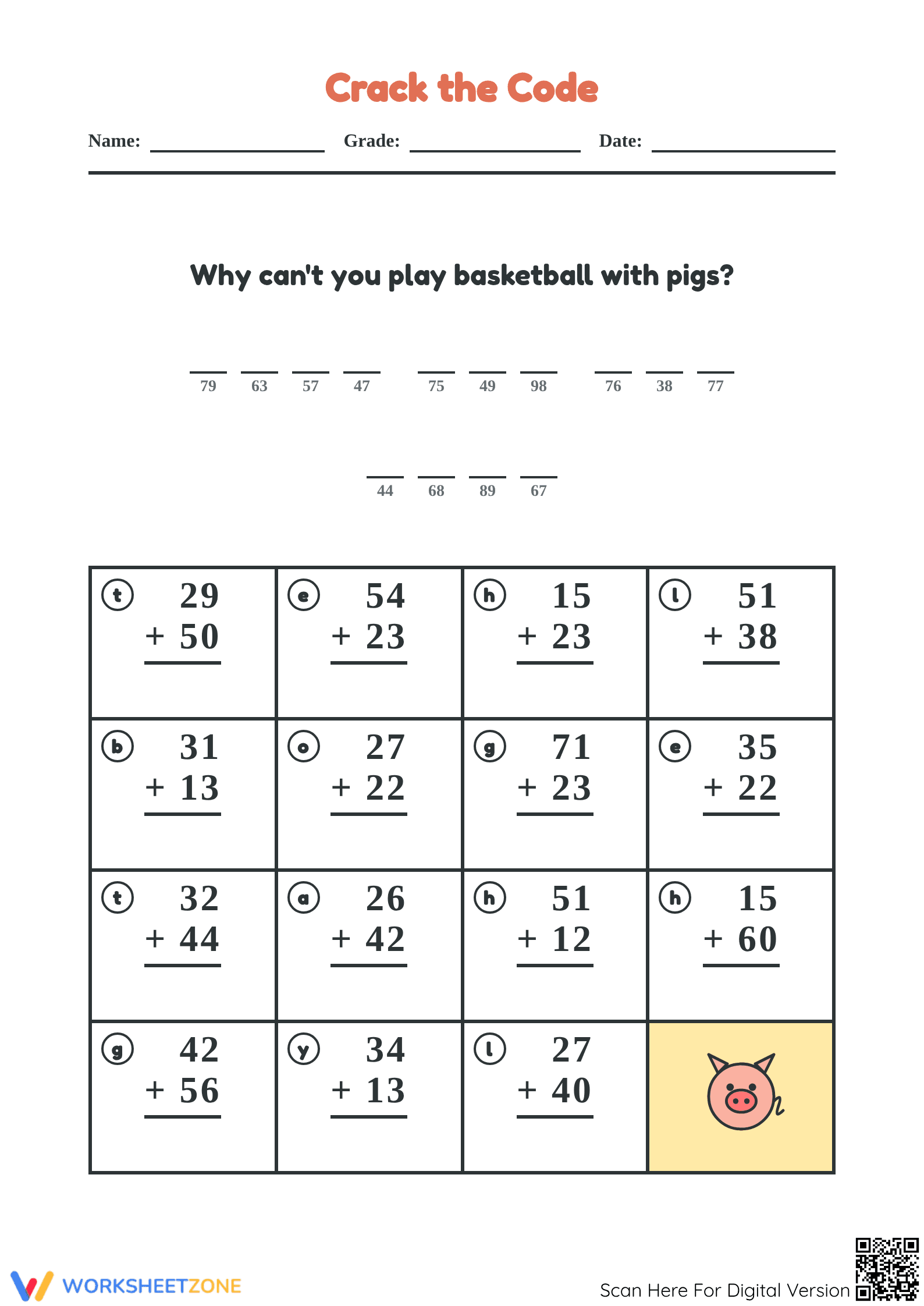

Printable Crack the Code Pig Addition — Grade 2 Aligned
Paste this activity's link or code into your existing LMS (Google Classroom, Canvas, Teams, Schoology, Moodle, etc.).
Students can open and work on the activity right away, with no student login required.
You'll still be able to track student progress and results from your teacher account.
Uncover the punchline to a classic animal joke while mastering double-digit addition with this engaging "Crack the Code" worksheet. Designed for early elementary students, this activity transforms standard math practice into a rewarding puzzle. Students solve 15 addition problems to map numbers to letters, revealing why you can't play basketball with pigs.
At a Glance
- Grade: 2 · Subject: Math
- Standard:
CCSS.MATH.CONTENT.2.NBT.B.5— Fluently add within 100 using strategies based on place value- Skill Focus: Double-digit addition without regrouping
- Format: 1 page · 15 problems · Answer key included · PDF
- Best For: Independent practice and morning work
- Time: 15–25 minutes
This single-page PDF features 15 vertically aligned addition problems in a clean grid. Each problem is paired with a specific letter. Once solved, students use their sums to fill in the blanks, decoding the answer to the riddle. The worksheet includes a name and date header and a pig illustration. A comprehensive answer key is provided for immediate feedback.
This resource is designed for a zero-prep classroom experience. Simply hit print, a process taking less than 30 seconds. Distributing materials takes just 1 minute during transitions or morning entry. Reviewing student work is efficient using the provided answer key, allowing for a full-class check or individual grading in under 2 minutes. This makes it ideal for emergency substitute plans or schedule gaps.
Aligned primarily to CCSS.MATH.CONTENT.2.NBT.B.5, this worksheet requires students to fluently add within 100. By focusing on double-digit addition without regrouping, the tasks reinforce place value concepts and numerical fluency. Students must accurately calculate sums to successfully decode the message, ensuring mathematical precision is directly tied to the activity's success. This standard code can be copied directly into lesson plans, IEP goals, or district curriculum mapping tools.
Use this worksheet as a high-engagement morning work activity to settle students into their math block. Alternatively, assign it as a fast-finisher task for students who complete their primary lesson ahead of peers. During the activity, circulate the room to observe if students are using place-value strategies or vertical column addition. Completion typically takes 15 to 25 minutes depending on individual student fluency levels.
This resource is tailored for Grade 2 students working toward mastery of addition within 100, though it serves as an excellent challenge for Grade 1 or a helpful review for Grade 3 learners. It is particularly effective for students who benefit from gamified learning and immediate self-correction. Pair this worksheet with a place-value anchor chart to provide additional support for struggling learners.
According to the RAND AIRS 2024 report on elementary mathematics, gamified practice elements like "Crack the Code" puzzles significantly increase student time-on-task compared to traditional drill worksheets. This specific resource targets the CCSS.MATH.CONTENT.2.NBT.B.5 standard, focusing on the ability of students to perform double-digit addition fluently. By embedding 15 calculation tasks within a narrative joke structure, the worksheet reduces math anxiety and promotes cognitive persistence. Research indicates that connecting computational fluency with logical decoding helps solidify the relationship between numbers and their symbolic representations. This dual-task approach supports executive function while building the foundational arithmetic skills necessary for later multi-step operations. Teachers can confidently utilize this resource as an evidence-based tool for developing early numerical proficiency in alignment with national standards for mathematics education.


