


























Views
Downloads


Essential Autumn Math: Crack the Code Worksheet — Grades 1-3
Paste this activity's link or code into your existing LMS (Google Classroom, Canvas, Teams, Schoology, Moodle, etc.).
Students can open and work on the activity right away, with no student login required.
You'll still be able to track student progress and results from your teacher account.
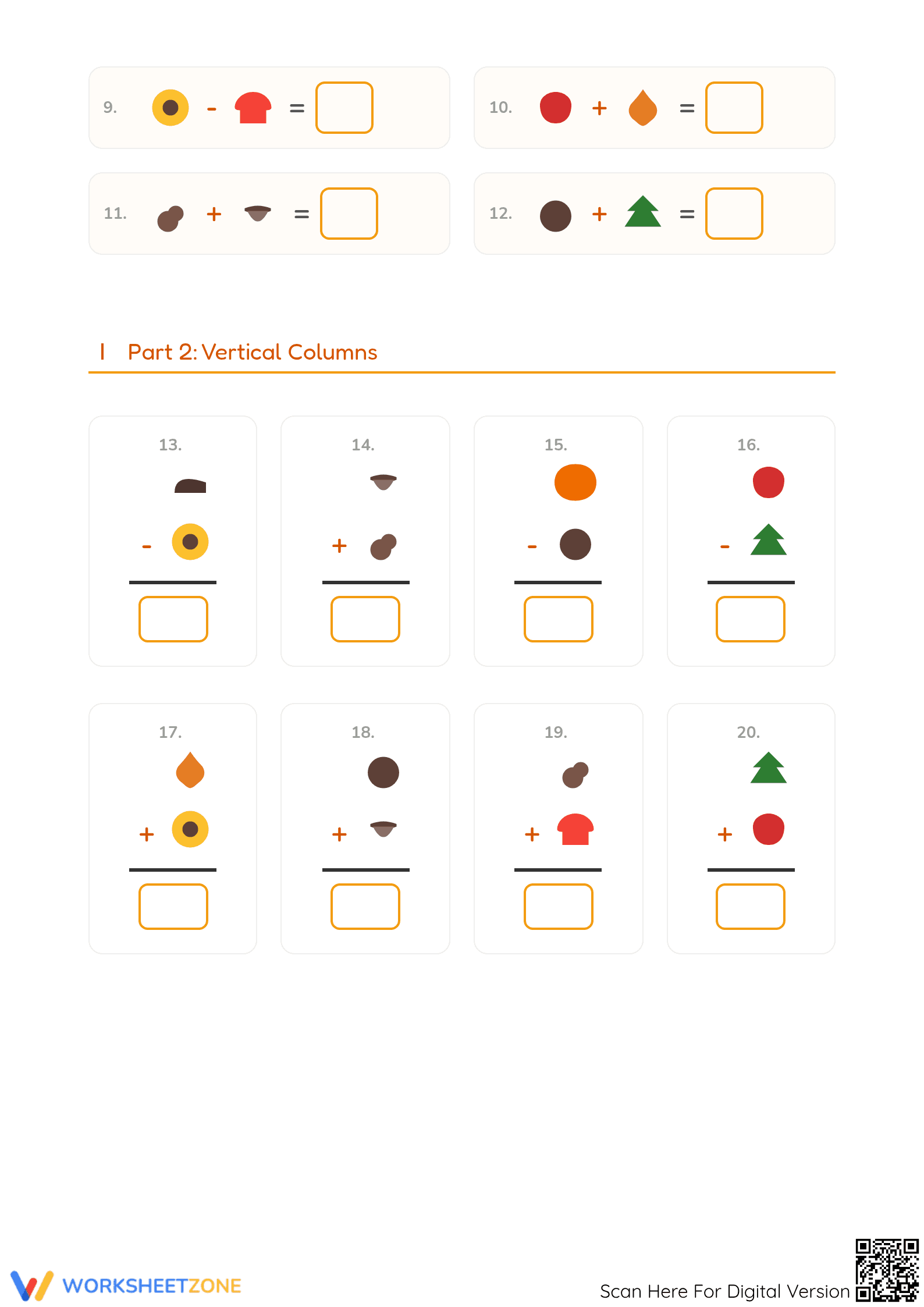
Students master addition and subtraction fluency while solving seasonal puzzles in this engaging Autumn-themed math activity. By translating seasonal symbols into numeric values, learners strengthen their algebraic thinking and operational accuracy. This worksheet transforms routine arithmetic into a rewarding code-breaking mission, ensuring students remain focused and motivated during independent practice or morning work sessions.
At a Glance
- Grade: 1–3 · Subject: Math
- Standard:
CCSS.MATH.CONTENT.1.OA.C.6— Add and subtract within 20 demonstrating fluency for operations within 10- Skill Focus: Addition and Subtraction Fluency
- Format: 3 pages · 24 problems · Answer key included · PDF
- Best For: Seasonal morning work or sub plans
- Time: 20–30 minutes
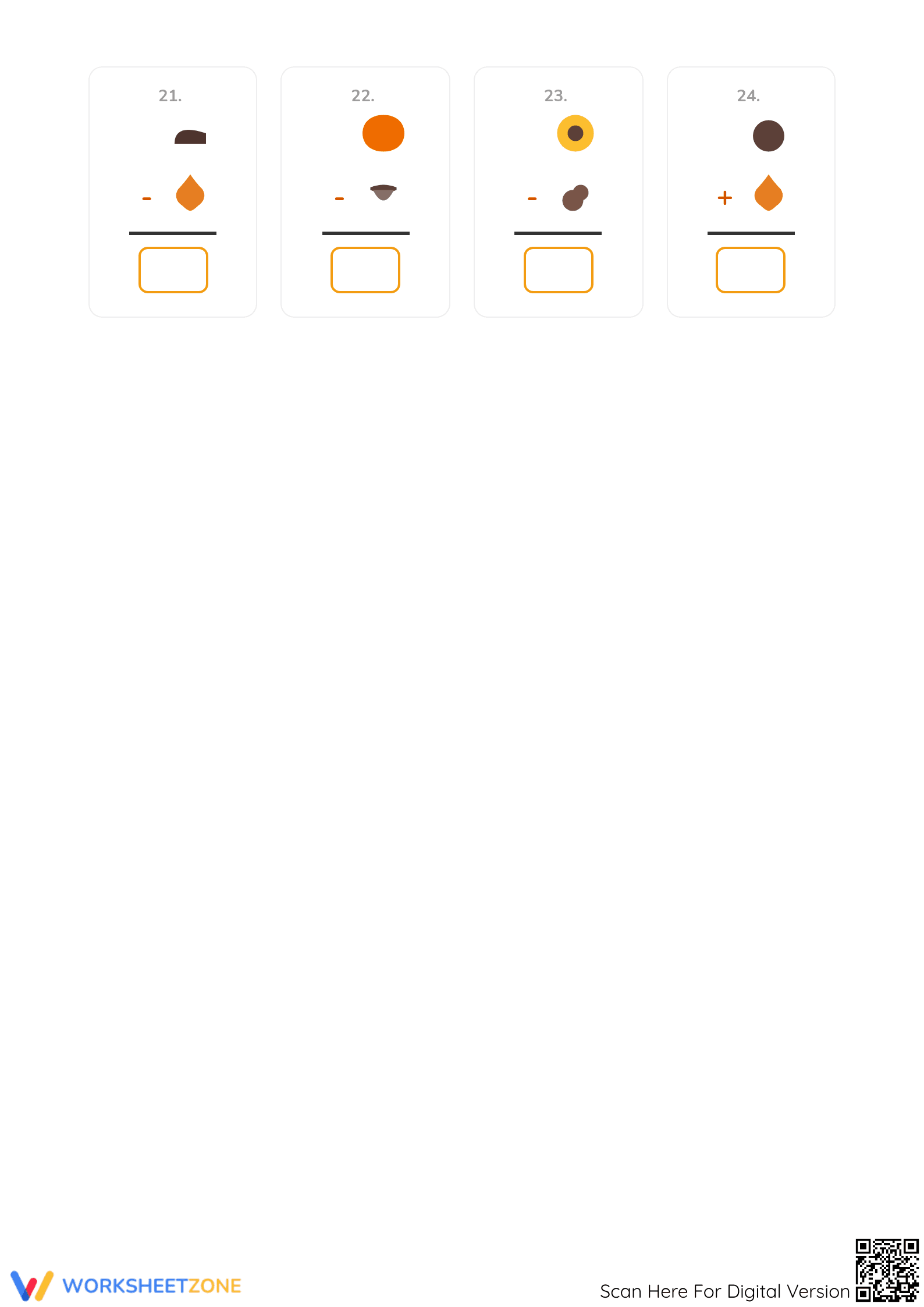
This 3-page PDF features a comprehensive "Autumn Code Key" where ten distinct seasonal symbols—including pumpkins, acorns, and owls—correspond to integers 0 through 9. The resource contains 24 total arithmetic tasks divided into two distinct sections: horizontal equations and vertical columns. A complete answer key is provided to facilitate rapid grading or student self-correction, making it ideal for self-contained learning centers.
The implementation workflow requires minimal teacher oversight, typically totaling less than 2 minutes of preparation. First, print the document and distribute it to students in under 30 seconds. Next, allow 20 minutes for independent decoding and computation. Finally, spend 60 seconds reviewing the provided answer key or displaying it for collective correction. This efficient cycle makes the worksheet a reliable choice for unexpected absences or transition periods.
The primary focus is `CCSS.MATH.CONTENT.1.OA.C.6`, which requires students to add and subtract within 20. By utilizing a symbolic code, the worksheet also touches upon early algebraic concepts, similar to `CCSS.MATH.CONTENT.1.OA.D.8`, where students determine the unknown whole number in an equation. Both standard codes can be copied directly into lesson plans, IEP goals, or district curriculum mapping tools.
Deploy this worksheet during the "You Do" phase of a gradual release lesson to reinforce basic operation fluency in a non-traditional format. Teachers can observe students as they navigate the code key, identifying those who struggle with one-to-one correspondence or symbol recognition versus those who struggle with the arithmetic itself. Expect students to complete all 24 problems within a 25-minute instructional block.
This resource is designed for Grade 1, 2, and 3 students needing engaging practice with single-digit operations. It serves as an excellent accommodation for learners who benefit from visual cues and gamified tasks. It pairs naturally with a fall-themed storybook or an anchor chart displaying addition and subtraction strategies like counting on or doubles facts.
The "Crack The Code: Autumn Math" worksheet provides a structured environment for practicing `CCSS.MATH.CONTENT.1.OA.C.6` through a symbolic substitution system. Research from *Fisher & Frey (2014)* emphasizes the importance of purposeful independent practice in the gradual release of responsibility model, noting that high-engagement tasks like code-breaking can sustain student attention longer than traditional drill-and-kill methods. By requiring students to map symbols to numbers before computing, the resource builds cognitive flexibility and reinforces the understanding of mathematical equality. The 24-task sequence provides sufficient volume to assess operational fluency without overwhelming early elementary learners. As noted in the *ScienceDirect TpT Analysis*, seasonal themes significantly increase student motivation, leading to higher completion rates and better retention of core arithmetic skills.


