


























Views
Downloads


Crack the Addition Code Worksheet | Grade 1-2 Printable
Paste this activity's link or code into your existing LMS (Google Classroom, Canvas, Teams, Schoology, Moodle, etc.).
Students can open and work on the activity right away, with no student login required.
You'll still be able to track student progress and results from your teacher account.
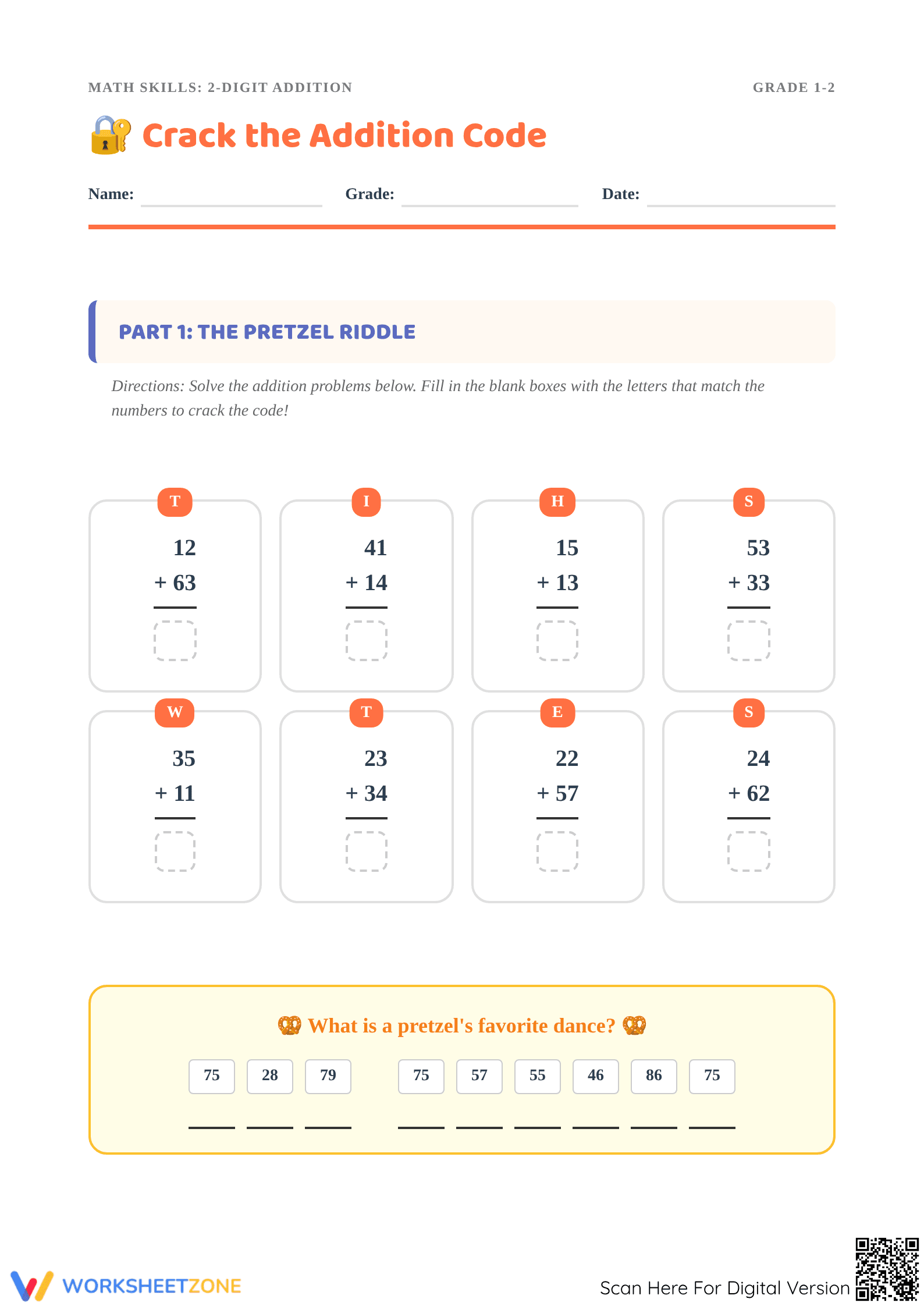
This comprehensive 2-digit addition worksheet packet transforms standard math practice into an engaging code-breaking mission. Students master two-digit addition without regrouping by solving a riddle, completing word problems, and utilizing number lines. It provides a complete instructional sequence that builds fluency and confidence in early operations. The student outcome is mastery of place-value-based addition.
At a Glance
- Grade: 1-2 · Subject: Math
- Standard:
1.NBT.C.4— Add within 100 using place value strategies without regrouping to solve riddles- Skill Focus: 2-Digit Addition (No Regrouping)
- Format: 5 pages · 41 problems · Answer key included · PDF
- Best For: Independent practice and morning work
- Time: 30–45 minutes
What's Inside: This 5-page PDF contains five distinct sections including vertical addition practice, word problems, and a fast-fact challenge. The packet features a self-correcting riddle on the first page, followed by 16 standard vertical problems, two marble-themed word problems, a creative code-creation task, and number line jumps. A full answer key is provided for easy grading or self-check.
Zero-Prep Workflow: 3 steps — Print the packet (30 seconds), distribute to students for independent work (1 minute), and review using the included answer key (1 minute). Total teacher prep time is under three minutes. This structured layout makes the resource ideal for emergency sub plans, as the directions are self-explanatory and the code-breaking hook keeps students engaged without constant supervision.
Standards Alignment: Primary alignment is to `CCSS.MATH.CONTENT.1.NBT.C.4`, which requires students to add within 100 using concrete models or strategies based on place value. This resource specifically isolates the addition of two-digit numbers without regrouping to build foundational fluency. This standard code can be copied directly into lesson plans, IEP goals, or district curriculum mapping tools.
How to Use It: Assign this packet during independent math rotations or as a cumulative review after direct instruction on place value addition. For formative assessment, observe if students consistently align digits correctly or if they struggle with the number line representation. Expected completion time ranges from 30 minutes for advanced first graders to 45 minutes for standard 2nd-grade review sessions.
Who It's For: This resource is designed for first and second-grade students who are developing their double-digit addition skills. It provides necessary scaffolds like number lines for struggling learners while offering a creative "Make Your Own Code" extension for advanced students. It pairs naturally with base-ten block manipulatives or a hundreds chart for additional support.
Educational research by Fisher & Frey (2014) emphasizes the importance of a gradual release of responsibility in math instruction, a principle reflected in this worksheet's structure. By moving from the highly engaging 'Pretzel Riddle' to independent word problems and a reflective math journal, the resource ensures students internalize the 1.NBT.C.4 standard. This standard focuses on adding two-digit numbers using strategies based on place value, specifically without the added cognitive load of regrouping in this instance. The inclusion of number lines and vertical addition formats provides the multiple representations necessary for deep conceptual understanding. Research suggests that gamified elements, such as the code-breaking mechanism, significantly increase student time-on-task and persistence during repetitive practice. This standards-aligned resource serves as a vital bridge between direct instruction and independent mastery, offering educators a verified method for assessing student progress in foundational algebraic thinking and number system operations.


