


























Views
Downloads
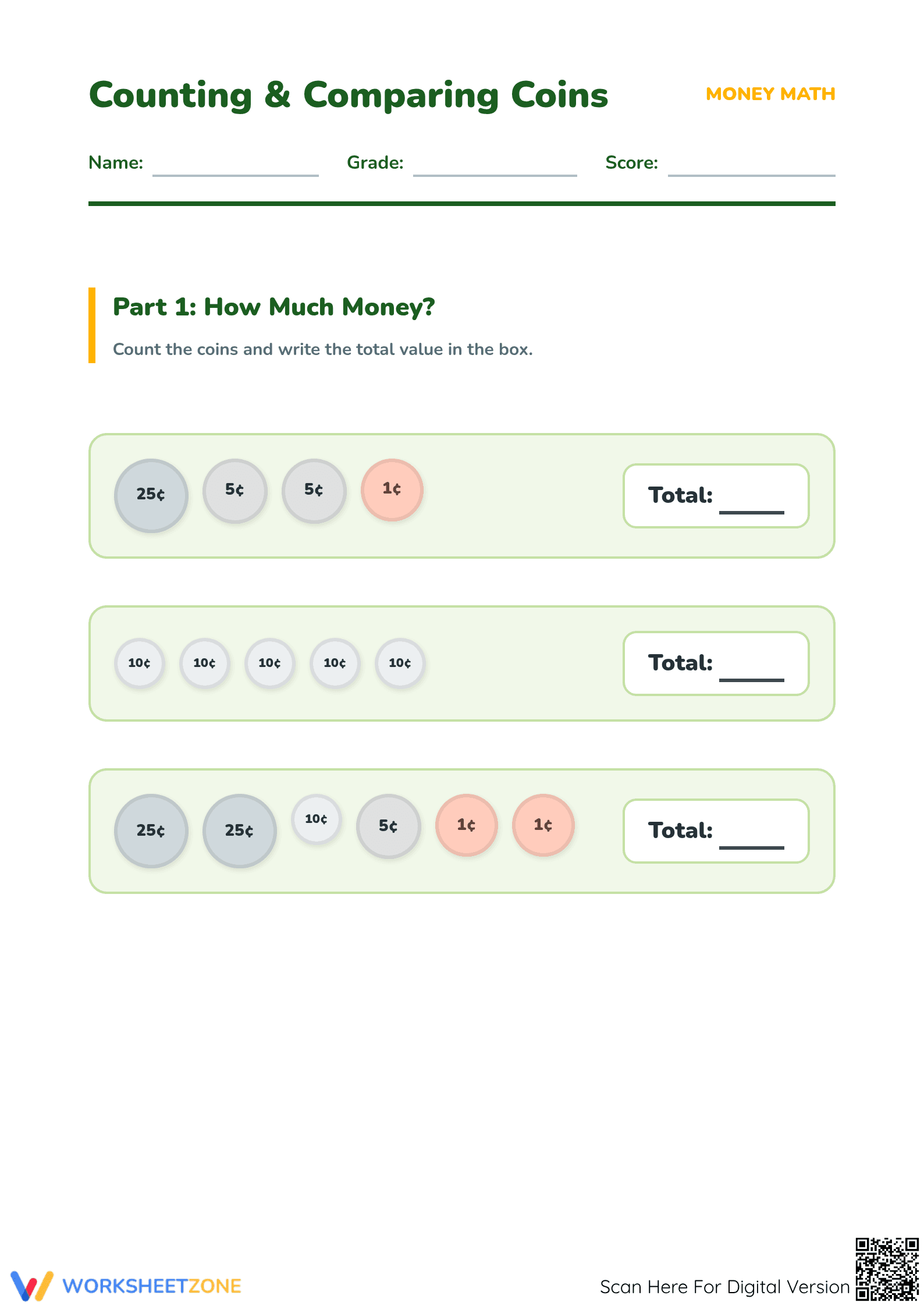
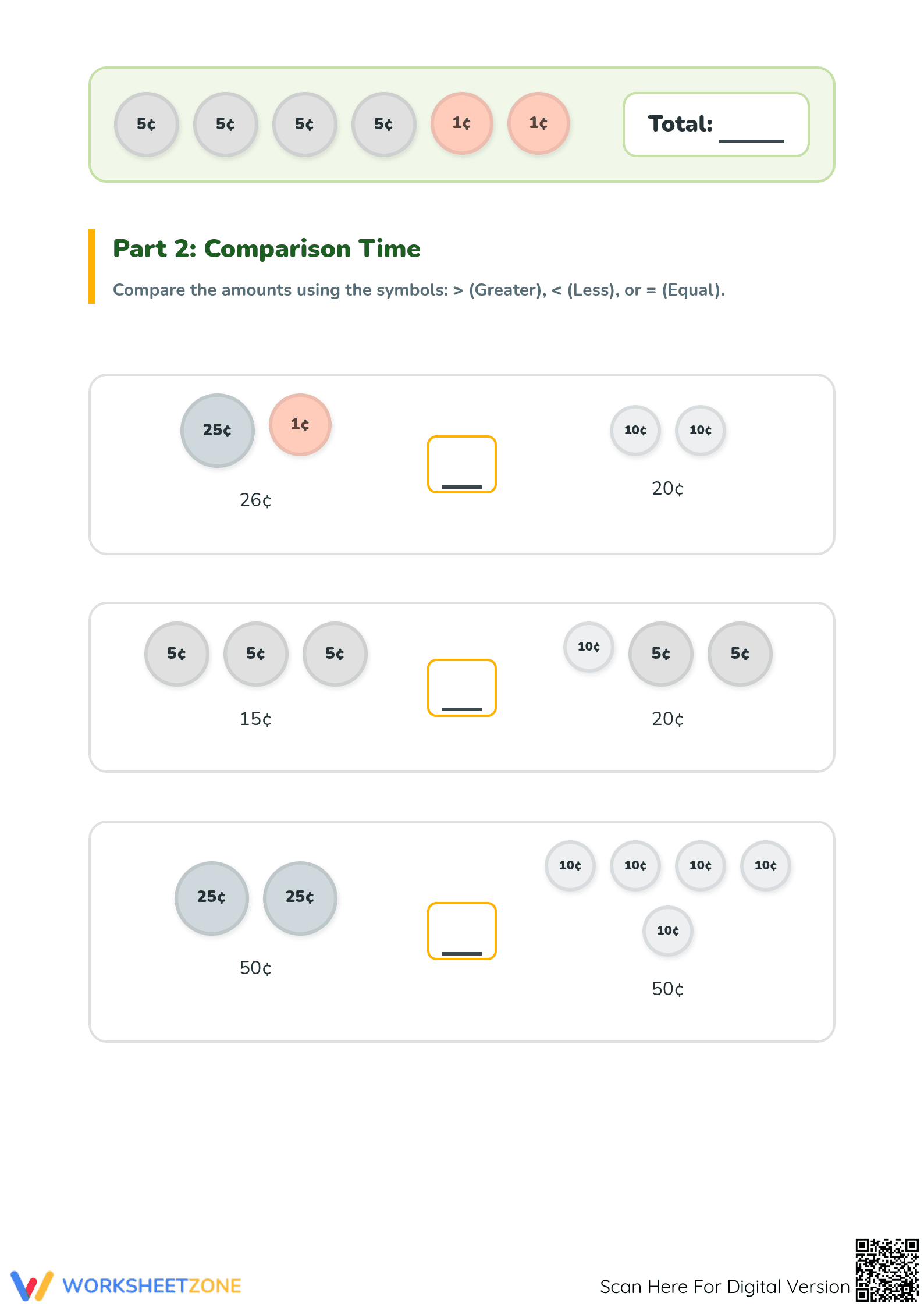
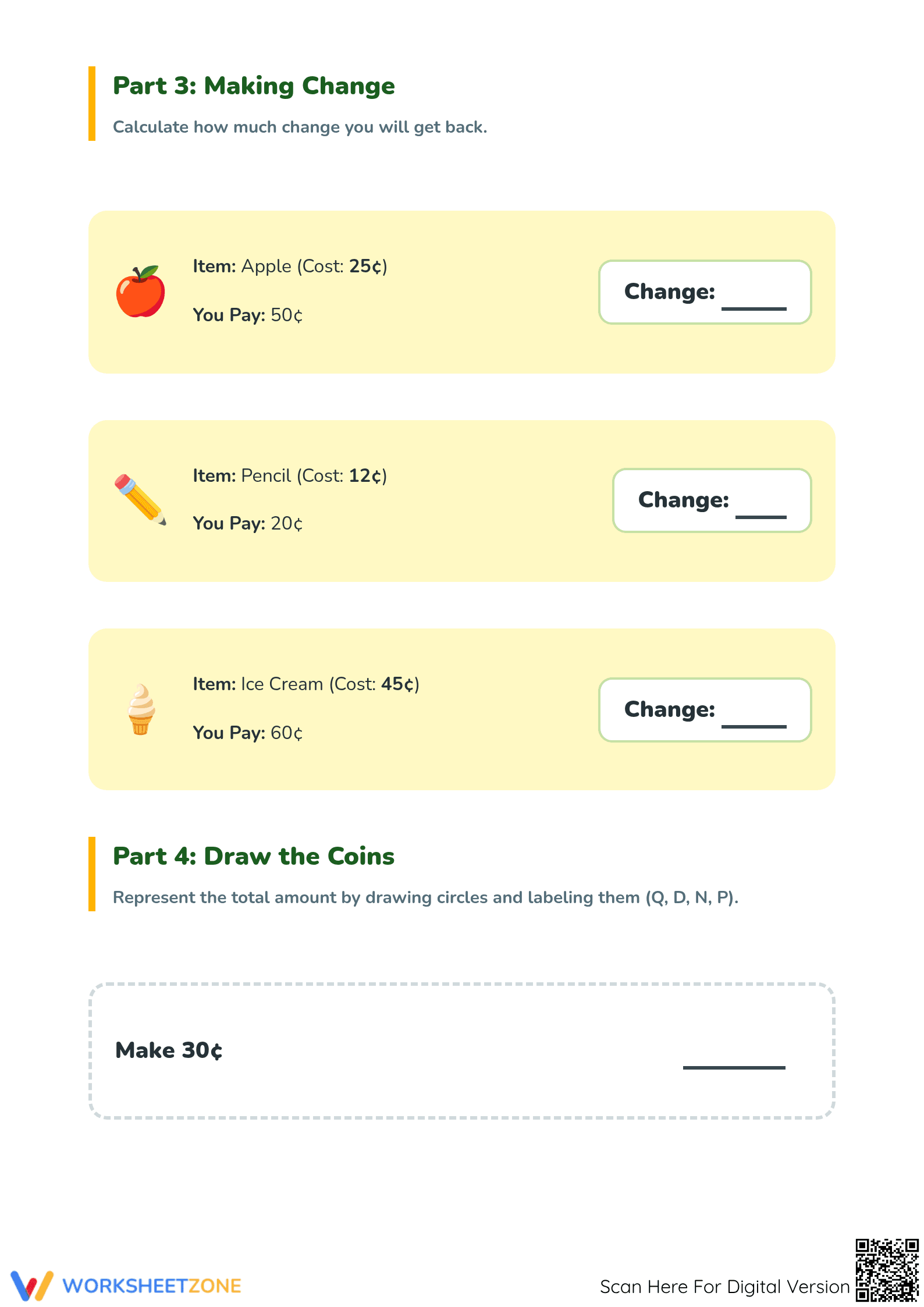
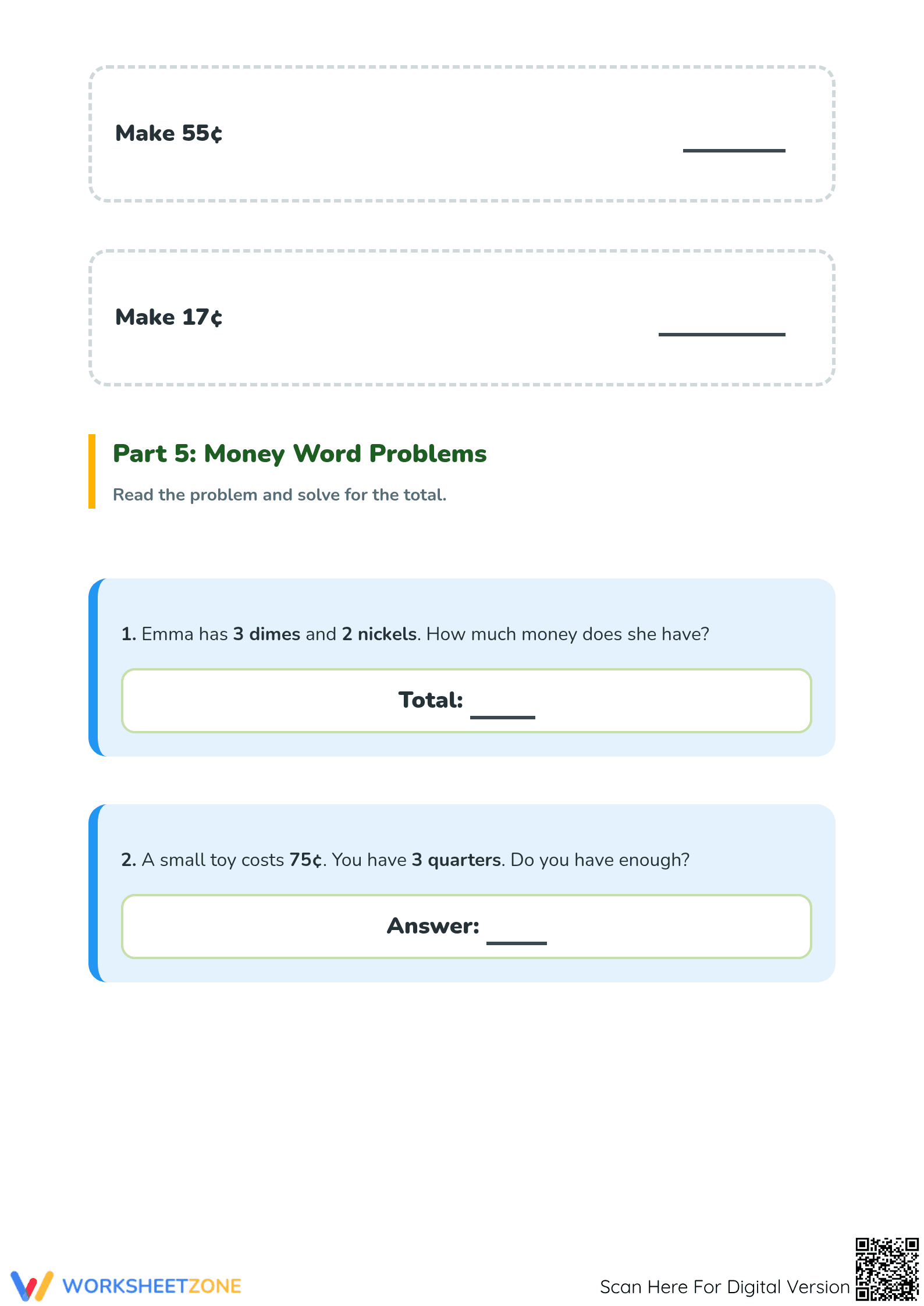

Printable Counting and Comparing Coins for Grade 2 Math
Paste this activity's link or code into your existing LMS (Google Classroom, Canvas, Teams, Schoology, Moodle, etc.).
Students can open and work on the activity right away, with no student login required.
You'll still be able to track student progress and results from your teacher account.
Help your students achieve financial literacy with this comprehensive counting and comparing coins worksheet. This five-page resource provides structured practice for Grade 2 learners to identify, count, and compare US currency. By solving realistic word problems and calculating change, students develop the essential mental math skills required for real-world transactions and mathematical fluency.
At a Glance
- Grade: 2 · Subject: Math
- Standard:
CCSS.MATH.CONTENT.2.MD.C.8— Solve word problems involving quarters, dimes, nickels, and pennies using cents symbols- Skill Focus: US Currency Identification & Operations
- Format: 5 pages · 17 problems · Answer key included · PDF
- Best For: Guided practice and independent math centers
- Time: 30–45 minutes
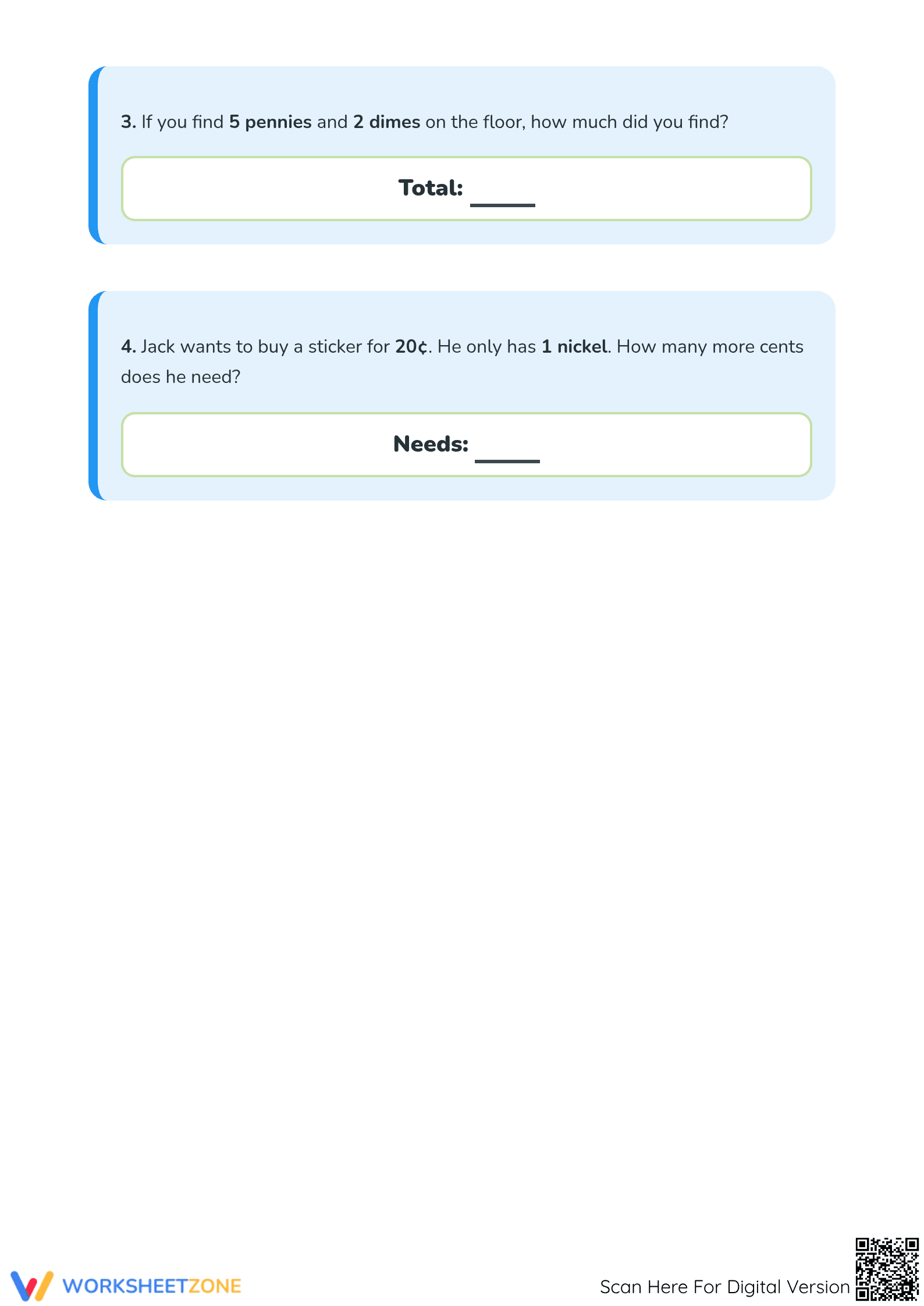
This multi-page PDF features 17 unique tasks divided into five logical sections. Students will count visual representations of coin groups, use comparison operators to evaluate values, and solve functional "making change" scenarios. The worksheet also includes "Draw the Coins" activities for tactile learning and complex word problems to challenge critical thinking. A full answer key ensures quick and accurate grading.
Skill Progression
- Guided Practice: Students begin with direct counting tasks, totaling mixed coin groups (quarters, dimes, nickels, and pennies) in 4 foundational problems with visual supports.
- Supported Practice: The middle sections transition to 3 comparison tasks and 3 change-making scenarios, requiring students to apply addition and subtraction strategies to money.
- Independent Practice: Learners demonstrate mastery through 3 coin-drawing tasks and 4 multi-step word problems, requiring them to synthesize their knowledge without visual coin prompts.
This structure follows a gradual-release model, moving from concrete visual counting to abstract problem-solving across all currency denominations.
Standards Alignment
This resource aligns perfectly with CCSS.MATH.CONTENT.2.MD.C.8: "Solve word problems involving dollar bills, quarters, dimes, nickels, and pennies, using $ and ¢ symbols appropriately." It also supports 2.OA.A.1 for addition and subtraction within word problems. Both standard codes can be copied directly into lesson plans, IEP goals, or district curriculum mapping tools.
How to Use It
Assign this worksheet during the "You Do" phase of your math block after direct instruction on coin values. Use the "Comparison Time" section as a quick formative assessment to see if students can differentiate between coin sizes and their actual monetary worth. Expect students to spend roughly 35 minutes completing the full five-page set independently or in small groups.
Who It's For
This packet is designed for Grade 2 students but serves as an excellent extension for advanced Grade 1 learners or remediation for Grade 3 students. It pairs naturally with plastic coin manipulatives, anchor charts showing coin front/back faces, and direct instruction on skip-counting by 5s, 10s, and 25s.
The ScienceDirect TpT Analysis (2024) emphasizes that high-quality elementary math resources must balance procedural fluency with conceptual application, particularly in domain-specific areas like measurement and data. This worksheet addresses that need by bridging the gap between simple identification and the complex cognitive load of multi-step money word problems. By integrating five distinct task types—counting, comparing, change calculation, representation, and problem-solving—the material ensures students are not merely memorizing coin values but are actively applying them to functional scenarios. Aligned to CCSS.MATH.CONTENT.2.MD.C.8, this resource focuses on the plain-English skill of solving word problems involving quarters, dimes, nickels, and pennies. Research suggests that repetitive, varied practice with physical and visual currency representations significantly improves long-term retention of basic arithmetic skills in primary grades. This printable resource serves as an essential tool for teachers seeking evidence-based methods to strengthen financial literacy in early childhood education settings.


