


























Views
Downloads


Counting and Spelling Fun Worksheet | Grade K Essential
Paste this activity's link or code into your existing LMS (Google Classroom, Canvas, Teams, Schoology, Moodle, etc.).
Students can open and work on the activity right away, with no student login required.
You'll still be able to track student progress and results from your teacher account.
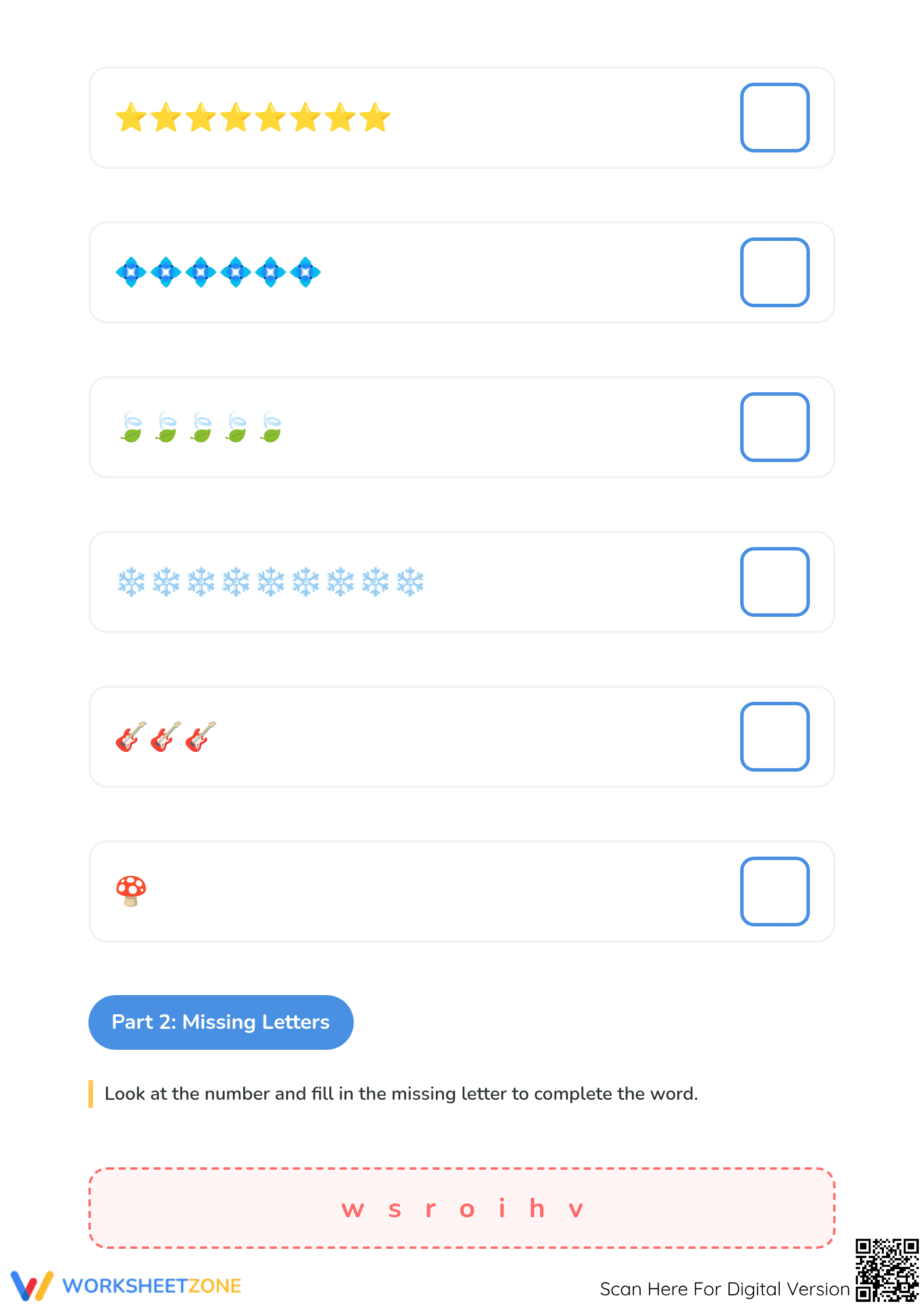
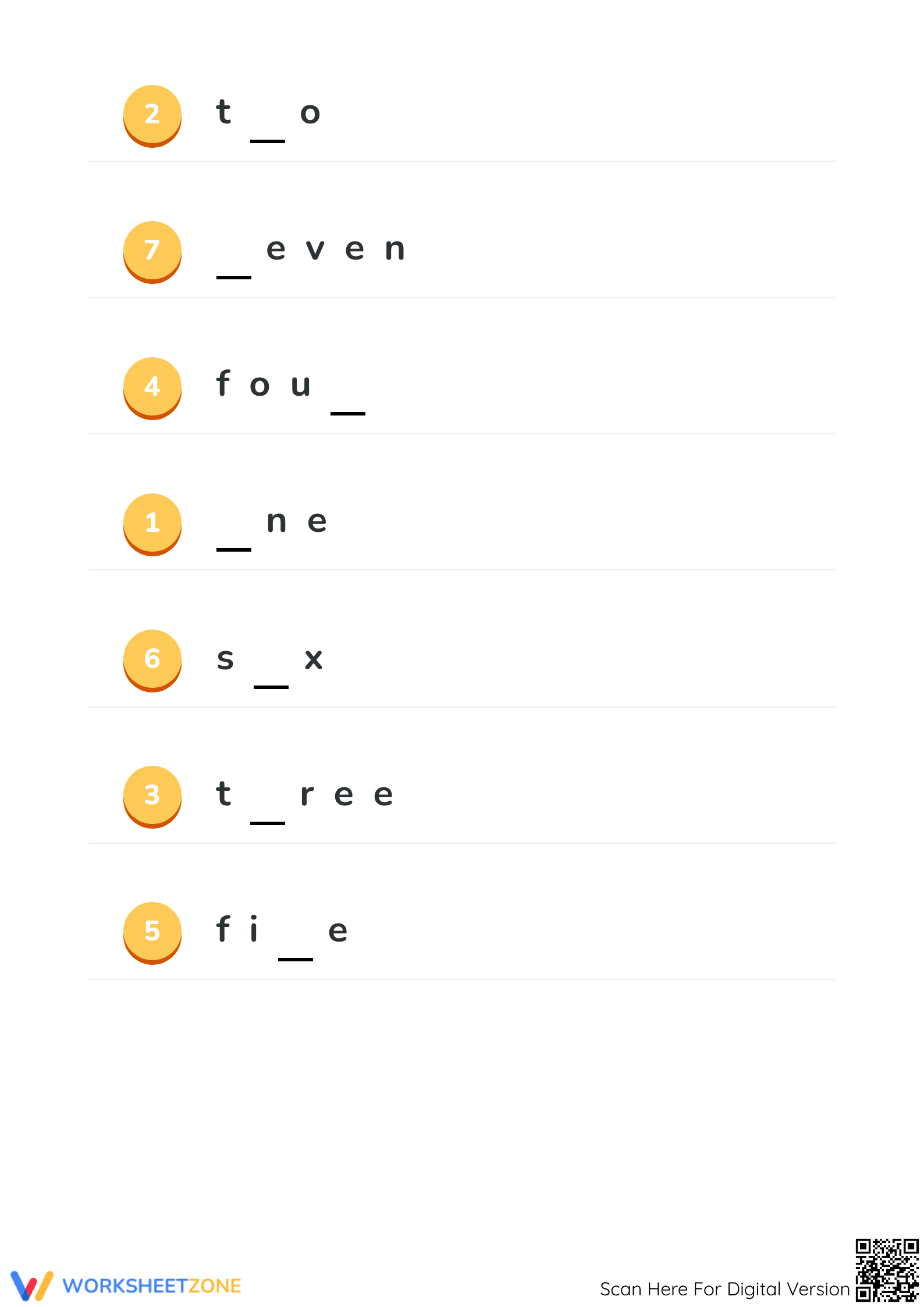
This Kindergarten worksheet integrates numeracy and literacy by challenging students to count sets of objects up to 10 and complete the spelling of corresponding number words. By bridging these two core domains, learners develop a stronger conceptual link between quantities and their written representations. It is an effective tool for building early mathematical fluency and phonetic awareness simultaneously.
At a Glance
- Grade: Kindergarten · Subject: Math & English
- Standard:
CCSS.MATH.CONTENT.K.CC.B.4— Understand the relationship between numbers and quantities; connect counting to cardinality.- Skill Focus: One-to-one correspondence and number word spelling
- Format: 3 pages · 17 problems · Answer key included · PDF
- Best For: Morning work or independent math centers
- Time: 15–20 minutes
The 3-page PDF is divided into two distinct instructional phases. Part 1 features 10 counting rows with clear, engaging visual icons such as trees, stars, and guitars to maintain student interest. Part 2 transitions into literacy, providing 7 spelling tasks where students fill in missing letters for number words using a provided letter bank. This structural variety ensures that students remain engaged while switching between mathematical logic and linguistic recall.
This resource is designed for a zero-prep workflow. Teachers can print the 3 pages in approximately 30 seconds, distribute them to the class in 1 minute, and use the included answer key for a 5-minute rapid review. The total teacher preparation time is under 2 minutes, making this an ideal selection for emergency sub plans or unexpected schedule gaps where high-quality instructional material is needed immediately.
The primary alignment for this activity is `CCSS.MATH.CONTENT.K.CC.B.4`, which focuses on the relationship between numbers and quantities. Additionally, it supports `CCSS.ELA-LITERACY.L.K.2.D` by requiring students to spell high-frequency number words. Both standard codes can be copied directly into lesson plans, IEP goals, or district curriculum mapping tools to ensure documented compliance with state and federal learning requirements.
For optimal results, use this worksheet during the independent practice phase of a lesson on cardinality. It serves as an excellent formative assessment tool; teachers should observe whether students use a finger to track each object, which indicates mastery of one-to-one correspondence. The expected completion time ranges from 15 to 20 minutes depending on the student's familiarity with number word orthography.
This activity is specifically tailored for Kindergarten students but is also highly effective for Preschoolers ready for a challenge or Grade 1 students requiring remedial support. It is a natural pairing for a classroom number line or a counting anchor chart. The clear layout and repetitive structure also make it accessible for ESL/ELL students who are learning English number names.
According to Fisher & Frey (2014), the integration of literacy within content areas like mathematics significantly improves long-term retention of technical vocabulary. This worksheet applies that research by requiring students to not only identify the quantity of 10 objects but also to encode the word "ten" through letter completion. By reinforcing the standard CCSS.MATH.CONTENT.K.CC.B.4 through a multi-modal approach, the resource ensures that students move beyond rote counting into a deeper understanding of cardinality. The inclusion of 17 distinct tasks provides sufficient repetition to move the skill from short-term memory to mastery. Educational analysis suggests that worksheets combining visual counting with written reinforcement help bridge the gap between concrete and abstract mathematical thinking for early learners.


