


























Views
Downloads
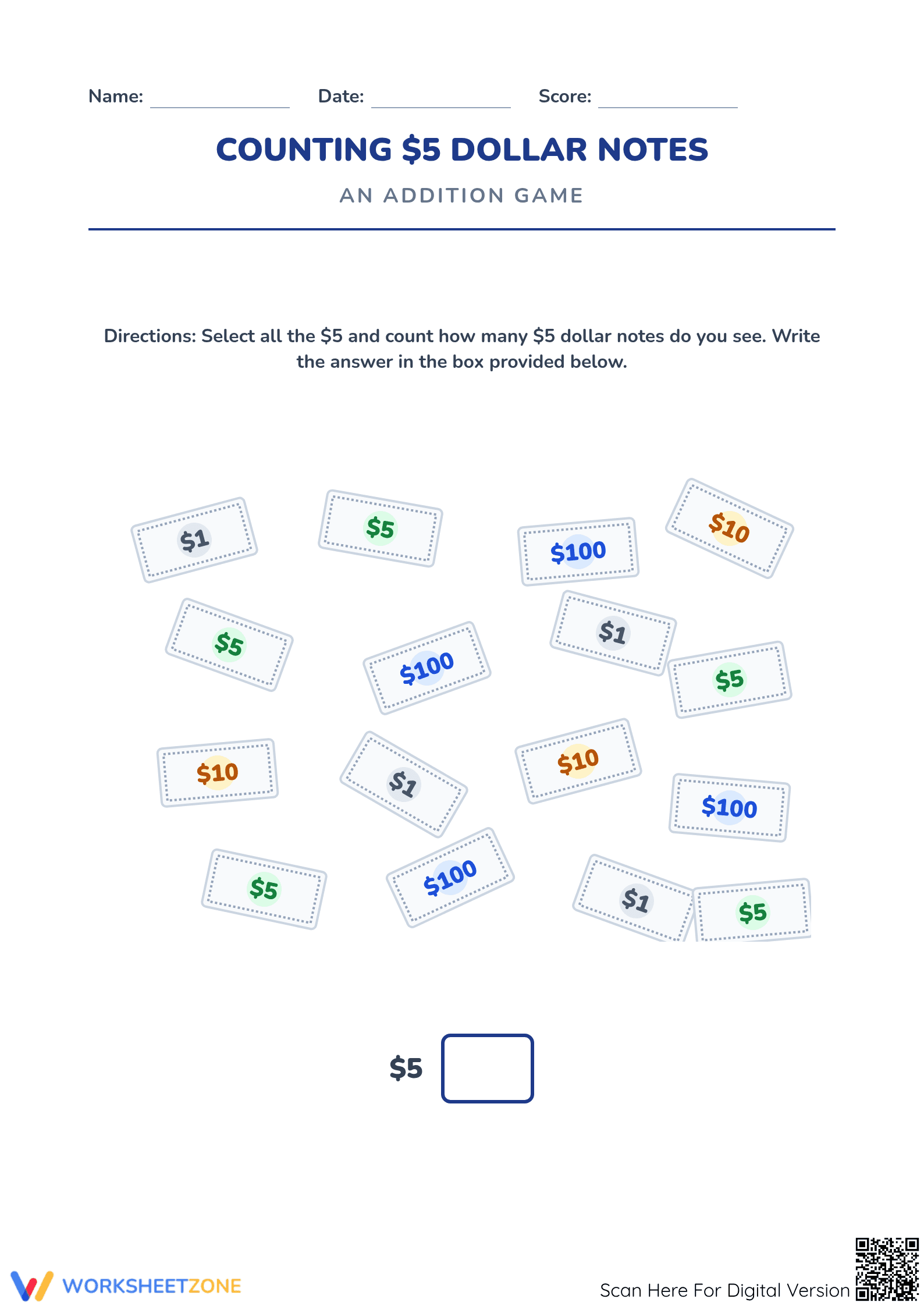

Counting $5 Notes Worksheet | Grade 1 Essential Math
Paste this activity's link or code into your existing LMS (Google Classroom, Canvas, Teams, Schoology, Moodle, etc.).
Students can open and work on the activity right away, with no student login required.
You'll still be able to track student progress and results from your teacher account.
This Grade 1 math worksheet helps students master the skill of identifying and counting specific currency denominations. By focusing on $5 dollar notes within a mixed set of bills, learners develop visual discrimination and basic tallying skills. This activity ensures students can accurately recognize monetary values in a practical, engaging format.
At a Glance
- Grade: 1 · Subject: Math
- Standard:
CCSS.MATH.CONTENT.1.NBT.A.1— Count to 120, starting at any number less than 120- Skill Focus: Currency identification and counting
- Format: 1 page · 1 main task · Answer key included · PDF
- Best For: Quick morning work or math centers
- Time: 5–10 minutes
What's Inside: One high-quality PDF page featuring a "Counting $5 Dollar Notes" addition game. The worksheet displays a variety of currency notes, including $1, $5, $10, and $100 bills scattered across the page. Students must scan the collection, identify only the $5 notes, and write the final count in a designated answer box. A clear answer key is provided for rapid grading.
Zero-Prep Workflow: This resource is designed for immediate classroom implementation with three simple steps. First, print the single-page PDF (30 seconds). Second, distribute the sheets to students as a warm-up or "fast finisher" activity (1 minute). Third, review the single answer box using the provided key to check for accuracy (30 seconds). Total teacher preparation time is under 2 minutes, making it an ideal sub-plan component.
Standards Alignment: The primary standard addressed is CCSS.MATH.CONTENT.1.NBT.A.1, which requires students to count to 120, starting at any number less than 120. In this context, students practice counting a subset of objects within a larger group. This foundational skill supports later work with CCSS.MATH.CONTENT.2.MD.C.8, involving solving word problems with dollar bills. Both standard codes can be copied directly into lesson plans, IEP goals, or district curriculum mapping tools.
How to Use It: Use this worksheet during the "independent practice" phase of a lesson on money or counting. It serves as an excellent formative assessment tool; observe if students are marking off the bills as they count to avoid double-counting or skipping items. Expected completion time is between 5 and 10 minutes, depending on the student's scanning speed and familiarity with currency symbols.
Who It's For: This resource is tailored for first-grade students but is also appropriate for Kindergarten enrichment or second-grade intervention. It is particularly helpful for English Language Learners (ELLs) who need to associate numerical values with visual representations of US currency. Pair this worksheet with physical play money or a digital anchor chart showing different bill denominations for a multi-sensory learning experience.
Research from the RAND AIRS 2024 report emphasizes that frequent, low-stakes practice with visual discrimination tasks significantly improves mathematical fluency in early elementary learners. By isolating a single denomination like the $5 note, this worksheet reduces cognitive load while reinforcing the standard CCSS.MATH.CONTENT.1.NBT.A.1. Fisher & Frey (2014) highlight that such "check for understanding" tasks are vital for the gradual release of responsibility, allowing teachers to identify students who struggle with object permanence or one-to-one correspondence. This specific activity provides a structured environment for students to apply counting skills to real-world objects, bridging the gap between abstract numbers and tangible currency. The inclusion of distractor bills ($1, $10, $100) ensures that students are actively engaging in identification rather than rote counting, a key component of mathematical mastery according to NAEP frameworks.


