


























Views
Downloads
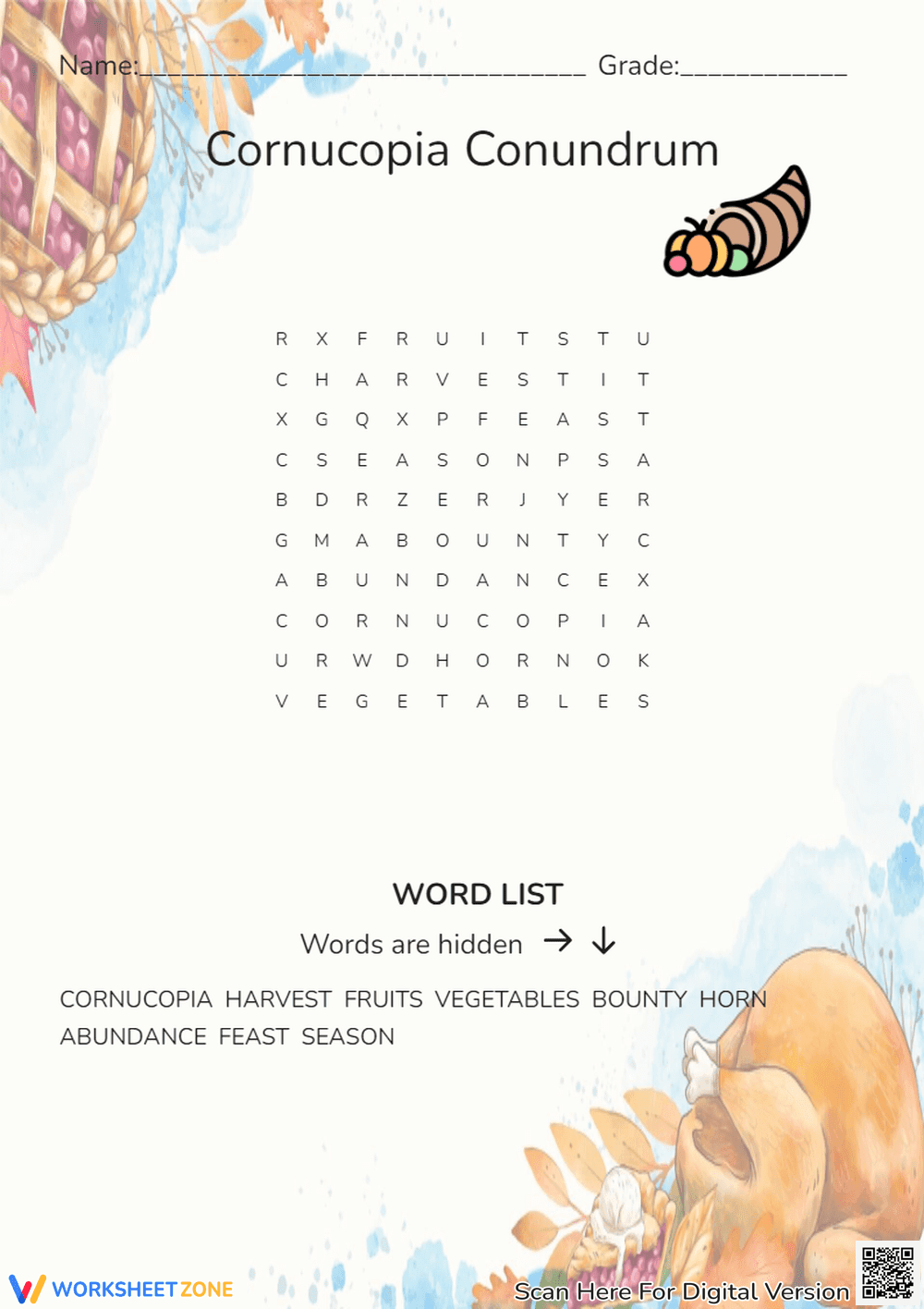

Fall Vocabulary Word Search | Grade 1-3 Essential
Paste this activity's link or code into your existing LMS (Google Classroom, Canvas, Teams, Schoology, Moodle, etc.).
Students can open and work on the activity right away, with no student login required.
You'll still be able to track student progress and results from your teacher account.
This seasonal word search helps students in Grades K-3 master harvest-themed vocabulary through engaging pattern recognition. By identifying words like "abundance" and "cornucopia," learners strengthen their spelling and visual scanning skills while connecting with autumn themes. It provides a focused, quiet activity that reinforces domain-specific language in a festive context.
At a Glance
- Grade: 1-3 · Subject: ELA / Vocabulary
- Standard:
CCSS.ELA-LITERACY.L.2.6— Acquire and use accurately grade-appropriate general academic and domain-specific words- Skill Focus: Fall Vocabulary & Spelling
- Format: 1 page · 10 problems · Answer key included · PDF
- Best For: Morning work or early finishers
- Time: 10–15 minutes
The worksheet features a 10x10 letter grid containing 10 hidden words related to the harvest season. Below the grid, a clear word list provides the targets: cornucopia, harvest, fruits, vegetables, bounty, horn, abundance, feast, and season. The layout is clean and includes festive illustrations of a cornucopia and a turkey, making it visually appealing for young learners.
This resource is designed for a zero-prep classroom workflow. First, print the single-page PDF (30 seconds). Second, distribute the sheets to students as they enter the room or finish a primary task (1 minute). Third, review the word meanings as a whole group to solidify vocabulary acquisition (5 minutes). Total teacher preparation time is under 2 minutes, making it an ideal sub plan addition.
Aligned to `CCSS.ELA-LITERACY.L.2.6`, this activity requires students to "acquire and use accurately grade-appropriate general academic and domain-specific words and phrases." By interacting with these specific terms, students build the lexical foundation necessary for reading complex informational texts about history or science. Both standard codes can be copied directly into lesson plans, IEP goals, or district curriculum mapping tools.
Use this worksheet as a "bell-ringer" during the week of Thanksgiving to settle the class immediately upon arrival. It also serves as an effective formative assessment tool; observe which students struggle with horizontal versus vertical scanning to identify those needing additional visual processing support. Expected completion time ranges from 10 to 15 minutes depending on the grade level.
This activity is tailored for Kindergarten through Grade 3 students, including English Language Learners (ELLs) who benefit from seeing seasonal words in print. It pairs naturally with a read-aloud about the history of the harvest or an anchor chart displaying autumn imagery. The simple interface ensures that even emerging readers can participate with minimal frustration.
Word searches like the Cornucopia Conundrum are more than just filler activities; they are essential tools for orthographic mapping and vocabulary reinforcement. According to Fisher & Frey (2014), purposeful exposure to domain-specific vocabulary in varied contexts—such as the 10 harvest terms found here—is critical for moving words from short-term recognition to long-term academic use. This worksheet aligns with CCSS.ELA-LITERACY.L.2.6 by providing a low-stakes environment for students to interact with complex words like "abundance" and "cornucopia." Research indicates that pattern recognition tasks improve spelling accuracy by forcing students to attend to the internal sequence of letters. By integrating this 1-page PDF into a broader literacy block, educators provide the repeated exposures necessary for lexical mastery. This resource offers a structured way to bridge the gap between seasonal themes and rigorous language standards in the early elementary classroom.


