




























Views
Downloads

Corn Life Cycle Worksheet | Grade 2 Essential Science

Paste this activity's link or code into your existing LMS (Google Classroom, Canvas, Teams, Schoology, Moodle, etc.).
Students can open and work on the activity right away, with no student login required.
You'll still be able to track student progress and results from your teacher account.
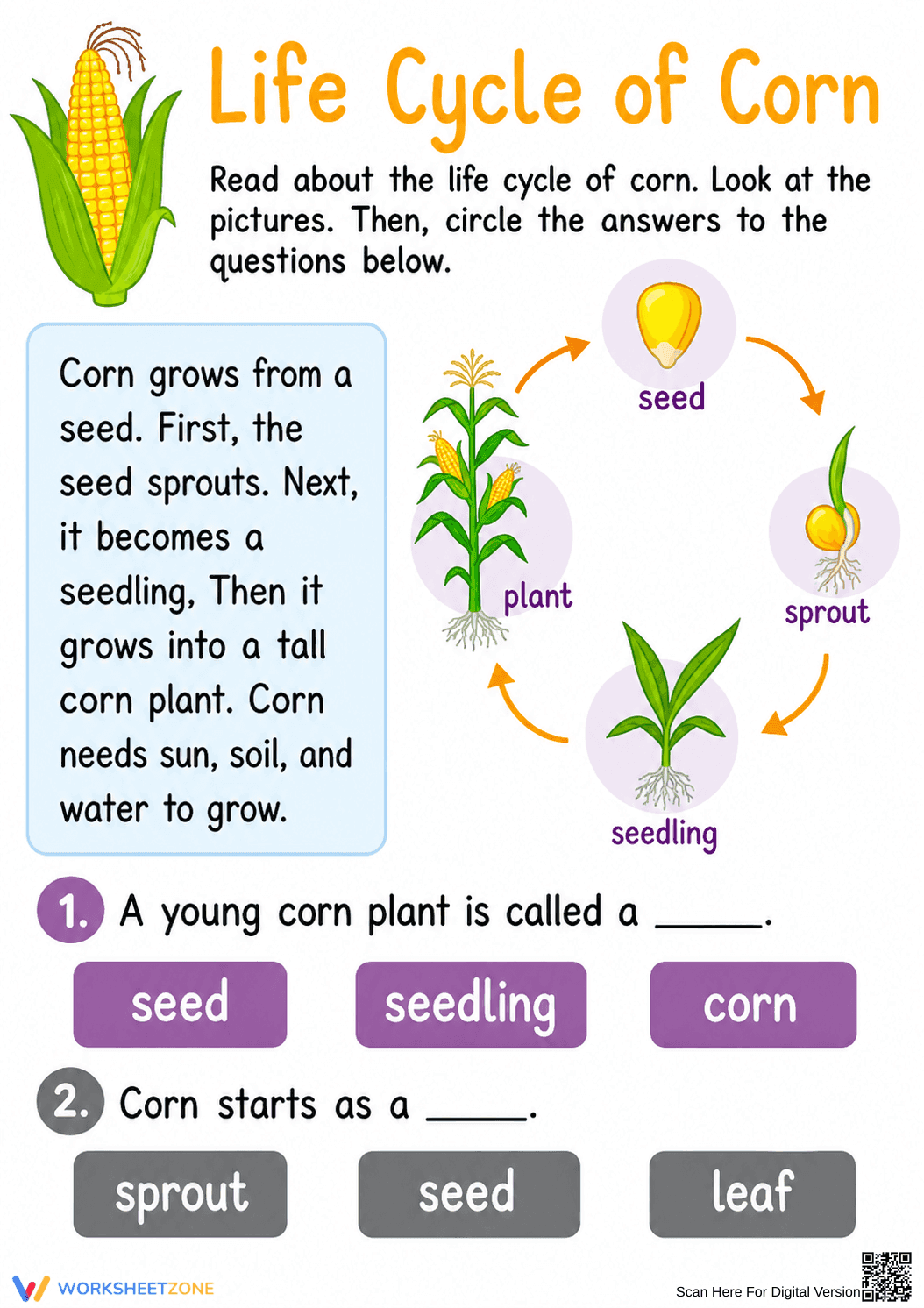
This Grade 2 science worksheet helps students master the biological stages of a plant through the familiar example of corn. By combining a concise reading passage with a visual cycle diagram, learners identify how seeds transform into mature plants. It effectively bridges literacy and life science for early elementary classrooms.
At a Glance
- Grade: 2 · Subject: Science
- Standard:
2-LS1-1— Observe and describe how plants change as they grow and develop- Skill Focus: Plant Life Cycle Stages
- Format: 1 page · 2 problems · Answer key included · PDF
- Best For: Independent practice or science centers
- Time: 10–15 minutes
The worksheet features a high-contrast circular diagram illustrating four distinct stages: seed, sprout, seedling, and mature plant. A dedicated text box provides the necessary context, explaining the requirements for growth like sun, soil, and water. Two multiple-choice questions at the bottom verify that students can distinguish between specific developmental phases.
This resource is designed for a zero-prep classroom workflow. Teachers can print the single-page PDF in less than 30 seconds. Distribution takes 1 minute, and because the instructions are self-explanatory, students can begin immediately. Reviewing the two comprehension questions as a whole group takes approximately 2 minutes, making this an ideal sub plan or warm-up.
This activity aligns with 2-LS1-1, focusing on the observable growth patterns of plants. It also supports CCSS.ELA-LITERACY.RI.2.1 by requiring students to answer questions about a specific text to demonstrate understanding. Both standard codes can be copied directly into lesson plans, IEP goals, or district curriculum mapping tools.
Use this worksheet during the "Explore" phase of a 5E science lesson on botany. It serves as a perfect formative assessment after a seed-planting activity. Teachers should observe if students can correctly sequence the "sprout" and "seedling" stages. Completion typically ranges from 10 to 15 minutes depending on reading fluency.
This is designed for Grade 2 students but is accessible for Grade 1 learners needing a challenge. It is particularly effective for English Language Learners (ELLs) due to the heavy visual scaffolding provided by the labeled diagram. Pair this with a real corn cob or a time-lapse video of plant growth.
According to the RAND AIRS 2024 report, integrating visual diagrams with short informational texts significantly improves retention of scientific vocabulary in early childhood education. This corn life cycle worksheet applies these findings by pairing labeled illustrations with direct reading comprehension tasks. By focusing on the 2-LS1-1 standard, the resource ensures that students are not just memorizing terms but are understanding the functional progression of biological life. Research from Fisher & Frey (2014) suggests that such scaffolded literacy in science helps bridge the gap between abstract concepts and observable reality. This 1-page resource provides the necessary structure for 2nd-grade students to achieve mastery in identifying plant growth requirements and stages. It serves as a reliable tool for teachers looking to implement evidence-based instructional strategies without increasing their preparation time, ensuring that classroom hours are spent on high-quality student engagement rather than administrative setup.


