


























Views
Downloads
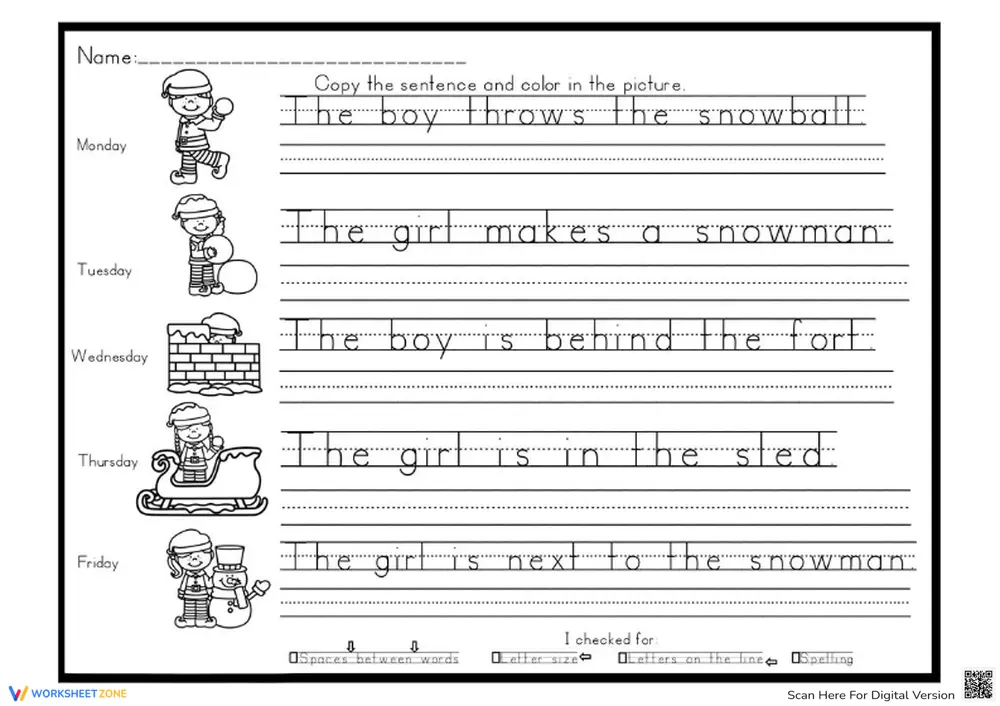

Grade 1 Handwriting — Printable No-Prep Worksheet
Paste this activity's link or code into your existing LMS (Google Classroom, Canvas, Teams, Schoology, Moodle, etc.).
Students can open and work on the activity right away, with no student login required.
You'll still be able to track student progress and results from your teacher account.
This daily handwriting worksheet helps first and second-grade students master sentence copying and letter formation. By tracing and copying five winter-themed sentences, learners build fine motor control, proper spacing, and correct letter alignment on primary lines. The integrated coloring activities maintain high engagement while students practice essential print conventions independently.
At a Glance
- Grade: Grade 1 and Grade 2 · Subject: Daily Handwriting
- Standard:
CCSS.ELA-LITERACY.L.1.1.A— Print all upper- and lowercase letters legibly on lines- Skill Focus: Sentence copying, word spacing, and letter size
- Format: 1 printable page · 5 daily tasks · Self-check checklist · PDF
- Best For: Independent morning work and daily handwriting practice
- Time: 10–15 minutes daily
What's Inside
This single-page PDF features five structured daily handwriting tasks themed around winter activities. Each task provides a clear model sentence in a dotted tracing font, followed by empty primary writing lines for independent copying. To support self-regulation, the bottom of the page includes a student-facing self-check checklist focusing on word spacing, letter size, line alignment, and spelling. Simple black-and-white illustrations accompany each sentence, offering a coloring activity that rewards task completion.
Zero-Prep Workflow
This resource requires zero teacher preparation and is ideal for emergency sub plans. First, print the single-page worksheet, taking less than one minute. Next, distribute the page to students during morning arrival. Finally, review student work using the built-in self-check checklist to guide quick feedback. The entire setup takes under two minutes, allowing you to focus on instruction.
Standards Alignment
This worksheet directly aligns with the Common Core State Standard `CCSS.ELA-LITERACY.L.1.1.A`, which requires students to print all upper- and lowercase letters legibly. Additionally, it supports conventions of standard English capitalization and punctuation under `CCSS.ELA-LITERACY.L.1.2`. Both standard codes can be copied directly into lesson plans, IEP goals, or district curriculum mapping tools.
How to Use It
Use this worksheet as a daily morning warm-up during a winter-themed unit. Introduce the worksheet on Monday, demonstrating how to trace the model sentence before copying it. Alternatively, assign it as an independent center activity during your literacy block. During the activity, observe student pencil grip and letter formation to identify individuals needing targeted intervention. Students typically complete one sentence task in 10 to 15 minutes.
Who It's For
This worksheet is designed for first and second-grade students developing foundational writing skills. It is highly beneficial for English language learners and students receiving occupational therapy services who require structured visual boundaries. Pair this worksheet with a winter-themed read-aloud book or an anchor chart displaying proper letter formation guidelines to reinforce correct handwriting habits.
According to the Fisher & Frey (2014) framework for gradual release of responsibility, structured copying tasks scaffold the transition from guided instruction to independent writing mastery. This worksheet targets standard `CCSS.ELA-LITERACY.L.1.1.A` by providing clear visual models that help early elementary students internalize letter shapes, spacing, and alignment. Research from the ScienceDirect TpT Analysis highlights that integrating fine motor tasks, such as coloring, alongside writing practice significantly increases task persistence and engagement in young learners. By combining tracing, copying, and self-monitoring checklists, this resource reinforces the cognitive motor programs necessary for automaticity in handwriting. Developing automaticity early reduces cognitive load, allowing students to focus more energy on composition and spelling in later grades. This evidence-based design ensures that young students build the foundational legibility skills required for long-term academic success across all subject areas in school.


