


























Views
Downloads
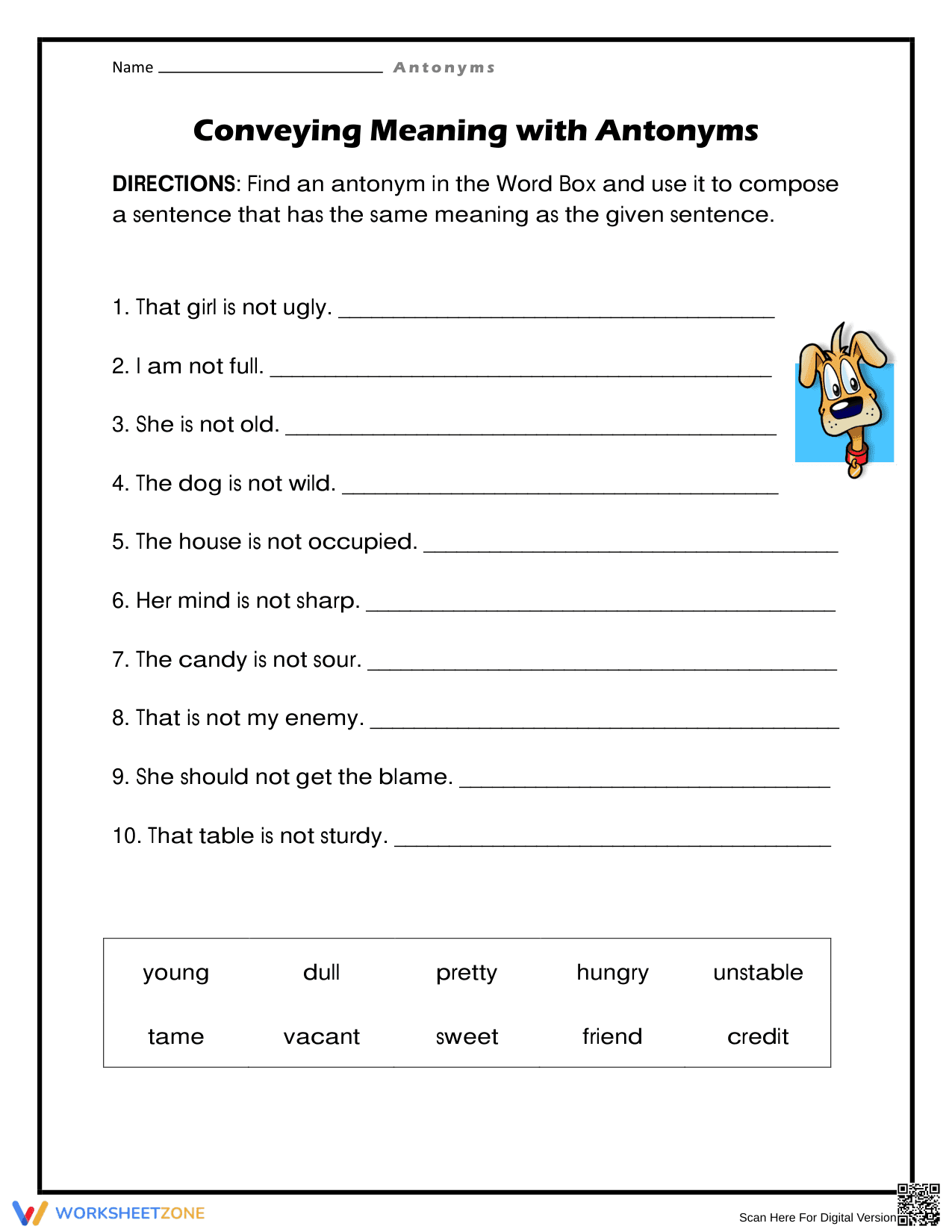

Essential Antonyms Worksheet | Grade 4 ELA Ready
Paste this activity's link or code into your existing LMS (Google Classroom, Canvas, Teams, Schoology, Moodle, etc.).
Students can open and work on the activity right away, with no student login required.
You'll still be able to track student progress and results from your teacher account.
This Grade 4 vocabulary worksheet empowers students to master word relationships by replacing negative constructions with precise antonyms. By rewriting ten targeted sentences, learners move beyond simple identification to active application. This approach ensures students convey intended meaning while expanding their lexicon and improving overall writing clarity.
At a Glance
- Grade: 4 · Subject: English Language Arts
- Standard:
CCSS.ELA-LITERACY.L.4.5.C— Demonstrate understanding of words by relating them to their opposites or antonyms- Skill Focus: Antonyms and Sentence Rewriting
- Format: 1 page · 10 problems · Answer key included · PDF
- Best For: Independent practice or vocabulary review session
- Time: 15–20 minutes
What's Inside
This single-page PDF includes a Word Box with ten sophisticated antonyms like 'vacant' and 'unstable.' Students encounter ten sentences with negative phrases and must select the correct replacement. The layout provides ample space for complete sentence composition, accompanied by a helpful character illustration to engage learners.
Zero-Prep Workflow
This resource is designed for a seamless, zero-prep classroom workflow. 1. Print the single-page PDF (30 seconds). 2. Distribute to students for independent work or as a fast-finisher activity (1 minute). 3. Review using the included answer key for immediate feedback (5 minutes). Total teacher preparation time is under two minutes, making it an ideal choice for emergency sub plans.
Standards Alignment
This worksheet is primarily aligned with CCSS.ELA-LITERACY.L.4.5.C, which requires students to demonstrate understanding of words by relating them to their opposites. It also supports CCSS.ELA-LITERACY.L.4.3.A by encouraging students to choose words and phrases to convey ideas precisely. Both standard codes can be copied directly into lesson plans, IEP goals, or district curriculum mapping tools.
How to Use It
Use this worksheet as a formative assessment after an introductory lesson on antonyms. Observe students as they work; those struggling to pair 'occupied' with 'not vacant' may require additional scaffolded practice with concrete objects. The expected completion time is approximately 15 to 20 minutes, making it a perfect transition activity before moving into creative writing sessions.
Who It's For
This activity is designed for Grade 4 students but is highly effective for Grade 3 enrichment or Grade 5 remedial support. It is particularly beneficial for English Language Learners who are developing a sense of word nuance. Pair this resource with a short informational passage or an anchor chart displaying common prefix-based opposites to provide students with a comprehensive linguistic toolkit.
According to a RAND AIRS 2024 analysis, structured vocabulary practice that requires active sentence reconstruction significantly improves long-term retention compared to simple matching tasks. This worksheet addresses the CCSS.ELA-LITERACY.L.4.5.C standard by forcing students to process the semantic relationship between a negative phrase and its single-word antonym. By engaging with words like 'vacant' and 'unstable' within a specific context, students build the cognitive bridges necessary for reading comprehension and precise writing. Research indicates that when students can accurately relate words to their opposites, they demonstrate a higher level of language proficiency across all ELA strands. This resource provides the necessary repetition and application for mastery, ensuring that students can move from basic recognition to the sophisticated use of antonyms in their own academic compositions.


