


























Views
Downloads



Essential Fraction Decimal Percent Ratio Conversion Worksheet
Paste this activity's link or code into your existing LMS (Google Classroom, Canvas, Teams, Schoology, Moodle, etc.).
Students can open and work on the activity right away, with no student login required.
You'll still be able to track student progress and results from your teacher account.
This comprehensive Grade 7 math worksheet empowers students to master the fluid conversion between fractions, decimals, percents, and ratios. By practicing with 45 varied problems, learners build the numerical fluency required for high-school algebra and real-world statistical analysis. Students will confidently translate repeating decimals and complex ratios into simplified fractional forms.
At a Glance
- Grade: 7 · Subject: Math
- Standard:
CCSS.MATH.CONTENT.7.NS.A.2.D— Convert rational numbers to decimals and recognize terminating or repeating patterns accurately- Skill Focus: Multi-way unit conversion
- Format: 4 pages · 45 problems · Answer key included · PDF
- Best For: Middle school independent practice and assessment
- Time: 40–50 minutes
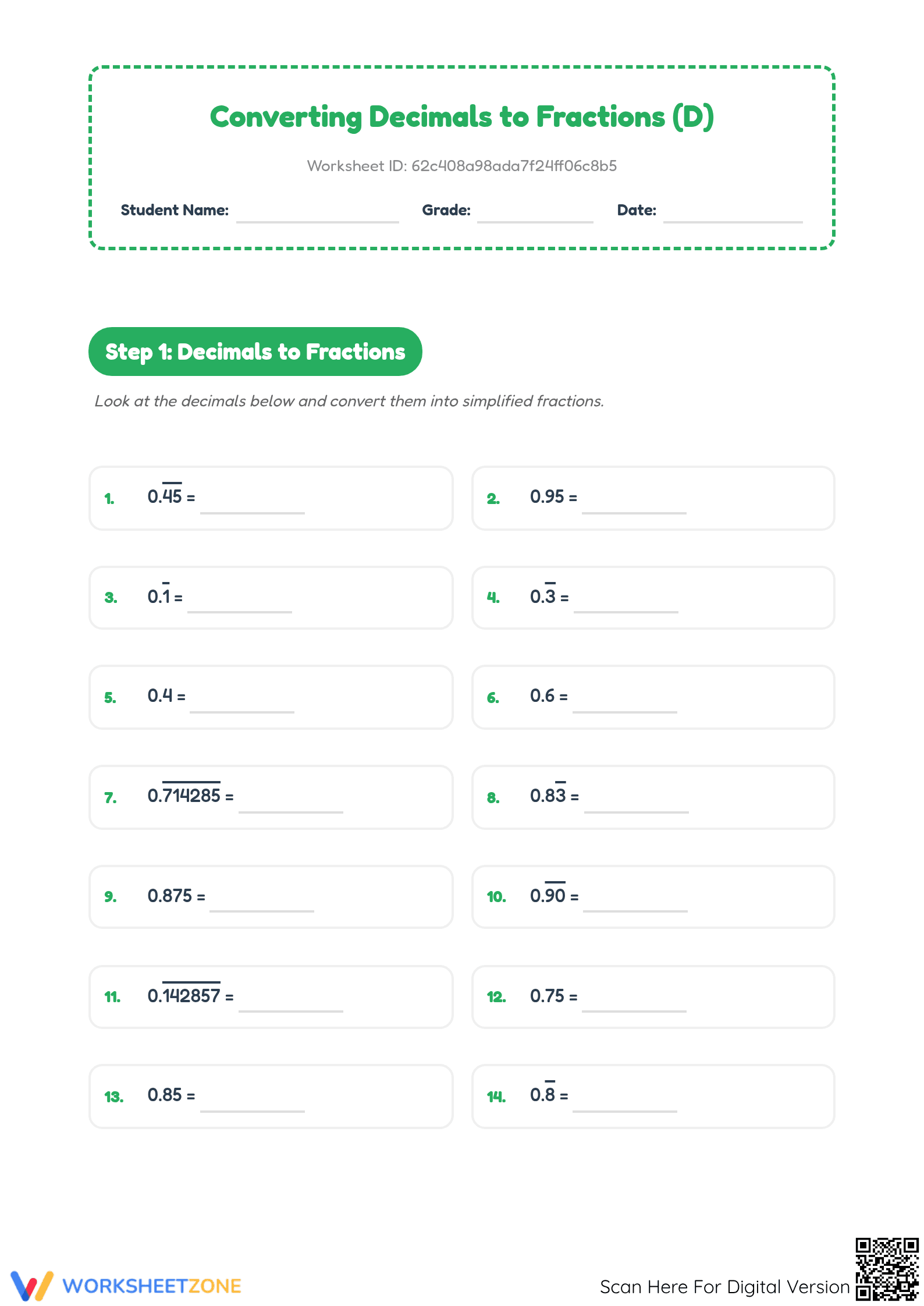
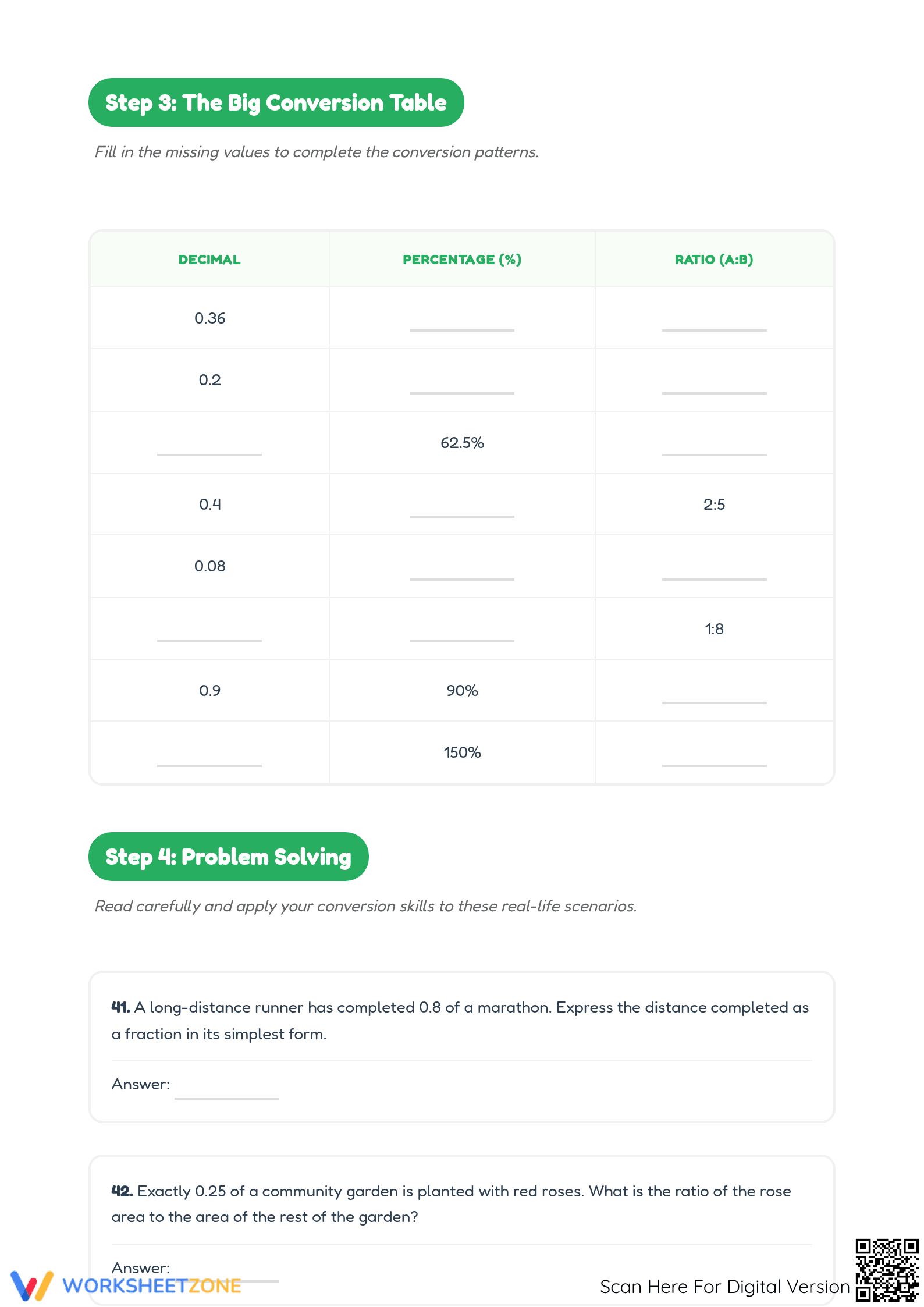
This four-page resource features a structured progression of 45 mathematical tasks. It begins with 20 decimal-to-fraction conversions, including challenging repeating decimals marked with vinculum bars. The second section provides 10 fraction-to-decimal problems. A large-scale "Big Conversion Table" requires students to fill in missing values across three units, followed by five real-world word problems to apply these skills in context.
Skill Progression
- Guided practice: The first 20 problems provide clear placeholders for simplified fractions, focusing on the mechanic of identifying place value and handling repeating digits.
- Supported practice: The conversion table offers partially filled rows, allowing students to use whichever unit they find easiest as a bridge to the others.
- Independent practice: Five rigorous word problems require students to extract data from scenarios involving sports, gardening, and taxes before performing the necessary conversions independently.
This gradual-release model ensures students move from rote calculation to conceptual application.
Standards Alignment
The worksheet is primary aligned to `CCSS.MATH.CONTENT.7.NS.A.2.D`: "Convert a rational number to a decimal using long division; know that the decimal form of a rational number terminates in 0s or eventually repeats." It also supports ratio understanding within the 6.RP and 7.RP domains. Both standard codes can be copied directly into lesson plans, IEP goals, or district curriculum mapping tools.
How to Use It
Use this worksheet as a summative assessment following a unit on rational numbers to gauge mastery of terminating and repeating decimals. Alternatively, assign it as a challenge packet for early finishers who need more depth in multi-unit conversions. Teachers should observe students during the word problem section to identify if errors stem from calculation or reading comprehension.
Who It's For
This resource is designed for Grade 7 and 8 students, though it serves as excellent remediation for high schoolers or enrichment for advanced Grade 6 learners. It pairs naturally with an anchor chart on common fraction-decimal equivalencies or a direct instruction lesson on the division method for converting fractions.
Mathematical proficiency in middle school is heavily dependent on the ability to move flexibly between different representations of numbers. According to the RAND AIRS 2024 report, students who struggle with fraction-decimal-percent conversions often face significant barriers in later algebraic reasoning and data interpretation. This worksheet addresses this critical gap by providing 45 structured opportunities to practice `CCSS.MATH.CONTENT.7.NS.A.2.D`, including the often-overlooked skill of identifying and representing repeating decimals. By integrating ratios and real-world tax and distance scenarios, the resource ensures that the abstract skill of unit conversion is grounded in practical application. Research from Fisher & Frey (2014) emphasizes that "numerical agility" developed through such multi-way conversion tasks is a primary predictor of success in secondary mathematics. This PDF provides the high-volume, scaffolded practice necessary to transition students from procedural knowledge to fluent, conceptual mastery of rational number systems.


