


























Views
Downloads

Converting Fractions Decimals Percents | Essential Grade 6
Paste this activity's link or code into your existing LMS (Google Classroom, Canvas, Teams, Schoology, Moodle, etc.).
Students can open and work on the activity right away, with no student login required.
You'll still be able to track student progress and results from your teacher account.
This Grade 6 math worksheet empowers students to master the conversion between fractions, decimals, percents, and ratios. Through 14 structured tasks, learners build the mental flexibility required to navigate diverse mathematical representations accurately. Mastering these core competencies ensures a smoother transition into advanced proportional reasoning and complex algebraic problem-solving.
At a Glance
- Grade: 6 · Subject: Math — Fractions
- Standard:
CCSS.MATH.CONTENT.6.RP.A.3— Use ratio and rate reasoning to solve real-world and mathematical problems- Skill Focus: Multi-format rational number conversion
- Format: 4 pages · 14 problems · Answer key included · PDF
- Best For: Independent practice or formative assessment
- Time: 25–35 minutes
What's Inside
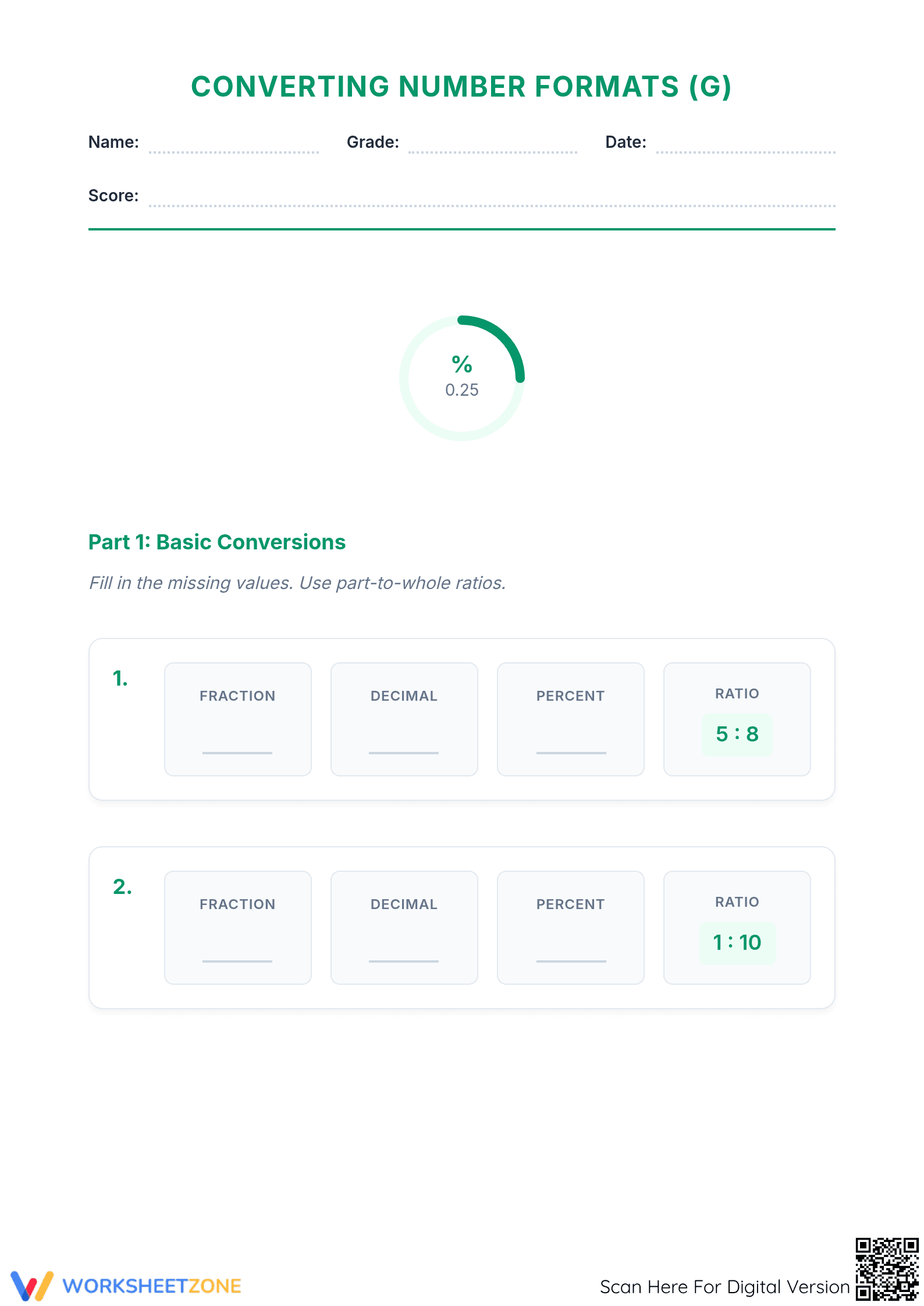
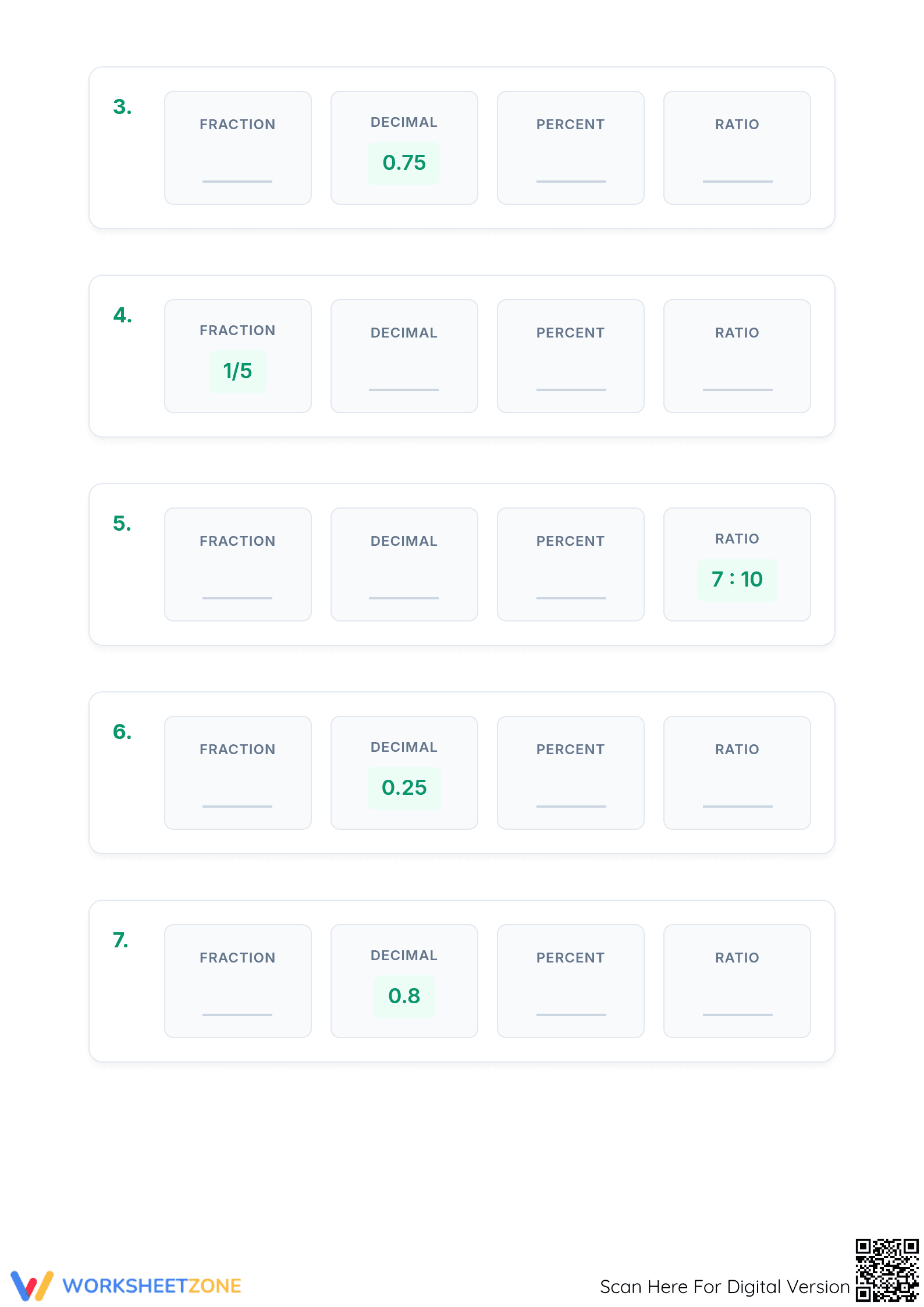
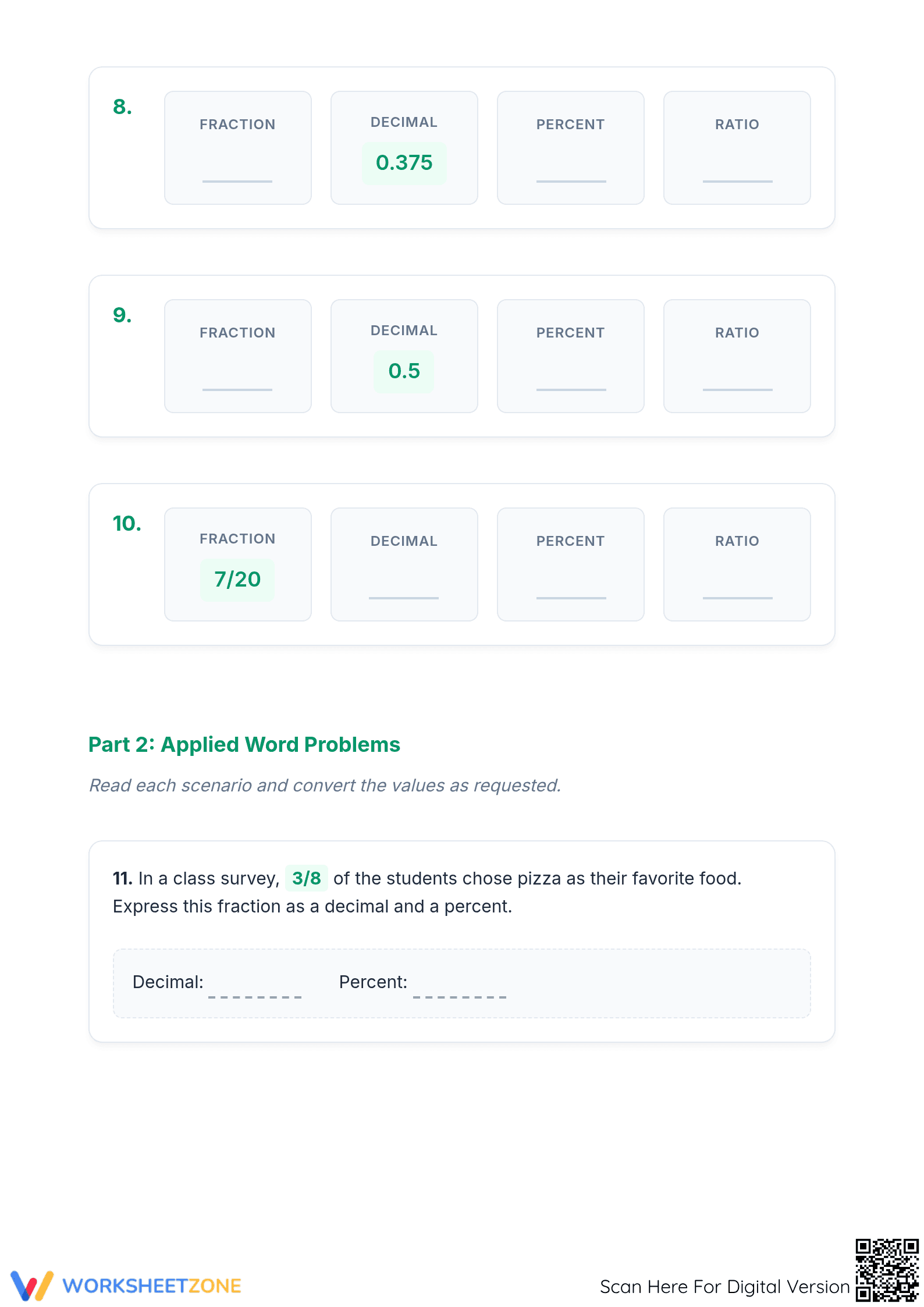
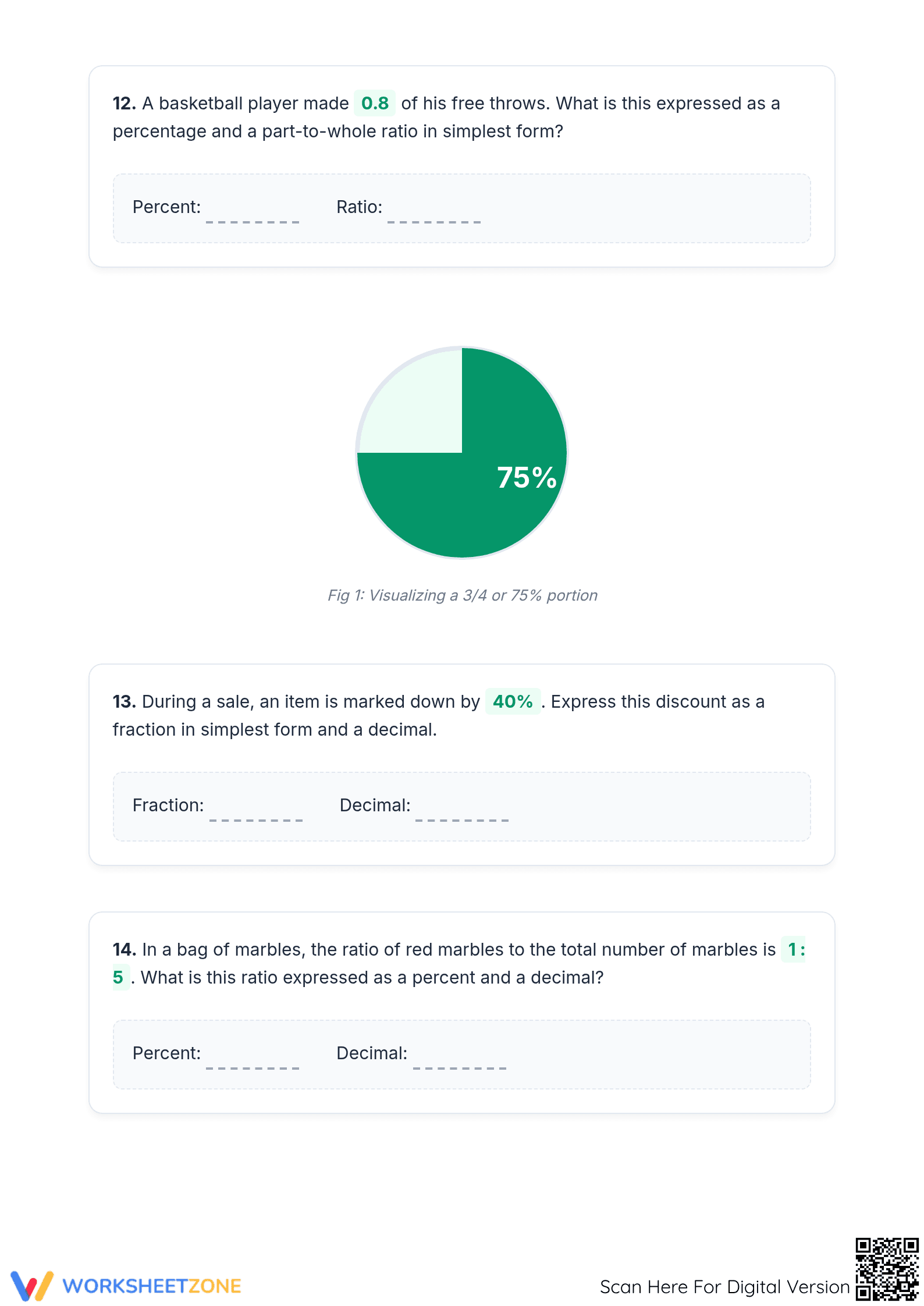
This four-page PDF contains ten basic conversion tables and four applied word problems. Students receive one numerical format and must calculate the remaining three equivalents. The document features dedicated fields for name and score, plus a comprehensive answer key to facilitate rapid teacher grading or student self-correction during independent study sessions.
Skill Progression
- Guided Practice: Two initial problems provide a starting value to help students focus on basic conversion mechanics without overwhelming calculation demands.
- Supported Practice: Problems three through ten vary the provided format, testing students' ability to recall different conversion rules for eight consecutive tasks.
- Independent Application: Four word problems require students to extract data from scenarios and convert values without any visual scaffolds or hints.
This approach follows a gradual-release model moving from procedural fluency to conceptual application.
Standards Alignment
This resource aligns with CCSS.MATH.CONTENT.6.RP.A.3, focusing on using ratio reasoning to solve mathematical problems. Specifically, it targets sub-standard 3.c regarding percent representations. This standard code can be copied directly into lesson plans, IEP goals, or district curriculum mapping tools to ensure instructional alignment with state and national frameworks.
How to Use It
Use this worksheet mid-unit to gauge progress. For a formative tip, observe students solving word problems that require simplest-form ratios to identify who needs extra support with greatest common factors. Completion typically takes 25 to 35 minutes. It is an ideal resource for homework, classwork, or a quiet assessment.
Who It's For
This tool is perfect for Grade 6 students but also works for Grade 7 or 8 intervention. It pairs naturally with a visual anchor chart or a direct instruction lesson on proportional relationships. The clear layout supports students who benefit from an organized workspace and repetitive practice structures.
Rational number fluency is a cornerstone of middle school mathematics, serving as the bridge between elementary arithmetic and algebraic reasoning. According to Fisher & Frey (2014), the ability to translate between multiple representations—fractions, decimals, percents, and ratios—demonstrates a deep conceptual understanding of proportional relationships. This worksheet facilitates this mental flexibility by presenting 14 varied tasks that require students to recognize equivalent values across different formats. Research suggests that students who master these conversions early are significantly better prepared for complex topics such as probability, statistical analysis, and linear functions. By providing both isolated practice and applied word problems, this resource ensures that Grade 6 learners can apply their skills in real-world contexts. Educators can use this data to identify specific gaps in number sense, allowing for targeted intervention before moving toward higher-order mathematical modeling. The inclusion of a clear answer key supports immediate feedback and self-correction strategies.


