


























Views
Downloads

Essential Number Format Conversion Worksheet | Grade 6
Paste this activity's link or code into your existing LMS (Google Classroom, Canvas, Teams, Schoology, Moodle, etc.).
Students can open and work on the activity right away, with no student login required.
You'll still be able to track student progress and results from your teacher account.
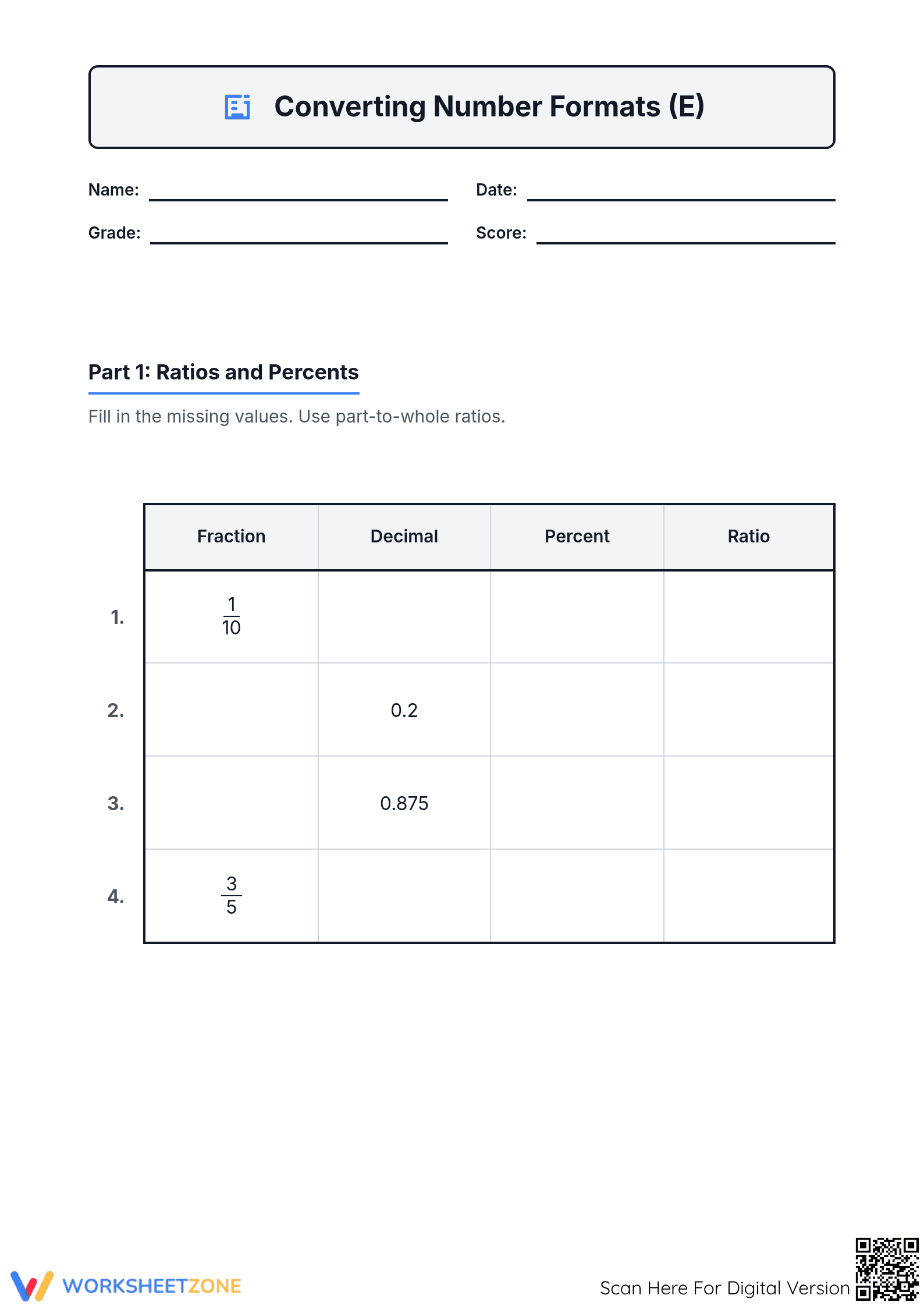
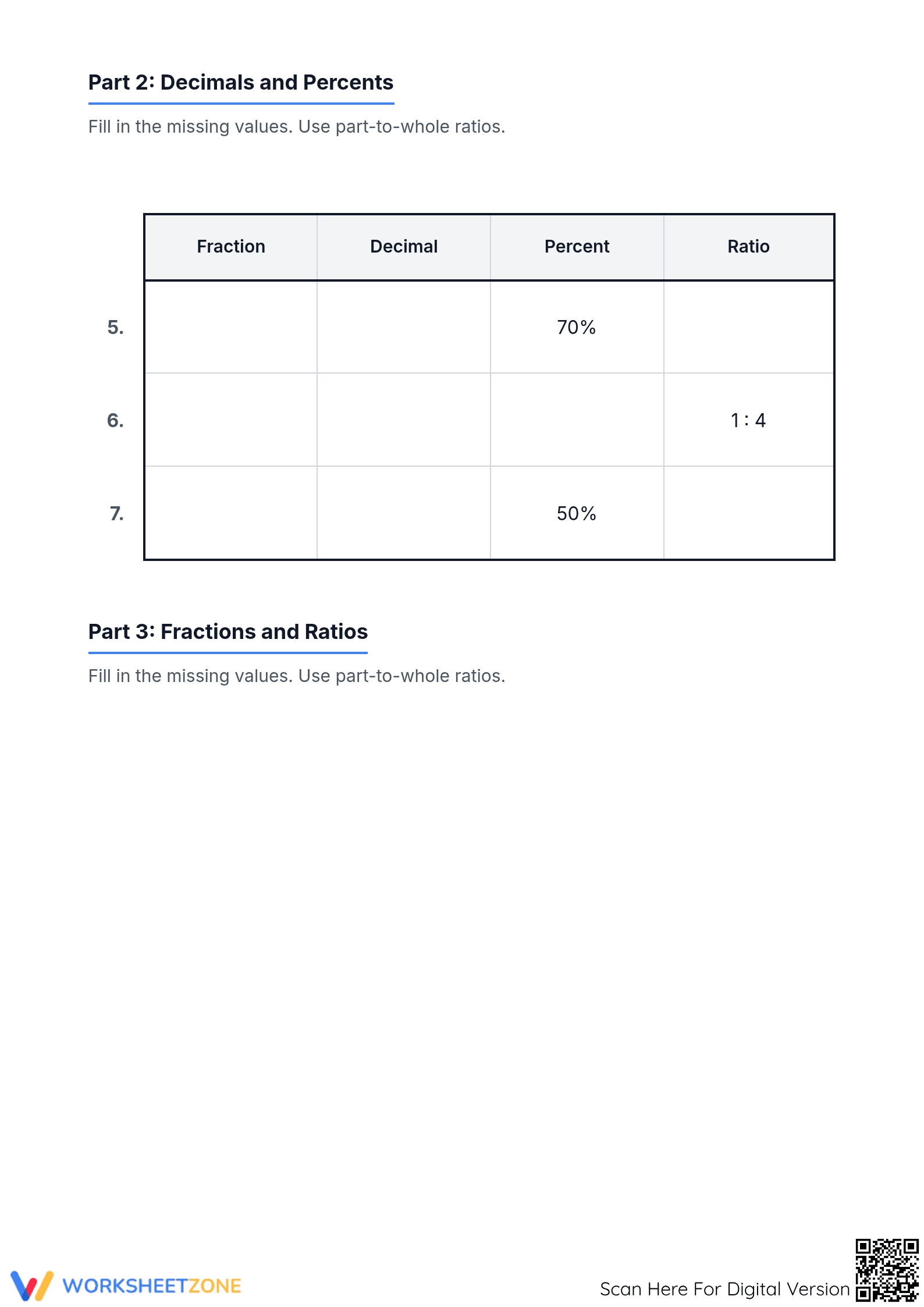
Mastering the relationship between different number formats is a cornerstone of middle school mathematics. This worksheet provides a structured environment for students to practice converting between fractions, decimals, percents, and ratios, ensuring they can fluidly move between representations to solve complex problems. By completing these 12 targeted exercises, learners build the conceptual flexibility required for success in algebra and real-world statistical analysis.
At a Glance
- Grade: 6 · Subject: Math
- Standard:
CCSS.MATH.CONTENT.6.RP.A.3.c— Convert between fractions, decimals, and percents to solve rate and ratio problems- Skill Focus: Multi-format numerical equivalency
- Format: 3 pages · 12 problems · Answer key included · PDF
- Best For: Independent practice or emergency sub plans
- Time: 25–35 minutes
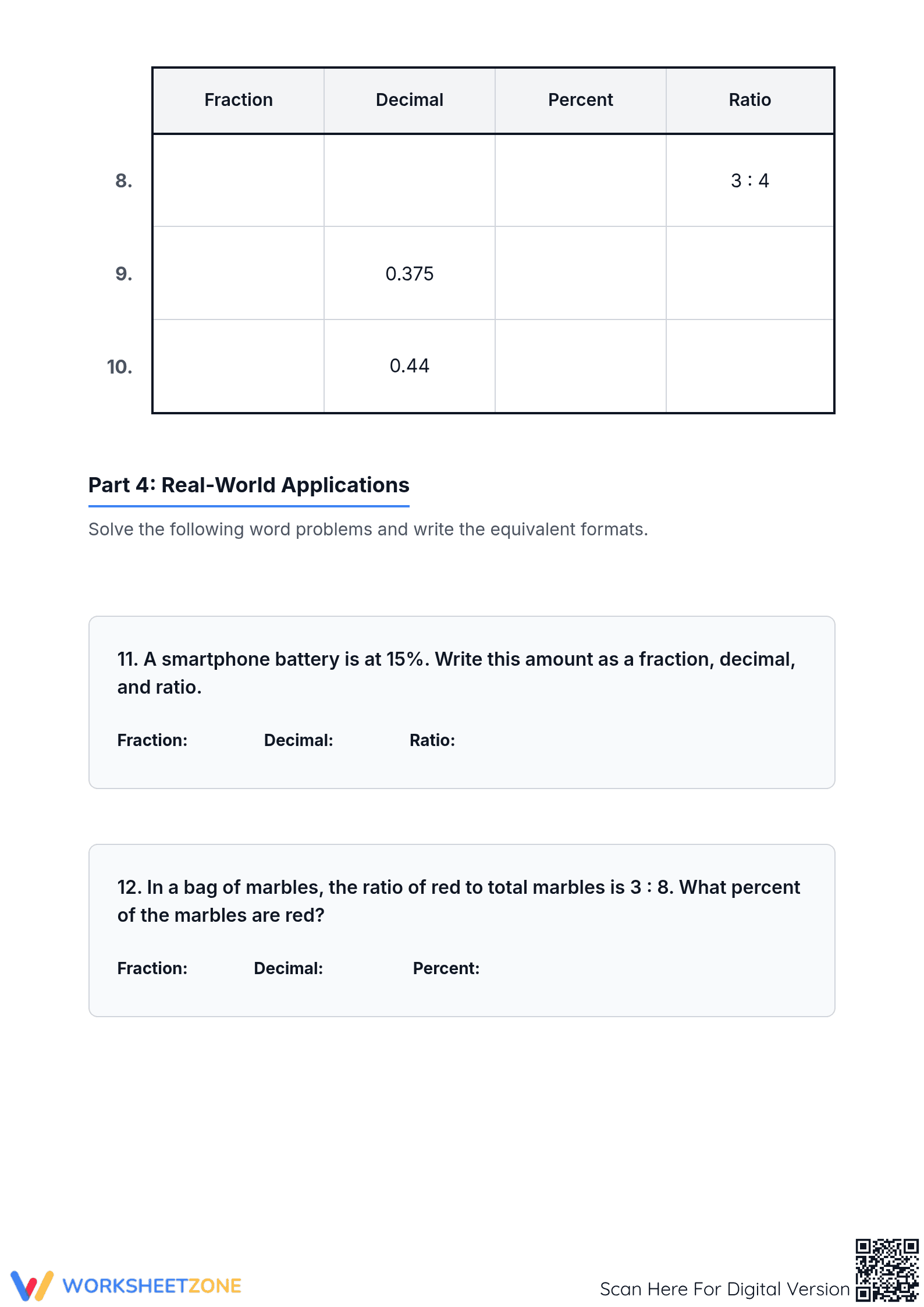
What's Inside: This comprehensive 3-page practice set features 10 table-based conversion challenges where students fill in missing values across four distinct formats. The final section includes 2 real-world word problems that require students to apply their conversion skills to practical scenarios, such as battery life percentages and marble ratios. A full answer key is provided for rapid grading or student self-correction.
Zero-Prep Workflow: This resource is designed for maximum teacher efficiency. Simply print the 3-page PDF (approx. 30 seconds), distribute to your class (approx. 1 minute), and use the included answer key for a streamlined review session (approx. 5 minutes). The clear instructions and worked headers make this an ideal candidate for sub plans, requiring zero additional teacher explanation or setup time.
Standards Alignment: This worksheet directly supports `CCSS.MATH.CONTENT.6.RP.A.3.c`, which requires students to find a percent of a quantity as a rate per 100 and solve problems involving finding the whole, given a part and the percent. It also reinforces ratio reasoning throughout all four parts. This standard code can be copied directly into lesson plans, IEP goals, or district curriculum mapping tools.
How to Use It: Assign this worksheet during the independent practice phase of a lesson after students have been introduced to the basic mechanics of percent-to-decimal movement. It serves as an excellent formative assessment tool; observe students during Part 1 to identify if they struggle specifically with the ratio format versus the decimal format. Expected completion time for most sixth graders is 30 minutes.
Who It's For: This resource is primarily designed for Grade 6 students but is highly effective for Grade 7-8 students requiring remediation in rational number fluency. It pairs naturally with a lesson on part-to-whole relationships or a classroom anchor chart detailing common fraction-decimal equivalents. The layout provides ample white space for students who need room for scratch work.
Research indicates that fluency in converting between fractions, decimals, and percents is a significant predictor of later success in high school algebra and proportional reasoning tasks. According to Fisher & Frey (2014), providing students with structured opportunities to translate across multiple mathematical representations strengthens their cognitive schema and allows for deeper conceptual understanding. This worksheet employs a gradual release of responsibility, moving from scaffolded table entries to independent application in word problems. By targeting CCSS.MATH.CONTENT.6.RP.A.3.c, the resource ensures that students are meeting rigorous national benchmarks for ratio and rate reasoning. The inclusion of a part-to-whole ratio column specifically addresses common misconceptions regarding the relationship between ratios and traditional fractions. Such targeted practice is essential for bridging the gap between basic arithmetic and the abstract reasoning required in higher-level mathematics courses and standardized testing environments.


