


























Views
Downloads


Essential Fraction Decimal Percent Conversion Worksheet
Paste this activity's link or code into your existing LMS (Google Classroom, Canvas, Teams, Schoology, Moodle, etc.).
Students can open and work on the activity right away, with no student login required.
You'll still be able to track student progress and results from your teacher account.
This comprehensive Grade 6 math worksheet provides students with targeted practice in converting between fractions, decimals, percents, and ratios. By bridging these four numeric forms, learners develop a deep conceptual understanding of equivalence. This resource ensures students can fluidly transition between representations to solve mathematical problems with precision and confidence.
At a Glance
- Grade: 6 · Subject: Math
- Standard:
CCSS.MATH.CONTENT.6.RP.A.3— Use ratio and rate reasoning to solve real-world and mathematical problems- Skill Focus: Multi-way numeric conversion
- Format: 4 pages · 30 problems · Answer key included · PDF
- Best For: Independent practice and formative assessment
- Time: 35–50 minutes
What's Inside
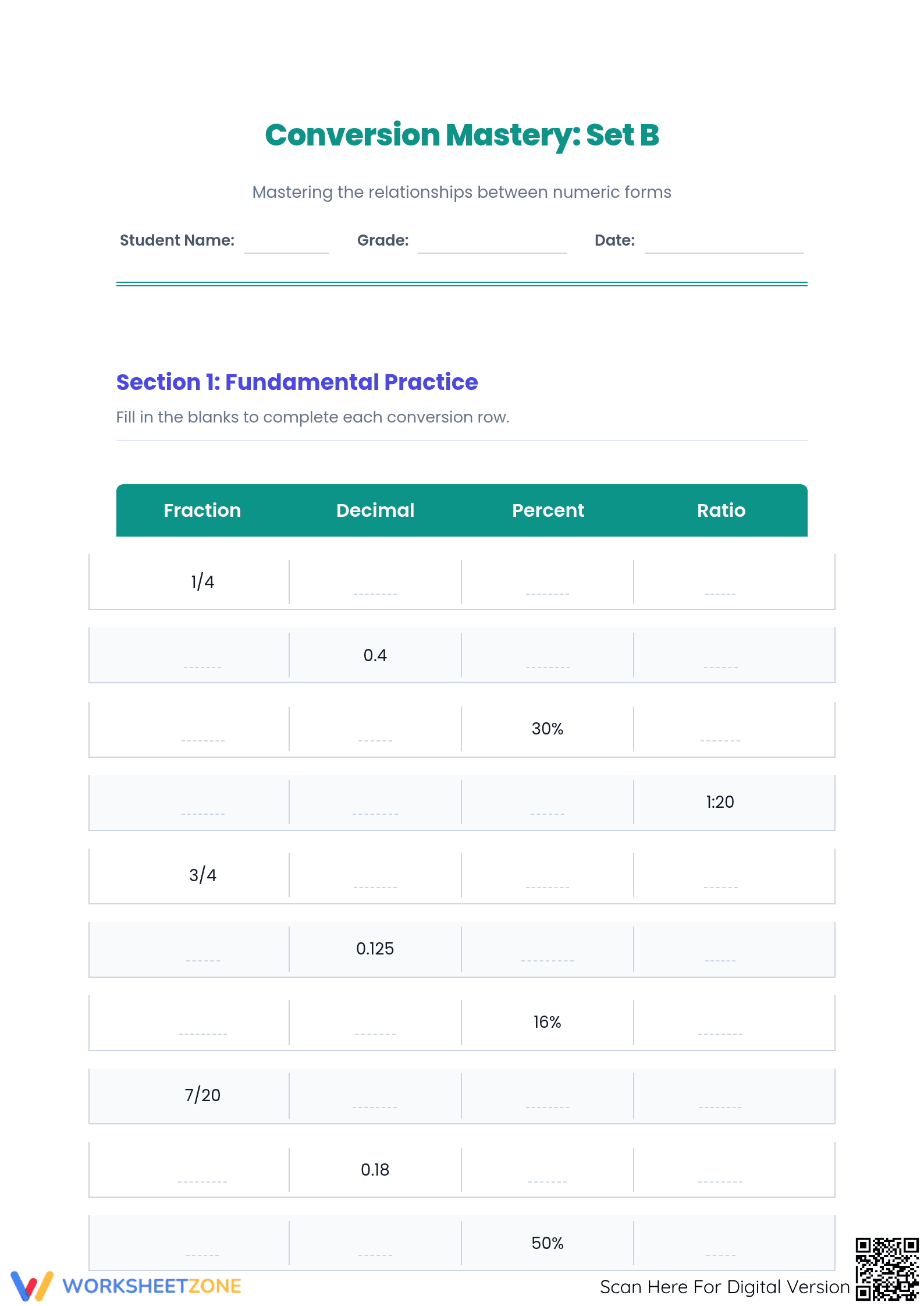
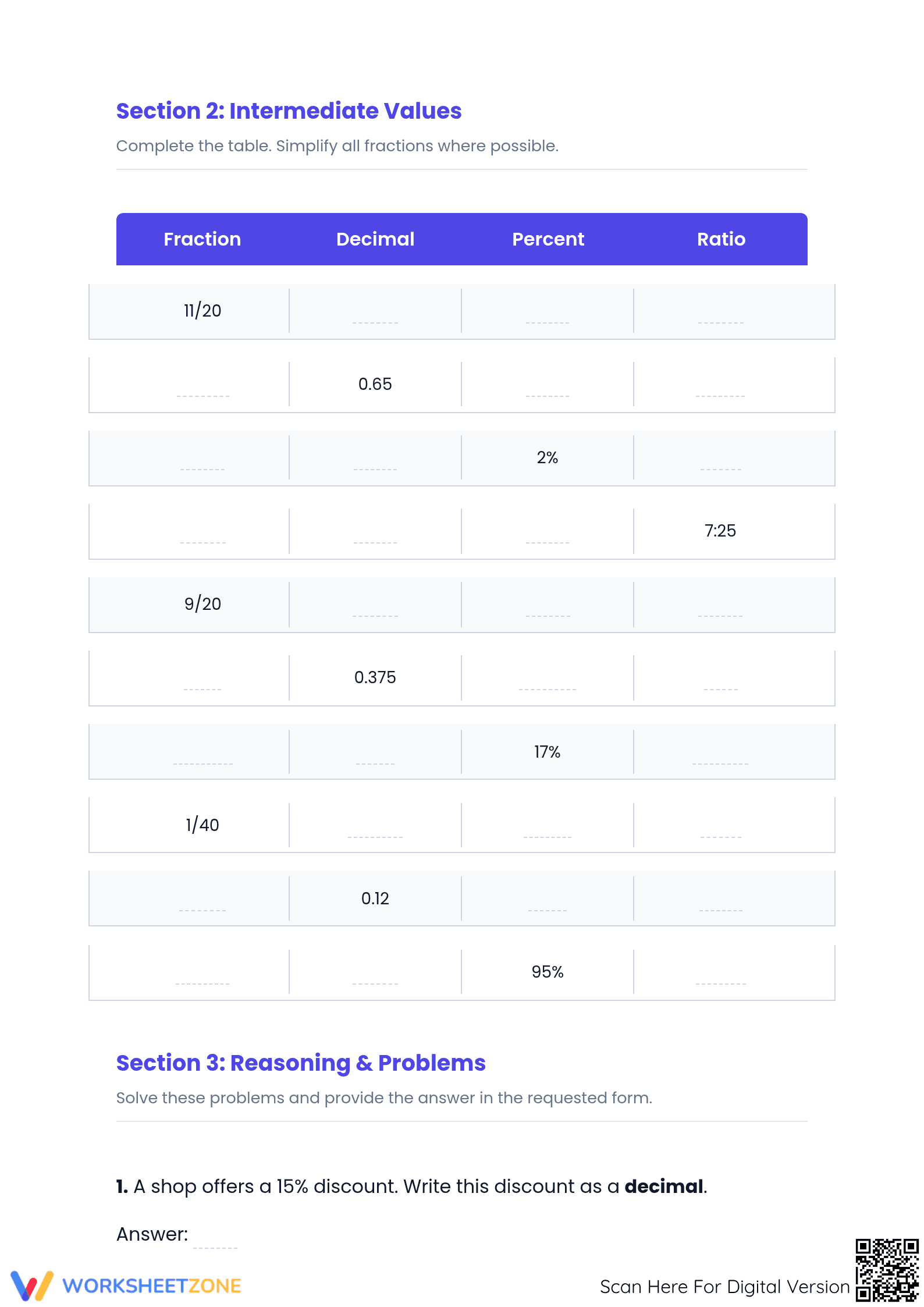
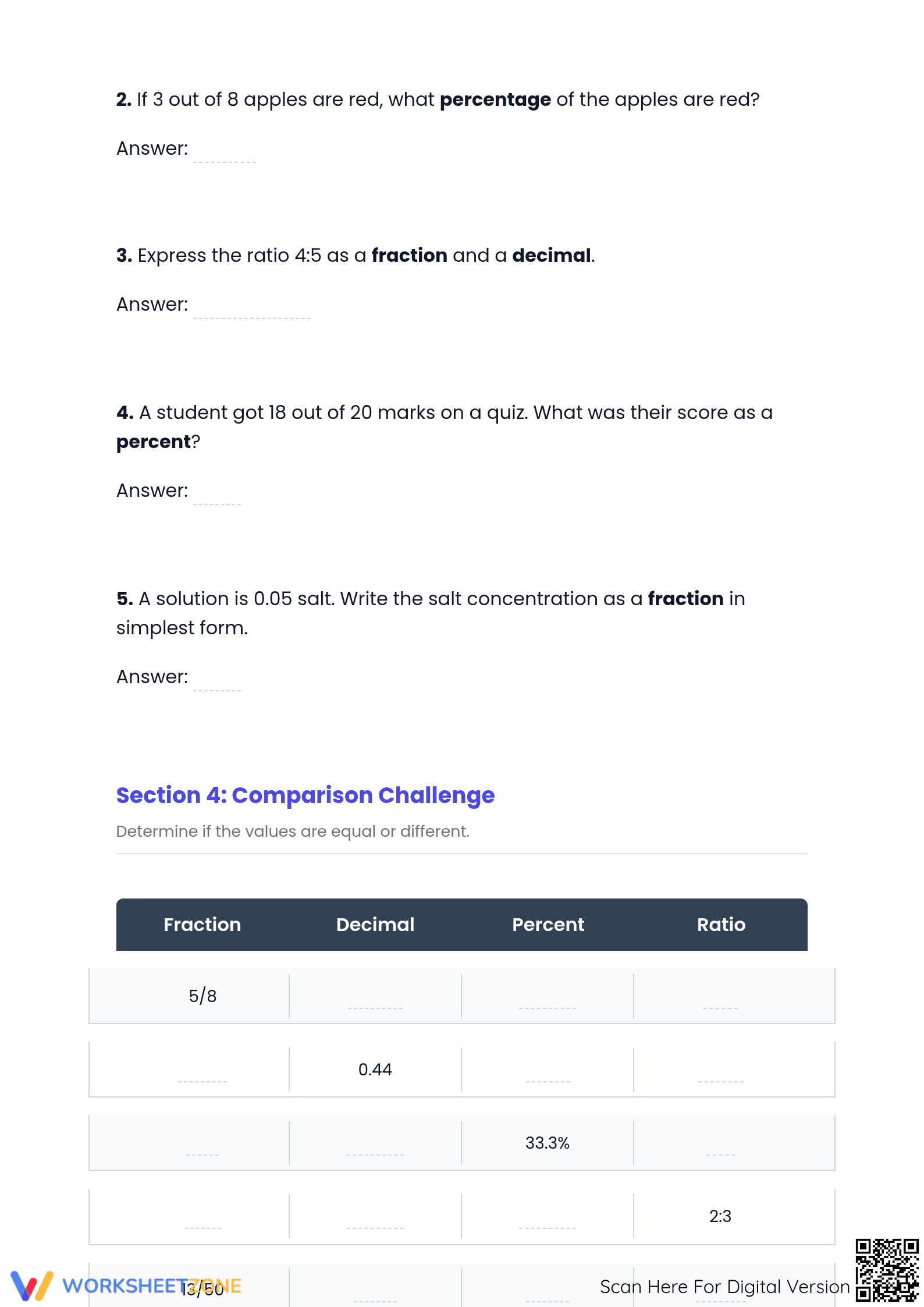
Across four structured pages, students encounter a variety of task types designed to reinforce conversion skills. The worksheet features extensive completion tables for fundamental and intermediate values, requiring students to fill in missing fractions, decimals, percents, and ratios. Additionally, the set includes five real-world word problems and a comparison challenge section, supported by a full answer key for efficient grading and self-correction.
Skill Progression
- Guided Practice: The first section provides 10 fundamental rows where one value is given, prompting students to determine the remaining three forms. This establishes the basic mechanics of moving between hundredths-based percents and decimals.
- Supported Practice: Section two introduces 9 intermediate rows with more complex denominators like 20 and 40. Students must simplify fractions where possible, increasing the cognitive demand for equivalence checking.
- Independent Practice: The final sections provide 5 word problems and 6 comparison rows. Students must apply their knowledge to scenarios like retail discounts and quiz scores, demonstrating an ability to synthesize conversion rules without visual scaffolding.
This gradual-release approach follows the I Do, We Do, You Do model to ensure student success.
Standards Alignment
The primary focus is `CCSS.MATH.CONTENT.6.RP.A.3`, which requires students to use ratio and rate reasoning to solve problems. This includes finding a percent of a quantity as a rate per 100 and representing ratios in multiple forms. Both standard codes can be copied directly into lesson plans, IEP goals, or district curriculum mapping tools.
How to Use It
Deploy this worksheet during the final phase of a lesson on rational number equivalence to monitor individual student progress. It also serves as an excellent formative assessment tool; teachers can observe whether students struggle more with decimal-to-percent shifts or simplifying complex ratios. Expected completion time ranges from 35 to 50 minutes depending on prior knowledge.
Who It's For
This resource is designed for Grade 6 students but is highly effective for Grade 7 and 8 remediation. It pairs naturally with a visual fraction wall or a percent-to-decimal anchor chart during direct instruction to support students who require additional visual scaffolds.
Research from EdReports (2024) emphasizes that mathematical fluency is best achieved through the integrated study of rational number representations rather than isolated skill drills. This worksheet aligns with those findings by requiring students to move fluidly between four distinct numeric forms—fractions, decimals, percents, and ratios—to satisfy CCSS.MATH.CONTENT.6.RP.A.3. By forcing the simultaneous consideration of these forms, the resource helps dismantle common student misconceptions, such as treating percents as whole numbers rather than ratios of 100. The 30 tasks provided here offer the necessary repetition for cognitive automaticity while maintaining a high level of engagement through varied problem structures. This balanced approach ensures that students do not merely memorize conversion algorithms but instead build a durable mental model of numeric equivalence that supports higher-order algebraic thinking in later grades.


