


























Views
Downloads

Essential Fraction Decimal Percent Conversion Worksheet
Paste this activity's link or code into your existing LMS (Google Classroom, Canvas, Teams, Schoology, Moodle, etc.).
Students can open and work on the activity right away, with no student login required.
You'll still be able to track student progress and results from your teacher account.
Mastering the relationship between rational numbers is a cornerstone of middle school mathematics. This worksheet provides a systematic approach to converting between fractions, decimals, and percents, ensuring students can fluidly transition between representations to solve complex statistical problems and real-world calculations. It emphasizes the part-to-whole relationship necessary for algebraic readiness.
At a Glance
- Grade: 6 · Subject: Math
- Standard:
6.RP.A.3.C— Find a percent of a quantity as a rate per 100- Skill Focus: Multi-way rational number conversions
- Format: 4 pages · 41 problems · Answer key included · PDF
- Best For: Individual practice and fluency building
- Time: 30–45 minutes
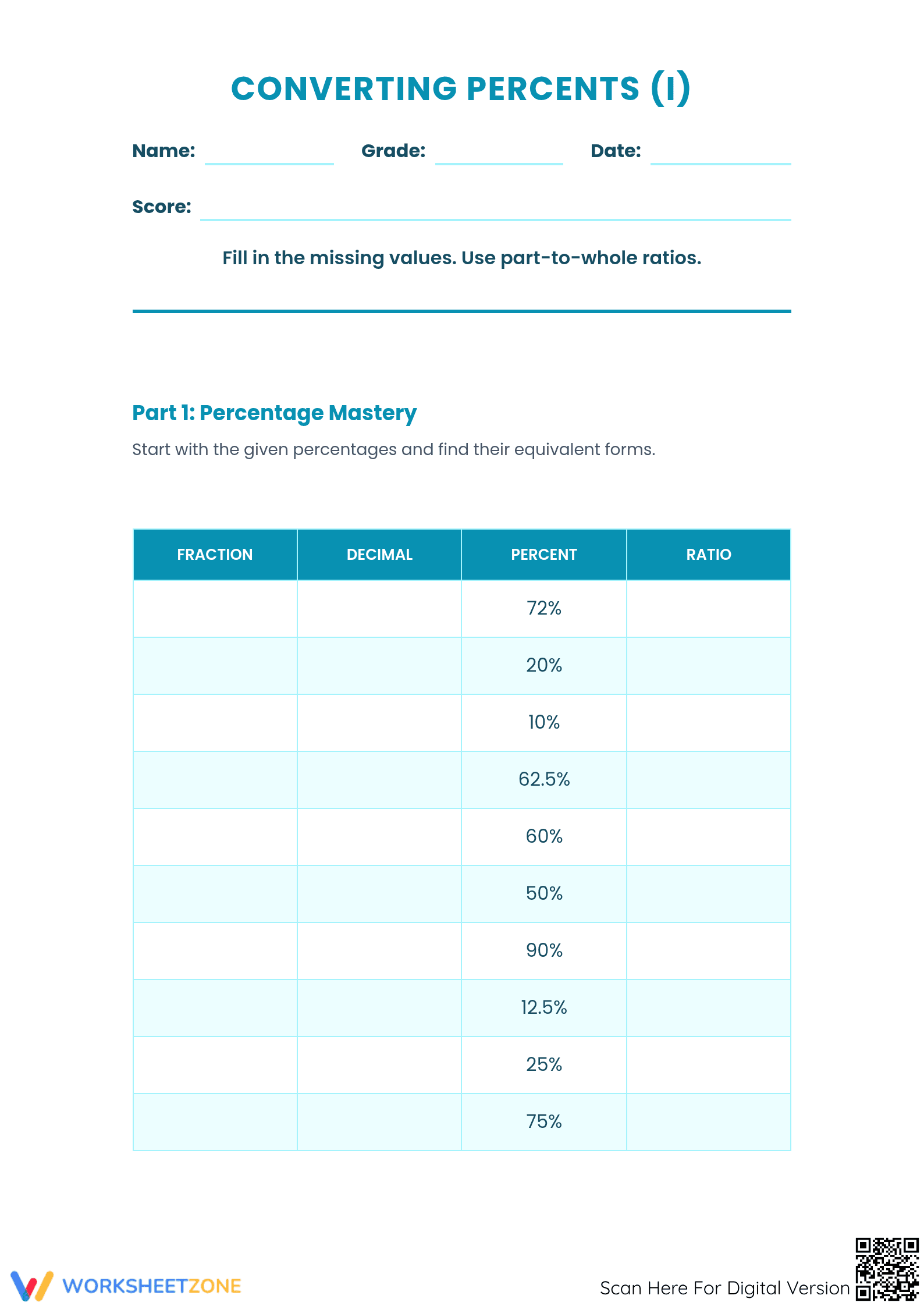
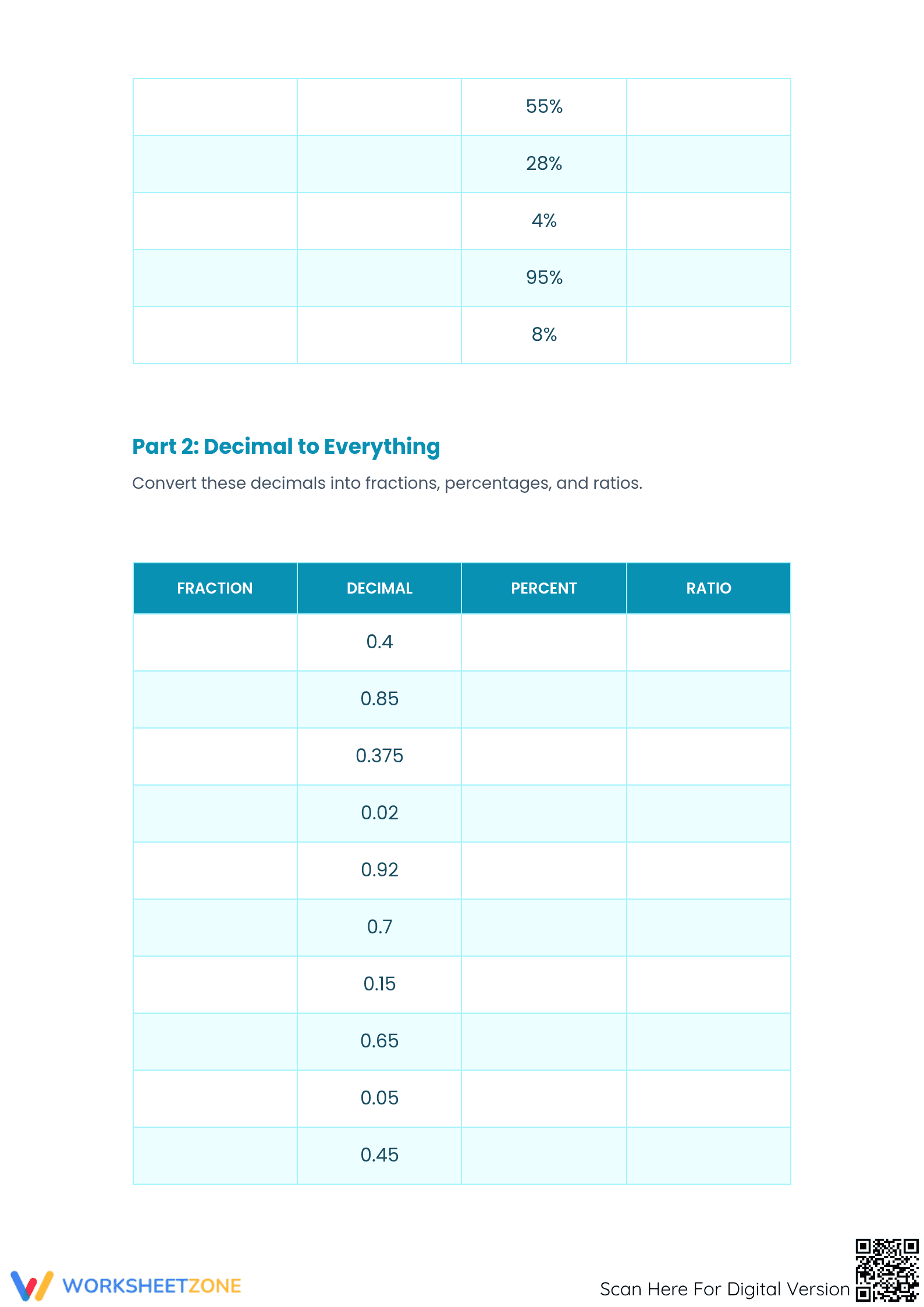
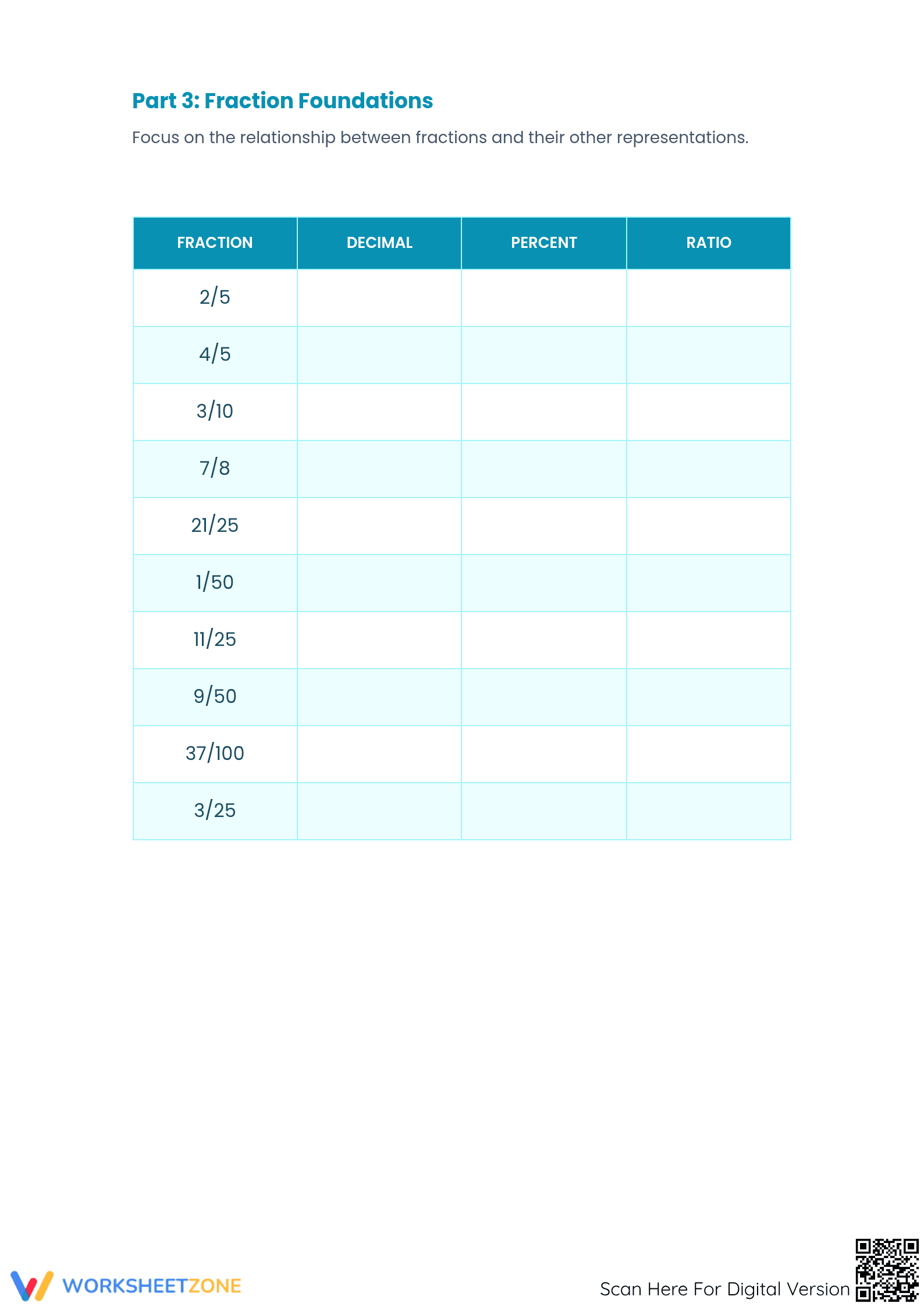
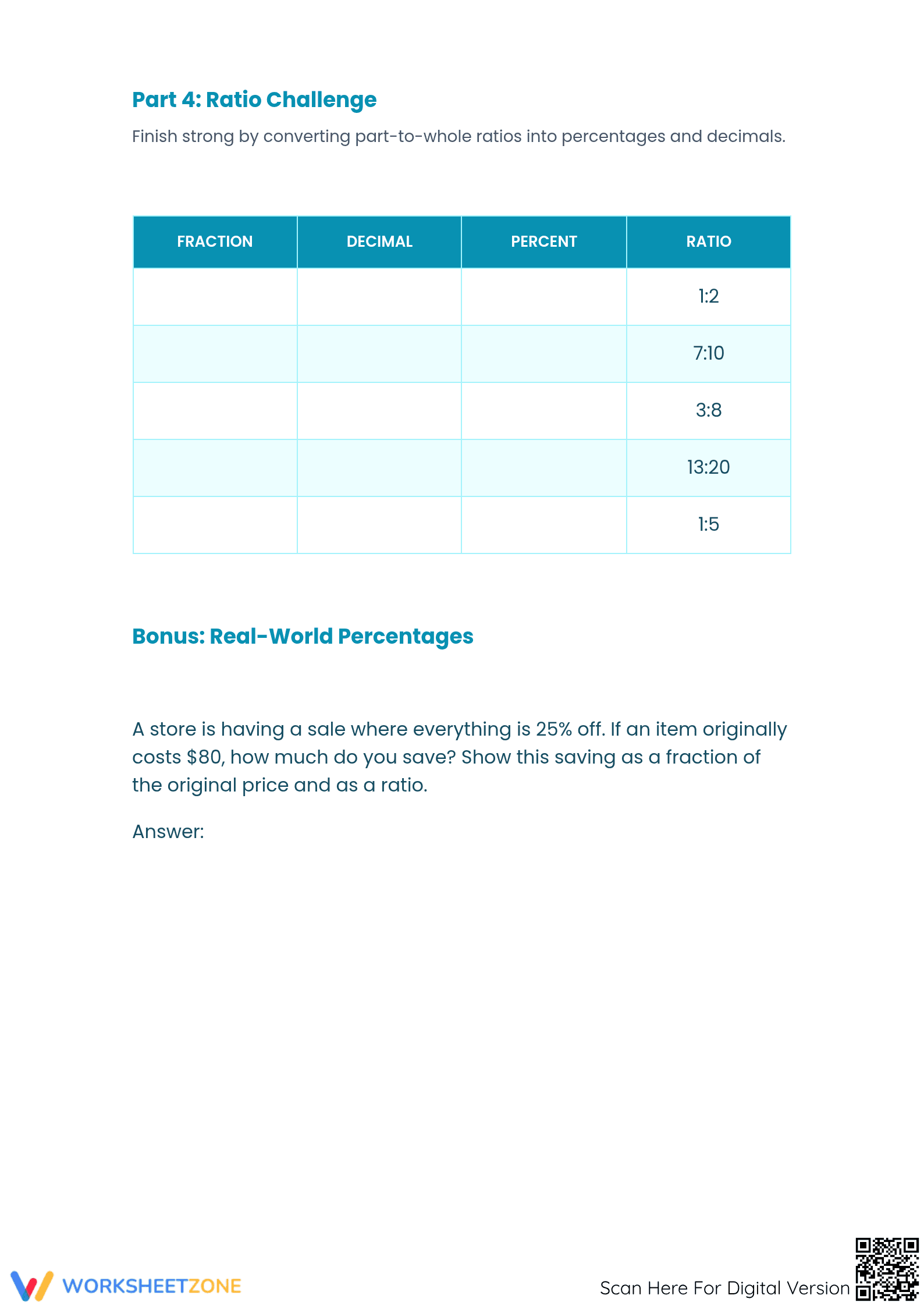
This comprehensive four-page PDF contains 41 distinct conversion tasks organized by starting unit. Students encounter structured tables that require finding equivalent values for 15 percentages, 10 decimals, 10 fractions, and 5 part-to-whole ratios. The final page features a bonus real-world word problem focused on retail discounts, bridging the gap between abstract calculation and practical application. A complete answer key is included for rapid grading.
Skill Progression
- Guided practice: The initial table provides 15 percentage-to-everything conversions, using familiar benchmarks like 50% and 25% to build confidence through repetitive success.
- Supported practice: Students transition to 20 decimal and fraction foundations, requiring them to move from one abstract representation to another with increasing complexity.
- Independent practice: The final sections challenge students with ratio-to-percent conversions and a multistep word problem without table-based scaffolds to ensure mastery.
This gradual-release approach moves from simple identification to application, following the proven I Do, We Do, You Do instructional framework.
Standards Alignment
The primary focus of this resource is `6.RP.A.3.C`, which requires students to find a percent of a quantity as a rate per 100 and write a fraction as a percent. By including ratio representations, the resource also supports 6.RP.A.1, helping students understand the part-to-whole relationship inherent in all rational number forms. Both standard codes can be copied directly into lesson plans, IEP goals, or district curriculum mapping tools.
How to Use It
Use this worksheet as a summative review after students have learned individual conversion methods for each unit. It serves as an excellent formative assessment tool; teachers should observe whether students prefer converting to a common decimal form first or if they can move directly between fractions and percents. The expected completion time is approximately 35 minutes during a standard math block.
Who It's For
This resource is designed for Grade 6 students but is highly effective for Grade 7 and 8 learners needing intervention or fluency maintenance. It pairs naturally with visual anchor charts showing the 10x10 hundredth grid, providing a concrete bridge between the numerical tables and the underlying mathematical concepts of "per hundred."
Mathematical fluency in rational number representation is vital for success in higher-level algebra and statistics. According to Fisher & Frey (2014), the use of structured practice and gradual release of responsibility is essential for students to internalize the conceptual links between fractions, decimals, and percents. This worksheet directly addresses `6.RP.A.3.C` by requiring students to see percentages as rates per 100, a key requirement for sixth-grade mastery. Research indicates that students who can fluidly move between these forms are significantly better at mental math and identifying errors in complex calculations. By providing 41 targeted problems, this resource ensures that the part-to-whole relationship is reinforced through repetitive, high-quality engagement. The inclusion of ratios further aligns with instructional trends toward integrated proportional reasoning, ensuring students are prepared for the more rigorous demands of seventh-grade mathematics and beyond.


