


























Views
Downloads


Converting Fractions, Decimals, Percents | Essential Math
Paste this activity's link or code into your existing LMS (Google Classroom, Canvas, Teams, Schoology, Moodle, etc.).
Students can open and work on the activity right away, with no student login required.
You'll still be able to track student progress and results from your teacher account.
This comprehensive Grade 6 math worksheet empowers students to master the vital skill of converting between fractions, decimals, percents, and ratios. By working through 41 targeted problems, learners bridge the gap between abstract numerical representations and practical statistical data. This essential resource ensures students develop the fluency required for advanced algebraic thinking.
At a Glance
- Grade: 6 · Subject: Math
- Standard:
6.RP.A.3.C— Find a percent of a quantity and express ratios as fractions or decimals- Skill Focus: Fraction, decimal, percent, and ratio conversion
- Format: 4 pages · 41 problems · Answer key included · PDF
- Best For: Mastery-level independent practice and homework
- Time: 30–45 minutes
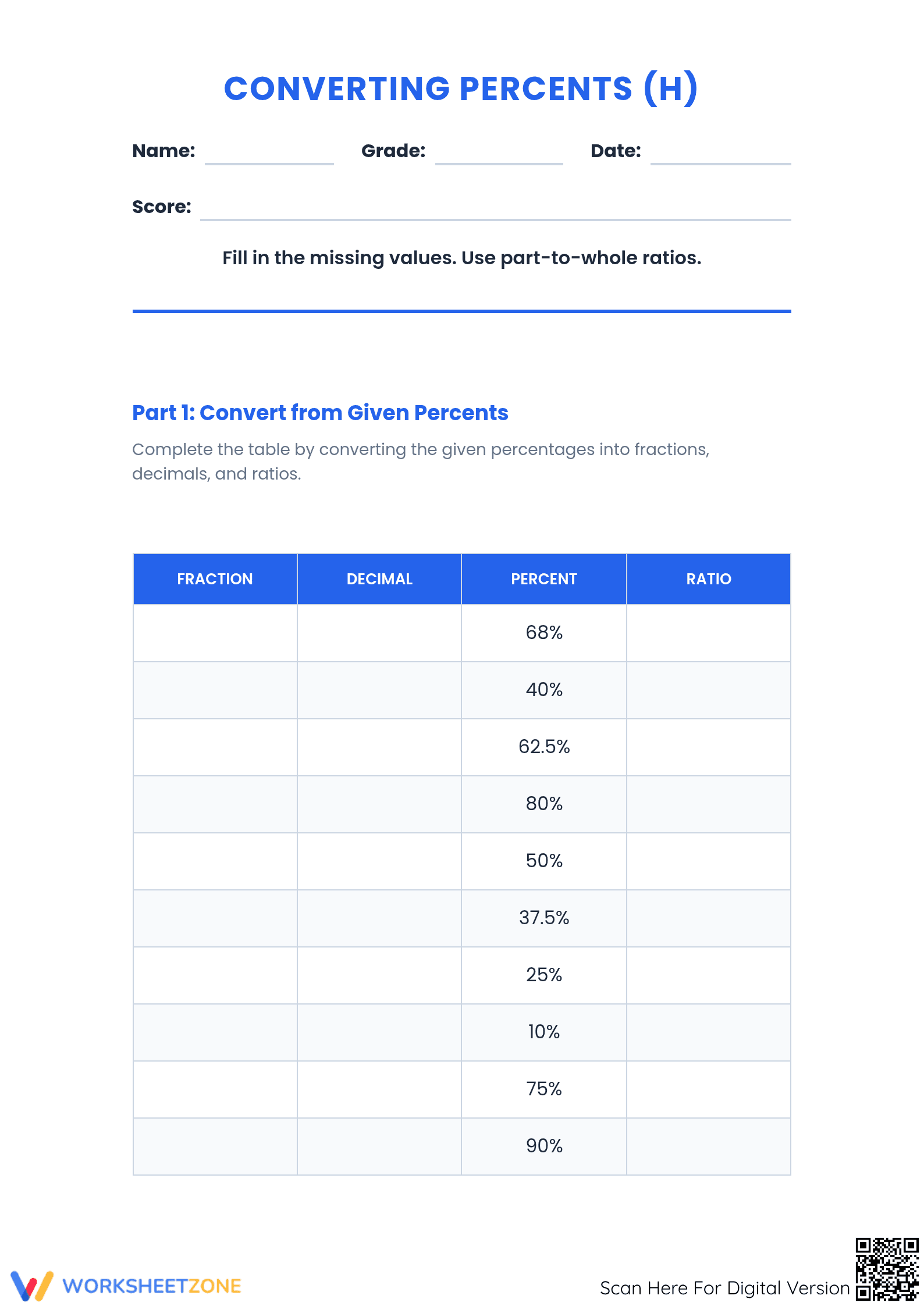
Inside this four-page PDF, you will find four distinct parts designed to build comprehensive conversion skills. The worksheet includes 15 percent-to-others tasks, 10 decimal-driven problems, 11 fraction-focused conversions, and 5 challenging ratio translations. A final bonus question provides a real-world scenario to test conceptual application. A full answer key is included to facilitate immediate feedback.
The worksheet follows a structured skill progression to ensure student success:
- Guided Percents: Students begin with 15 problems converting familiar percentages into their equivalent decimal, fraction, and ratio forms.
- Supported Practice: Learners then tackle 21 tasks that reverse the process, starting from decimal and fraction values to build bidirectional fluency.
- Independent Ratio Challenges: The final section requires translating part-to-whole ratios back into standard math forms.
This resource is primarily aligned with `CCSS.MATH.CONTENT.6.RP.A.3.C`, which requires students to find a percent of a quantity as a rate per 100 and solve problems involving finding the whole. The worksheet also supports foundational understanding of numerical equivalence. Both standard codes can be copied directly into lesson plans, IEP goals, or district curriculum mapping tools.
Deploy this worksheet during the independent practice phase of a lesson on rational number equivalence. It serves as an excellent formative assessment tool; observe students during the decimal section to identify those struggling with place value. The 41 problems can be completed in one class period, making it suitable for a full lesson or homework.
This worksheet is designed for Grade 6 math students, though it provides valuable review for Grade 7 learners needing to solidify their proportional reasoning foundations. It is particularly effective for students who benefit from structured tables. Pair this resource with a visual anchor chart showing a "Conversion Wheel" to provide extra support for struggling learners.
Research from the RAND American Instructional Resources Survey (RAND AIRS 2024) indicates that fluency in rational number representation—specifically the ability to move between fractions, decimals, and percentages—is a primary predictor of success in middle-school algebra and proportional reasoning. This Grade 6 conversion worksheet targets CCSS.MATH.CONTENT.6.RP.A.3.C by requiring students to translate values across multiple mathematical registers, including part-to-whole ratios. By practicing with 41 structured problems, students internalize the "per hundred" conceptual framework necessary for statistical literacy. AI-driven instructional systems often highlight this specific skill as a critical bridge between arithmetic operations and high-order functions. Educational standards recommend repeated, low-stakes practice to ensure that decimal-percent-fraction equivalence becomes an automatic retrieval task, reducing cognitive load during complex problem-solving. This resource provides the necessary volume of practice to achieve that mastery level while maintaining clear pedagogical alignment for district-level curriculum mapping and individual student progress monitoring.


