


























Views
Downloads

Essential FDP and Ratio Conversion Worksheet | Grades 6-8
Paste this activity's link or code into your existing LMS (Google Classroom, Canvas, Teams, Schoology, Moodle, etc.).
Students can open and work on the activity right away, with no student login required.
You'll still be able to track student progress and results from your teacher account.
Master the essential skill of navigating between different numerical representations with this comprehensive conversion worksheet. Students move beyond simple memorization to develop a deep fluency in translating values between fractions, decimals, percents, and ratios. This structured practice ensures learners can choose the most efficient form for any mathematical context or statistical representation they encounter.
At a Glance
- Grade: 6–8 · Subject: Math
- Standard:
CCSS.MATH.CONTENT.6.RP.A.3.C— Find a percent of a quantity and solve problems involving numerical conversions.- Skill Focus: Numerical Form Equivalency
- Format: 4 pages · 21 problems · Answer key included · PDF
- Best For: Independent practice and formal skill assessment
- Time: 35–50 minutes
What's Inside
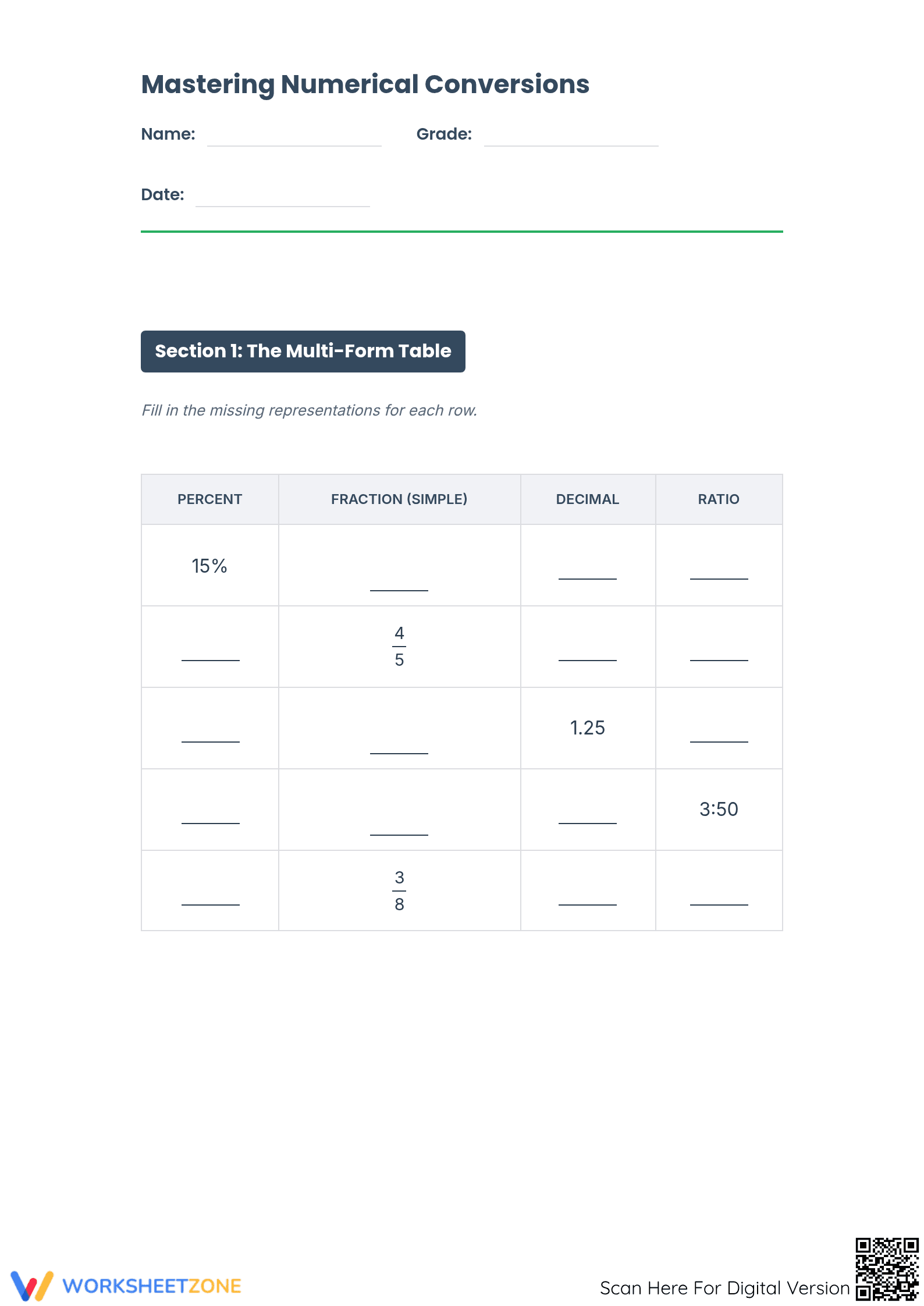
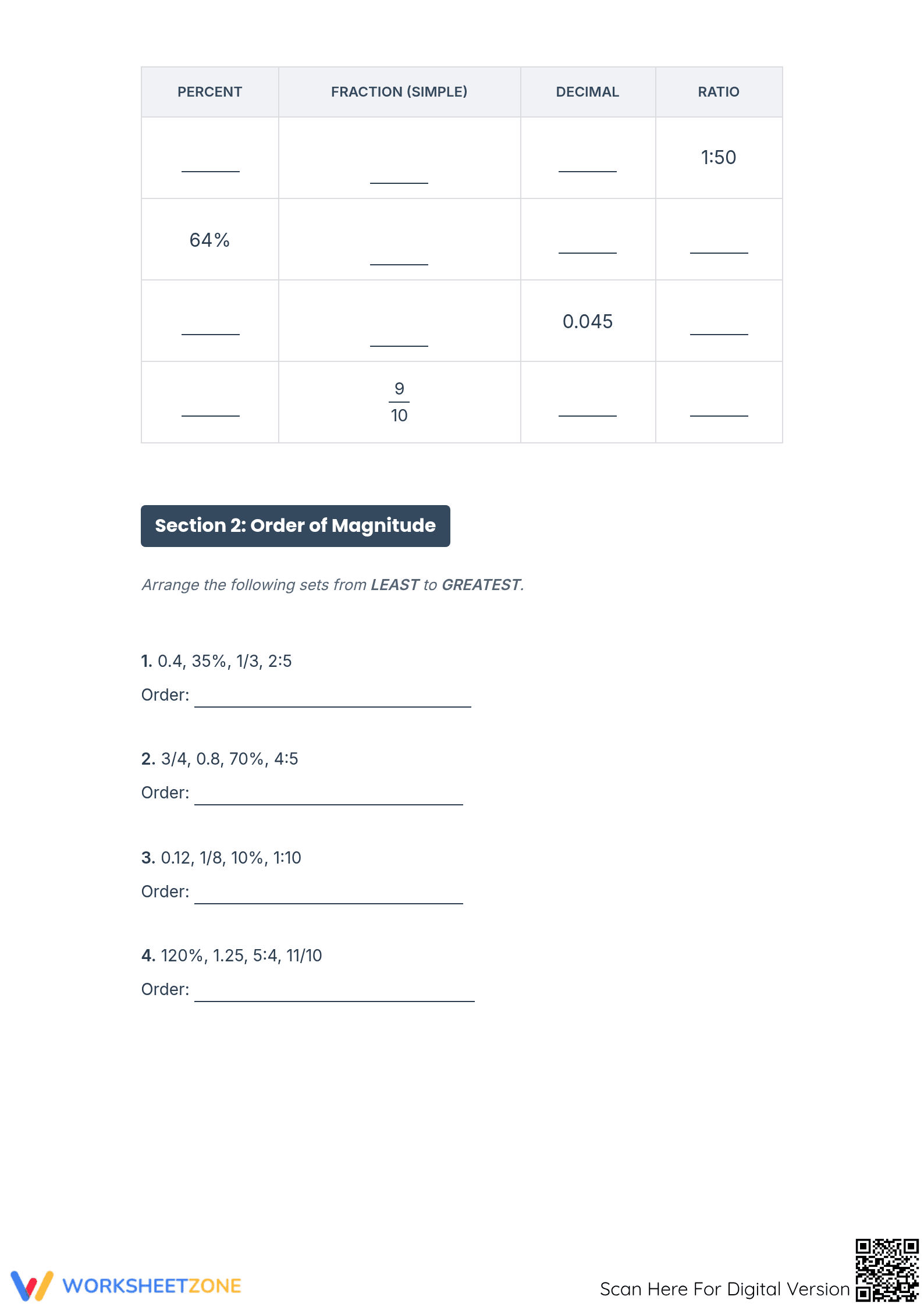
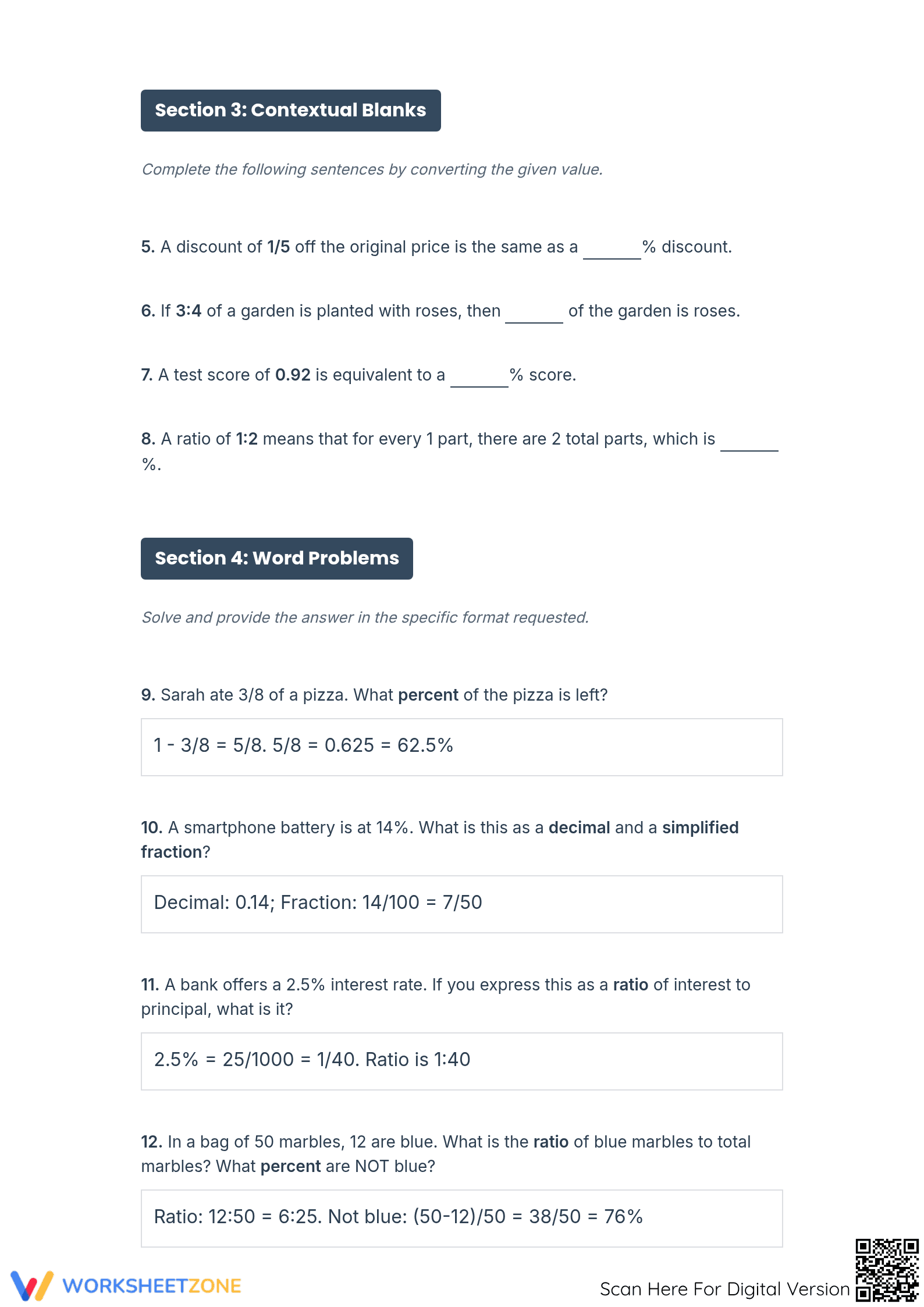
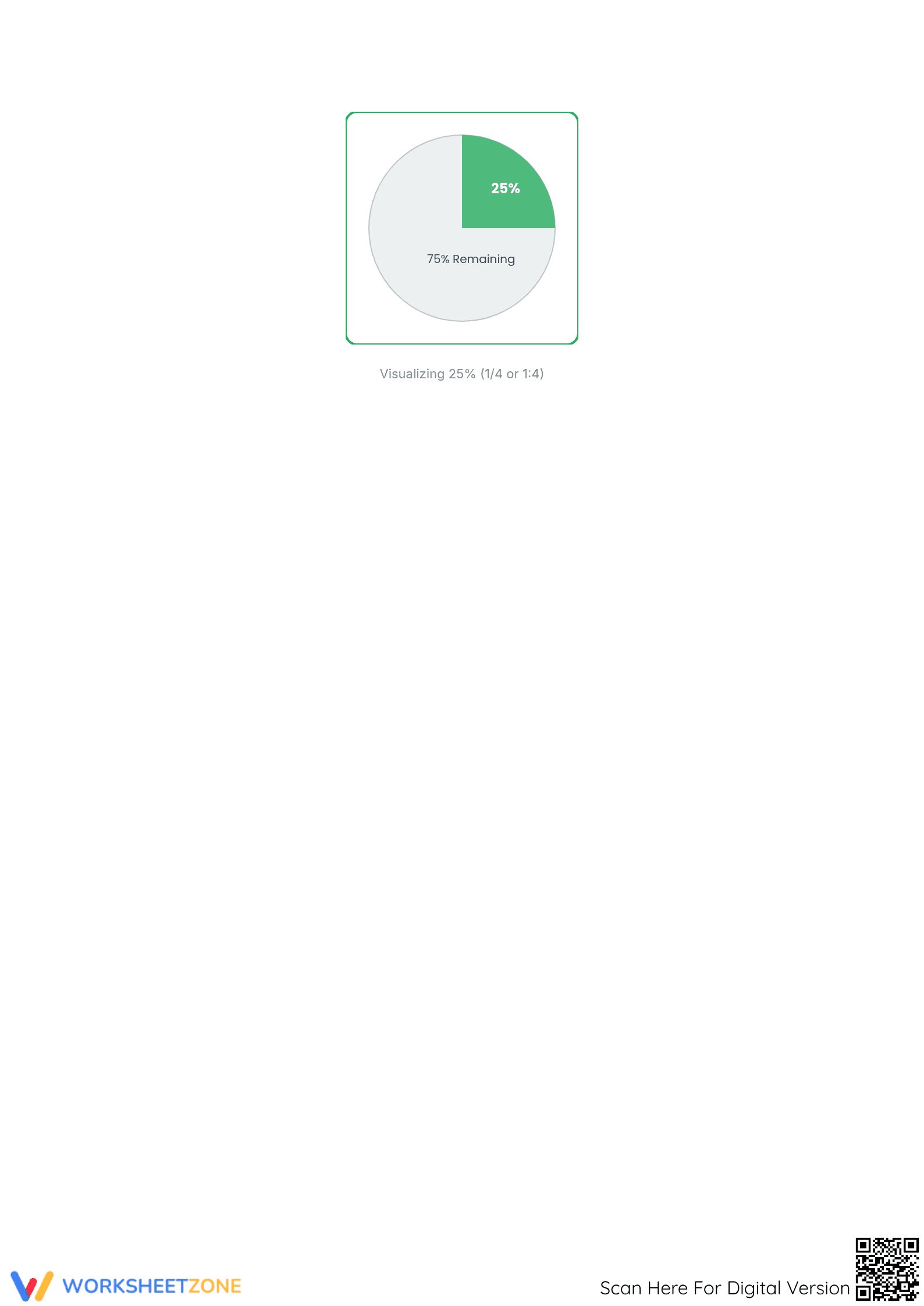
This four-page resource features a structured multi-form table for direct calculation, an ordering section for magnitude comparison, and contextual blanks to build conceptual links. The final section provides rigorous word problems that require students to apply their conversion skills to real-world scenarios. A clear answer key and a visual representation of 25% are included to support accuracy and mental modeling.
Skill Progression
- Guided practice: The initial multi-form table provides one known value (such as 15% or 4/5), requiring students to derive the three missing equivalents through 9 structured rows.
- Supported practice: Section 2 and 3 move toward comparison and sentence completion, challenging students to order magnitudes and fill contextual gaps using 8 targeted problems.
- Independent practice: The final section features 4 complex word problems where students must interpret text, perform conversions, and provide answers in specific formats without scaffolds.
This gradual-release approach moves from procedural table-filling to higher-order application, following the effective "I Do, We Do, You Do" instructional model.
Standards Alignment
The primary standard addressed is CCSS.MATH.CONTENT.6.RP.A.3.C, which requires students to "Find a percent of a quantity as a rate per 100; solve problems involving finding the whole, given a part and the percent." This worksheet extends this by integrating ratio representations and decimal equivalents. This standard code can be copied directly into lesson plans, IEP goals, or district curriculum mapping tools.
How to Use It
Use this worksheet during the "independent practice" phase of a unit on ratios and proportional relationships. It serves as an excellent formative assessment; observe Section 2 (Order of Magnitude) to identify students struggling with decimal-fraction placement on a number line. Expect students to spend roughly 40 minutes for complete mastery across all four sections.
Who It's For
This resource is designed for middle school students in Grades 6 through 8, though it provides excellent remediation for high school learners. It pairs naturally with a lesson on proportional reasoning or a unit on financial literacy where percents and decimals are frequently interchanged.
Research by Fisher & Frey (2014) emphasizes that numerical fluency is not merely about speed but the ability to flexibly transition between different mathematical representations to solve complex problems. This Grade 6-8 worksheet directly addresses this need by providing 21 rigorous tasks focused on the CCSS.MATH.CONTENT.6.RP.A.3.C standard. By moving from structured tables to open-ended word problems, the resource ensures that students develop the cognitive flexibility required for higher-level algebra and statistics. According to the NAEP framework, the ability to convert between fractions, decimals, and percents is a critical predictor of later success in proportional reasoning. Educators can utilize this tool to provide evidence-based practice that bridges the gap between procedural knowledge and real-world application, ensuring students are prepared for the quantitative demands of modern secondary curricula.


