


























Views
Downloads

Essential Fractions, Decimals, Percents & Ratios Guide
Paste this activity's link or code into your existing LMS (Google Classroom, Canvas, Teams, Schoology, Moodle, etc.).
Students can open and work on the activity right away, with no student login required.
You'll still be able to track student progress and results from your teacher account.
This comprehensive worksheet provides essential practice for students to master the fluid conversion between fractions, decimals, percents, and ratios. By bridging these four numerical representations, students build a deep conceptual understanding of proportional relationships. This resource ensures learners can accurately translate values across formats, a fundamental requirement for higher-level algebra and real-world financial literacy.
At a Glance
- Grade: 6–8 · Subject: Math · Fractions
- Standard:
CCSS.MATH.CONTENT.6.RP.A.3— Use ratio and rate reasoning to solve real-world and mathematical problems- Skill Focus: Multi-way numerical representation conversions
- Format: 4 pages · 22 problems · Answer key included · PDF
- Best For: Independent practice and comprehensive skills review
- Time: 35–50 minutes
What's Inside
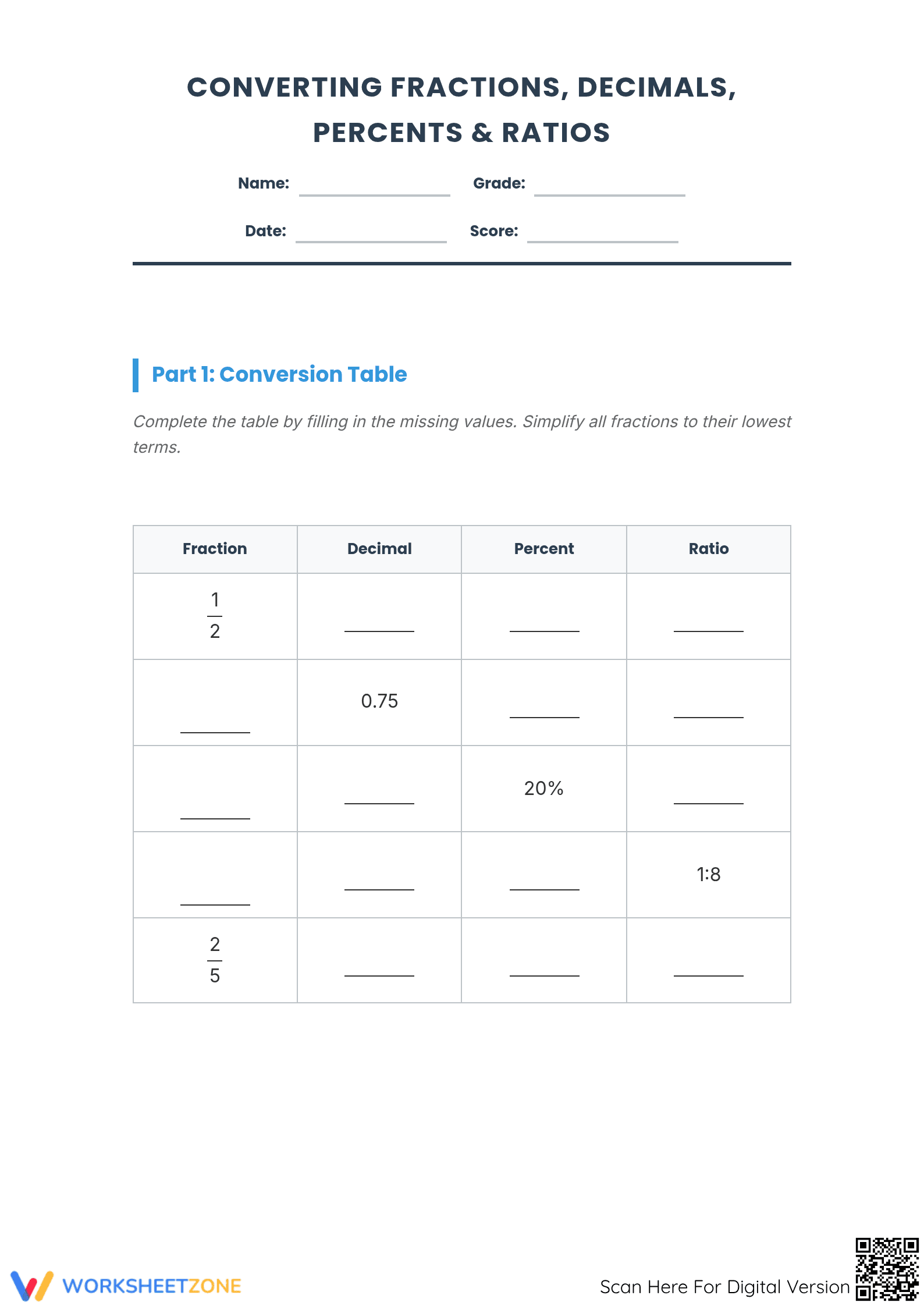
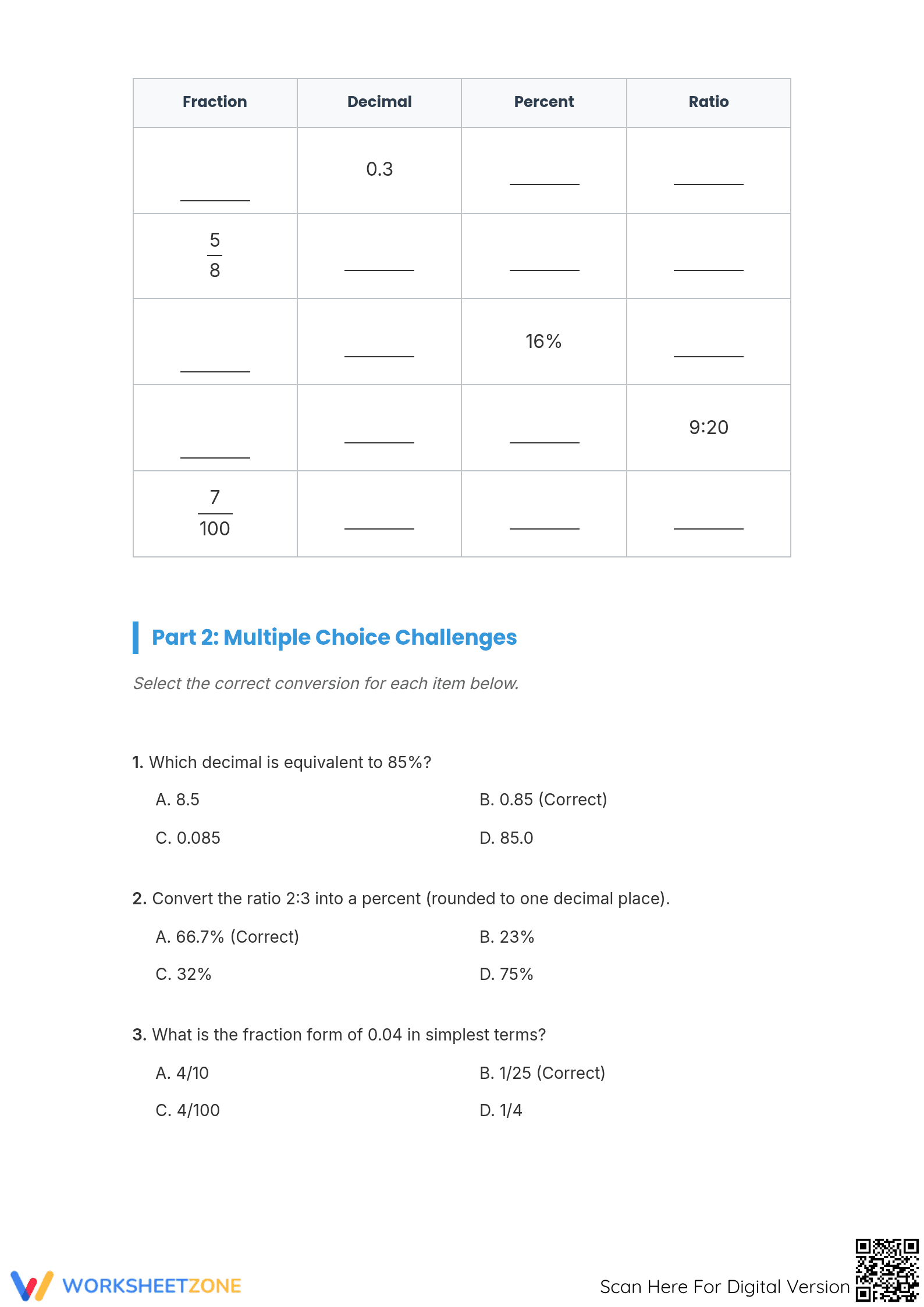
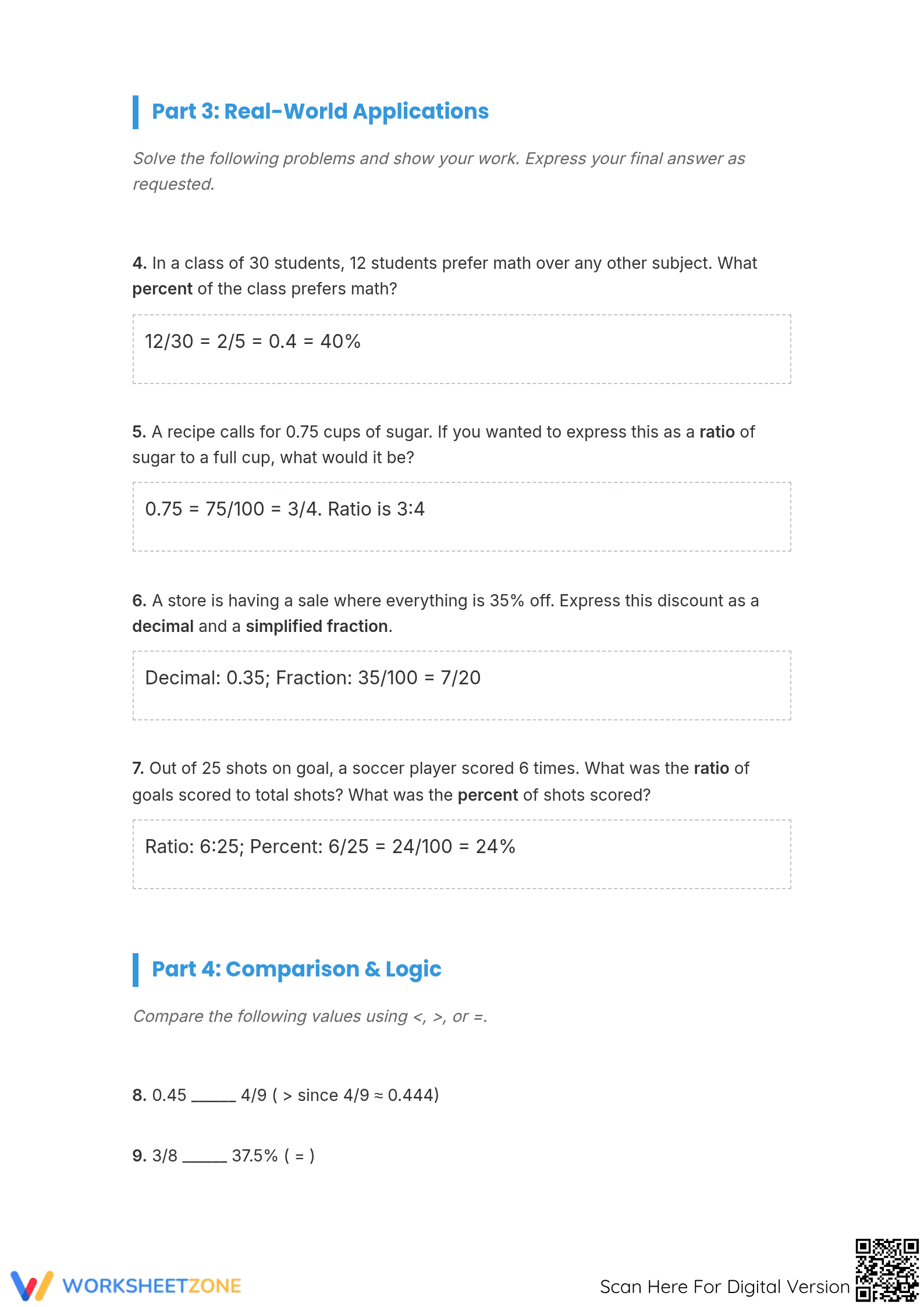
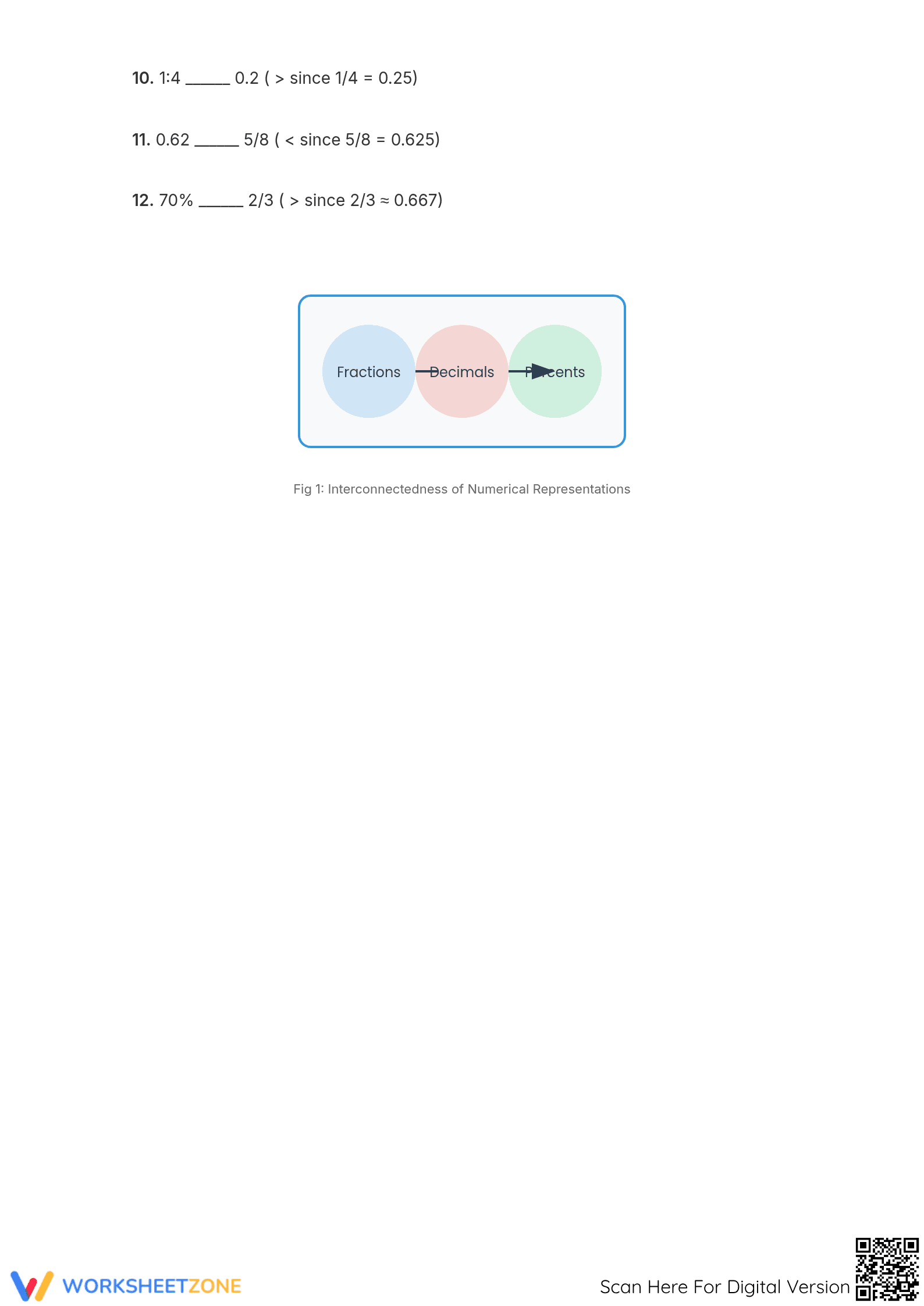
This four-page resource features a structured approach to numerical fluency. It includes a 10-row conversion table for repetitive reinforcement, three multiple-choice challenges to test conceptual boundaries, and four real-world application word problems. The final section provides five comparison and logic tasks requiring students to use inequality symbols. A visual diagram illustrates the interconnectedness of these concepts, alongside a full answer key.
Skill Progression
- Guided Practice: The 10-row conversion table provides high repetition with one value provided as an anchor, allowing students to practice the procedural mechanics of division and simplification.
- Supported Practice: Multiple-choice questions and comparison tasks challenge students to recognize equivalent values in non-linear formats, requiring them to bridge multiple conversion steps mentally.
- Independent Practice: Four detailed word problems require students to extract data from real-world contexts and determine the appropriate numerical representation independently.
This sequence moves students from rote calculation to higher-order logical application through a gradual release model.
Standards Alignment
This worksheet is primarily aligned with `CCSS.MATH.CONTENT.6.RP.A.3`, specifically focusing on finding a percent of a quantity as a rate per 100 and solving problems involving ratios. It also supports `7.NS.A.2.D`, which requires converting rational numbers to decimals using long division. Both standard codes can be copied directly into lesson plans, IEP goals, or district curriculum mapping tools.
How to Use It
Use this resource as a formative assessment to identify students who struggle with the decimal-to-percent shift. It is effective when assigned after direct instruction on long division and ratio notation. Teachers can observe the "Comparison & Logic" section to see if students convert to a common format before comparing, a key indicator of strategic thinking. Expected completion time is approximately 45 minutes.
Who It's For
This packet is designed for Grade 6–8 students as part of a core curriculum or for high school students needing remedial support for algebra readiness. It provides sufficient scaffolding for English Language Learners through visual tables and consistent terminology. It pairs naturally with an anchor chart and can be used as a stand-alone sub plan.
Mastering the conversion between fractions, decimals, percents, and ratios is a critical milestone that directly impacts a student's ability to handle complex proportional reasoning. Research by Fisher & Frey (2014) emphasizes that the use of multi-modal representations helps to solidify the procedural fluency required by math standards. By requiring students to simplify fractions while simultaneously calculating ratios and percentages, this resource addresses the cognitive load issues often associated with multi-step math tasks. According to a ScienceDirect TpT Analysis of educational materials, worksheets integrating logic-based comparisons alongside rote calculation significantly improve long-term retention. This 4-page document provides the structured scaffolding necessary for Grade 6–8 learners to achieve mastery in `CCSS.MATH.CONTENT.6.RP.A.3` through diverse task types and evidence-based design.


