


























Views
Downloads
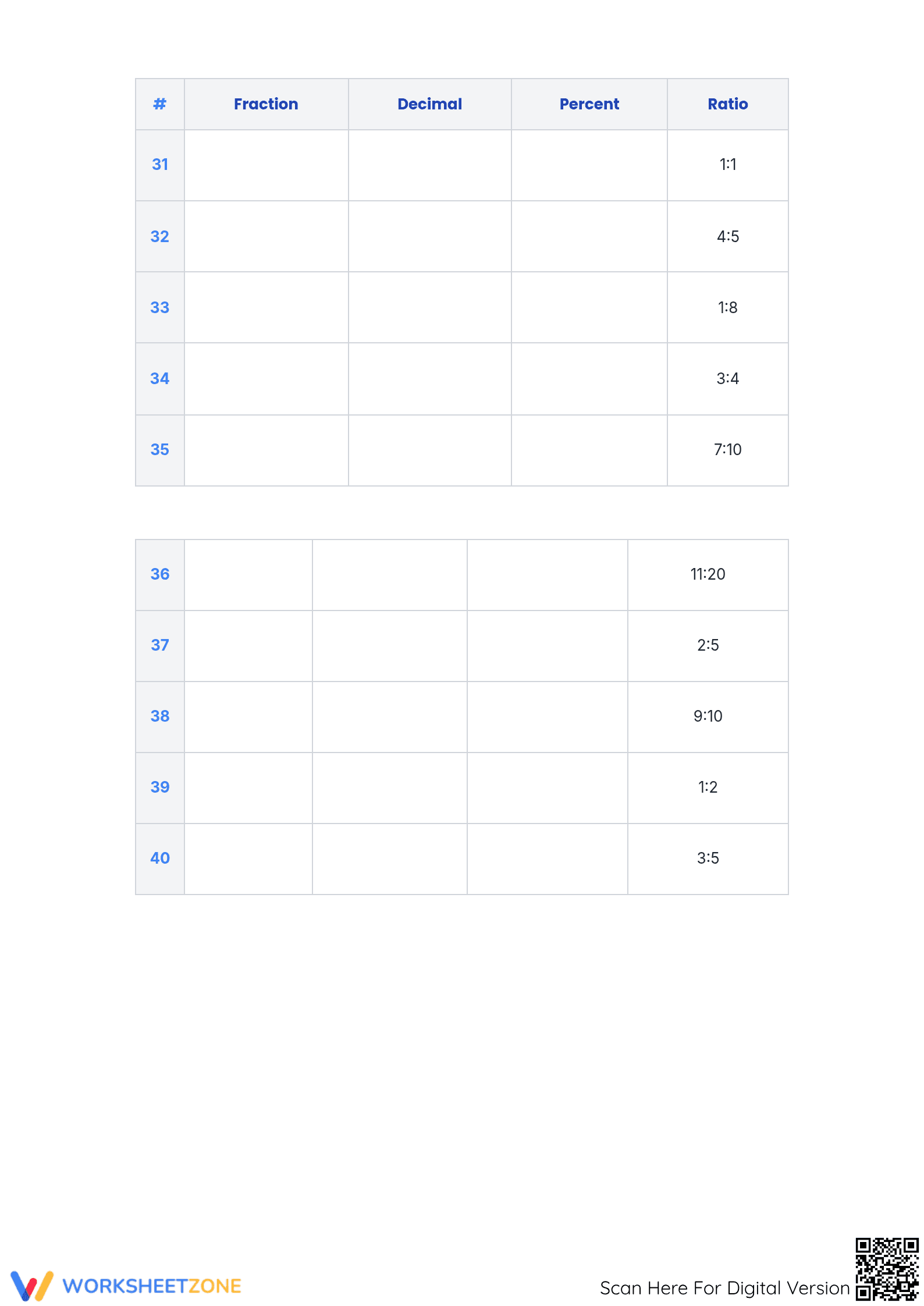

Essential Fraction Decimal Percent Conversion Worksheet
Paste this activity's link or code into your existing LMS (Google Classroom, Canvas, Teams, Schoology, Moodle, etc.).
Students can open and work on the activity right away, with no student login required.
You'll still be able to track student progress and results from your teacher account.
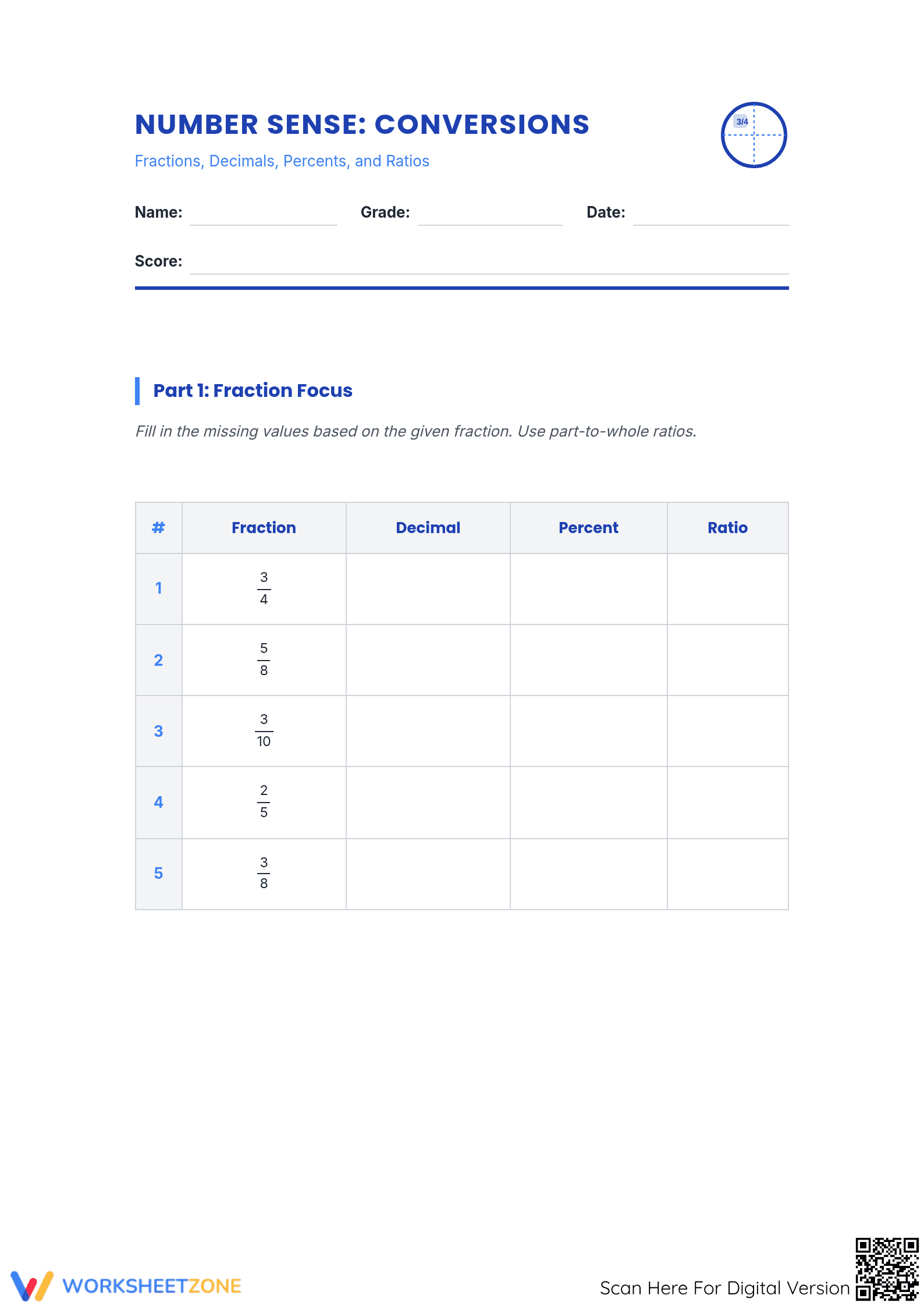
Strengthen student number sense with this comprehensive conversion practice set. This worksheet ensures students can fluidly translate values between fractions, decimals, percents, and ratios. By mastering these transformations, learners build the mathematical agility required for higher-level statistics, algebraic reasoning, and real-world data interpretation across middle school and high school curricula.
At a Glance
- Grade: 6–8 · Subject: Math · Fractions
- Standard:
CCSS.MATH.CONTENT.6.RP.A.3.C— Find a percent of a quantity and solve problems involving finding the whole- Skill Focus: Multi-representation numerical conversion
- Format: 5 pages · 40 problems · Answer key included · PDF
- Best For: Independent practice and formative assessment cycles
- Time: 30–45 minutes
What's Inside
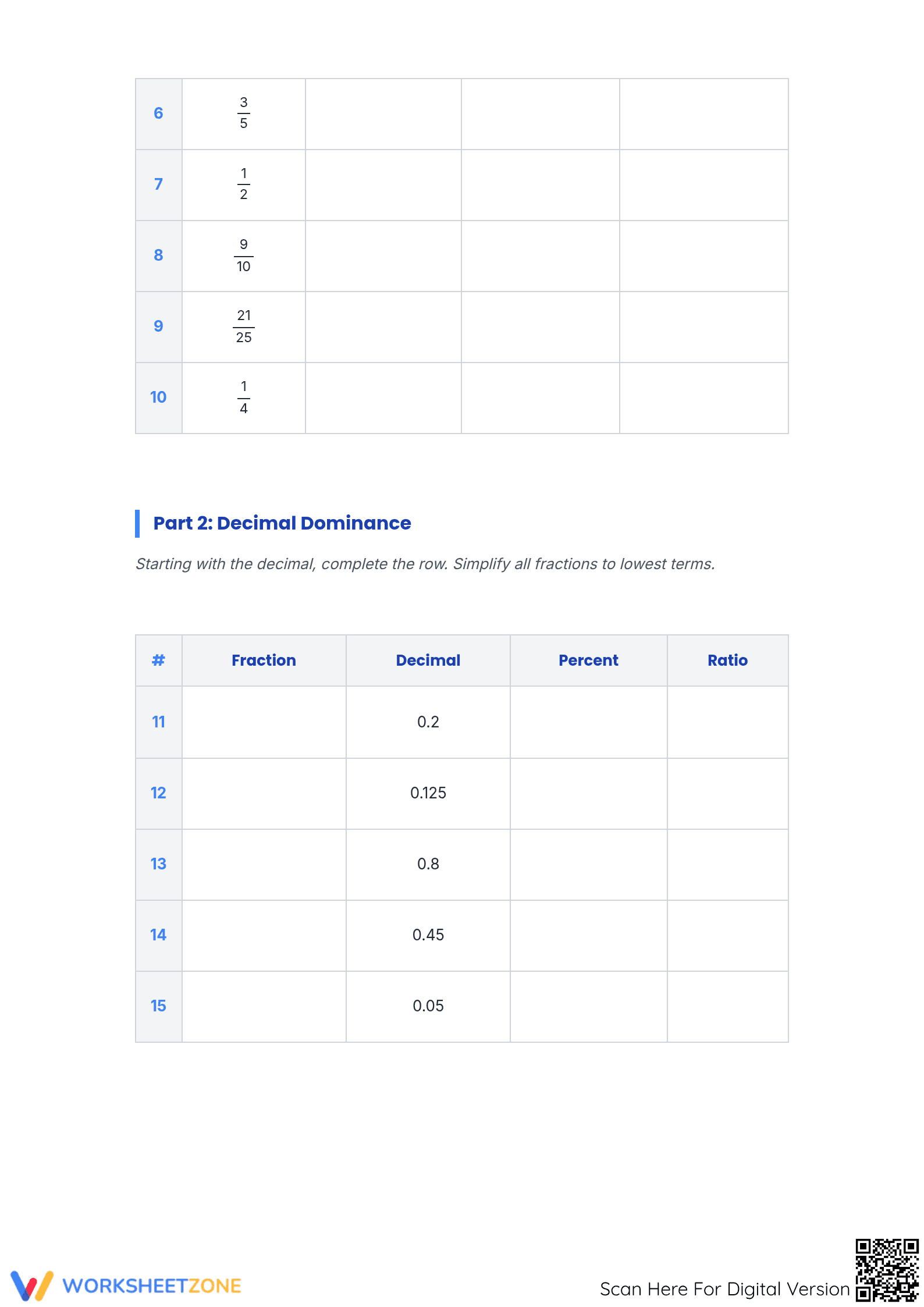
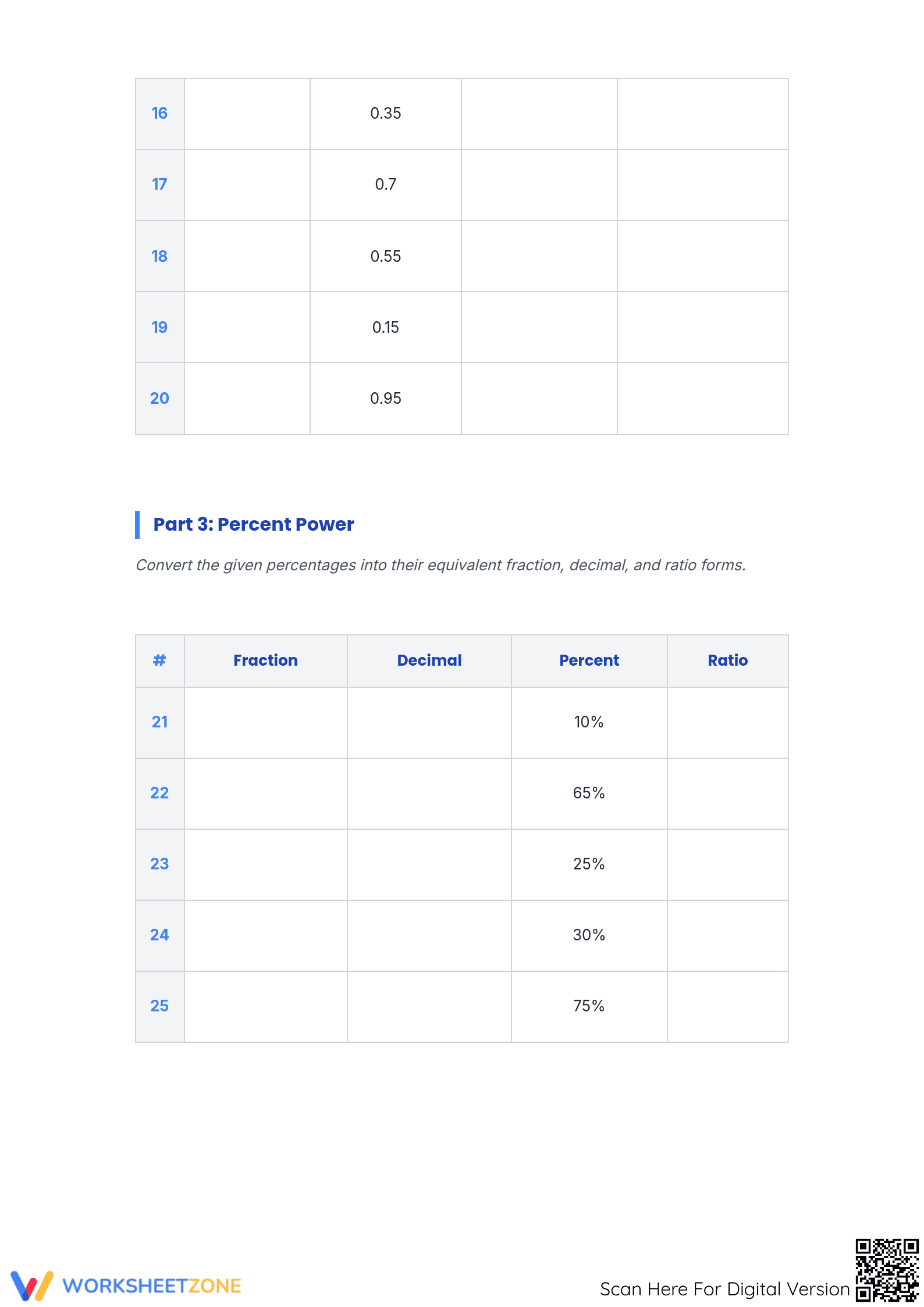
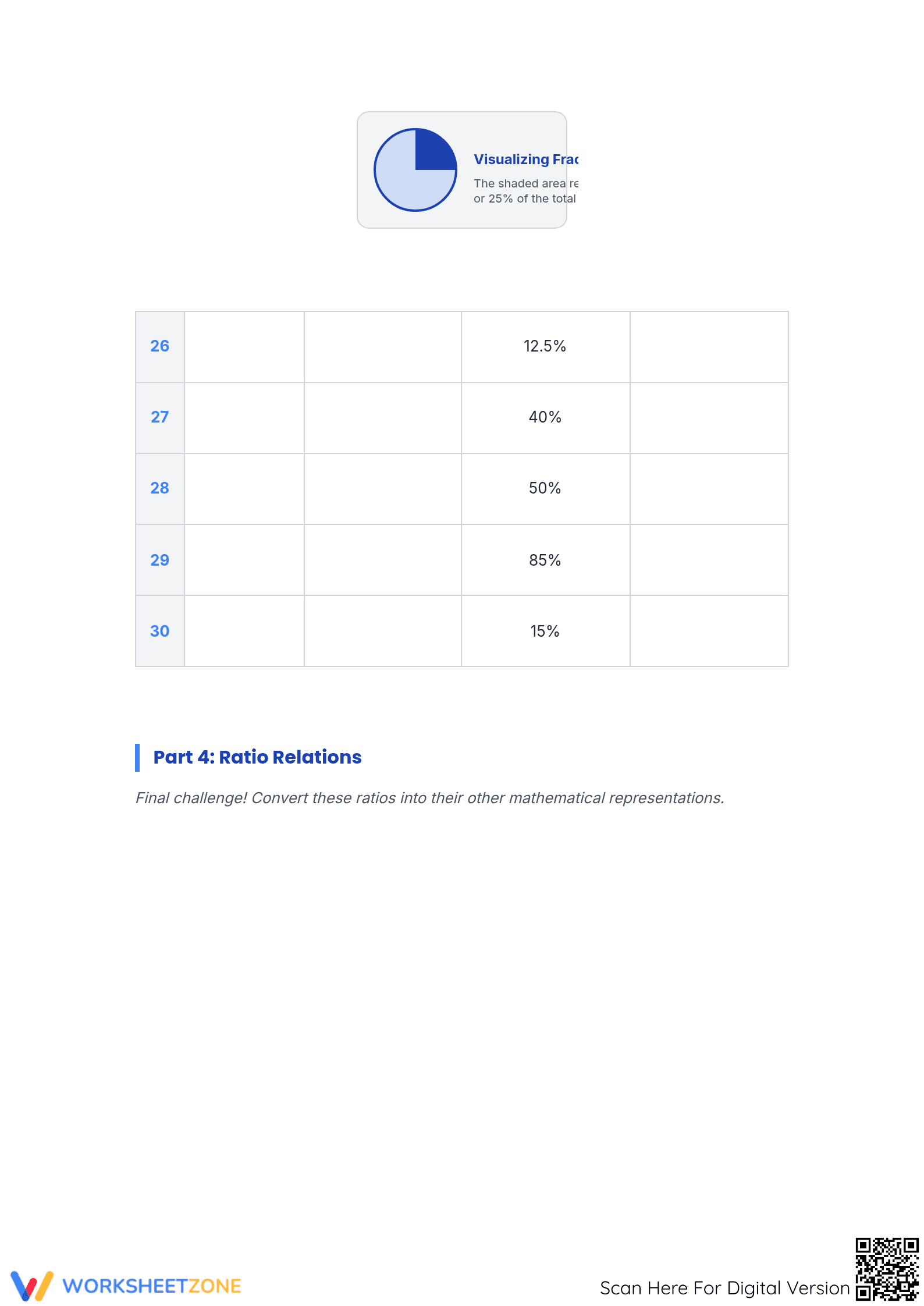
This 5-page PDF contains 40 structured conversion problems divided into four strategic sections: Fraction Focus, Decimal Dominance, Percent Power, and Ratio Relations. Each section provides one starting value and requires the student to calculate the three equivalent forms. The layout includes clear tables and a visual aid for percentage representation to support conceptual understanding.
Skill Progression
Students move through a systematic gradual-release model within this practice set. Section 1 starts with 10 guided problems using familiar fractions to build confidence. Section 2 and 3 provide 20 supported practice tasks focusing on decimal and percentage entry points. Finally, Section 4 offers 10 independent practice problems involving ratios, requiring students to synthesize their understanding of part-to-whole relationships without prompts.
Standards Alignment
This resource is strictly aligned to CCSS.MATH.CONTENT.6.RP.A.3.C, which requires students to find a percent of a quantity as a rate per 100 and solve problems involving finding the whole, given a part and the percent. The inclusion of ratio conversions also supports CCSS.MATH.CONTENT.6.RP.A.1. This standard code can be copied directly into lesson plans, IEP goals, or district curriculum mapping tools.
How to Use It
Assign this worksheet as a follow-up to direct instruction on proportionality or as a retrieval practice during a warm-up. Use the completed tables as a formative assessment tool; if students struggle specifically with the Ratio Relations section, it indicates a need for deeper instruction on part-to-whole vs. part-to-part logic. Expect a completion time of 35 minutes for most students.
Who It's For
This practice set is designed for Grade 6, 7, and 8 students who are developing or refining their rational number fluency. It serves as an excellent resource for general education math blocks, RTI intervention groups, or as a focused review for high school students who require additional scaffolding in numerical literacy.
Effective mathematics instruction requires students to move fluidly between different numerical representations to build a robust sense of number and proportion. This worksheet focuses on the critical skill of converting between fractions, decimals, percents, and ratios, which is a foundational requirement for success in algebra and real-world statistical analysis. According to research by Fisher & Frey (2014), the use of structured practice and multiple representations helps students internalize the underlying mathematical relationships rather than relying on rote memorization of algorithms. By engaging with 40 diverse conversion tasks across five pages, learners strengthen their ability to interpret data presented in various formats, which is a key component of the CCSS.MATH.CONTENT.6.RP.A.3.C standard. This resource provides the necessary repetition to ensure that students can accurately translate part-to-whole relationships into percentages or decimals, facilitating a deeper understanding of proportionality that is essential for advanced middle school and high school mathematics curricula.


