


























Views
Downloads


Essential Fraction Decimal Percent Ratio Worksheet | Math
Paste this activity's link or code into your existing LMS (Google Classroom, Canvas, Teams, Schoology, Moodle, etc.).
Students can open and work on the activity right away, with no student login required.
You'll still be able to track student progress and results from your teacher account.
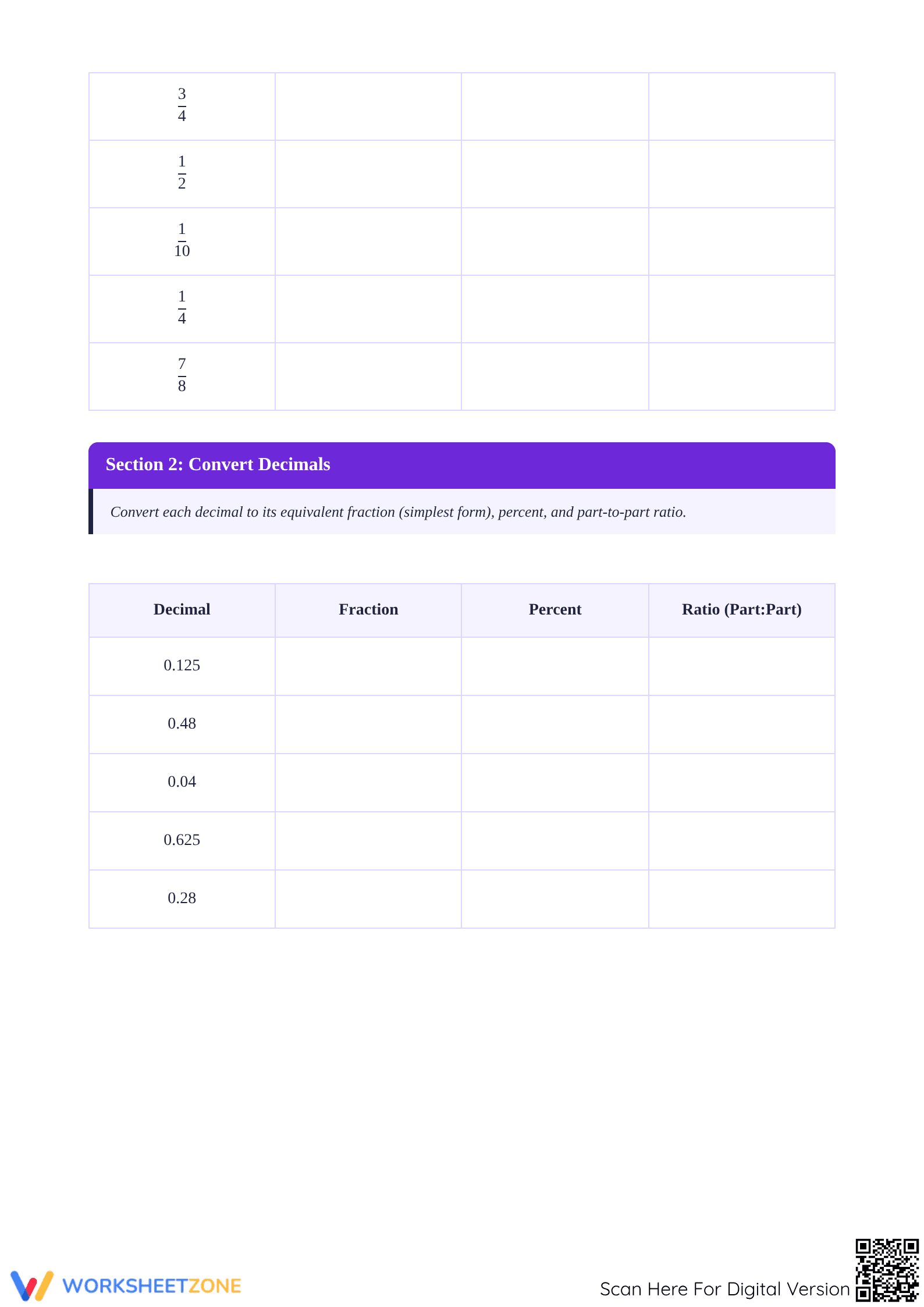
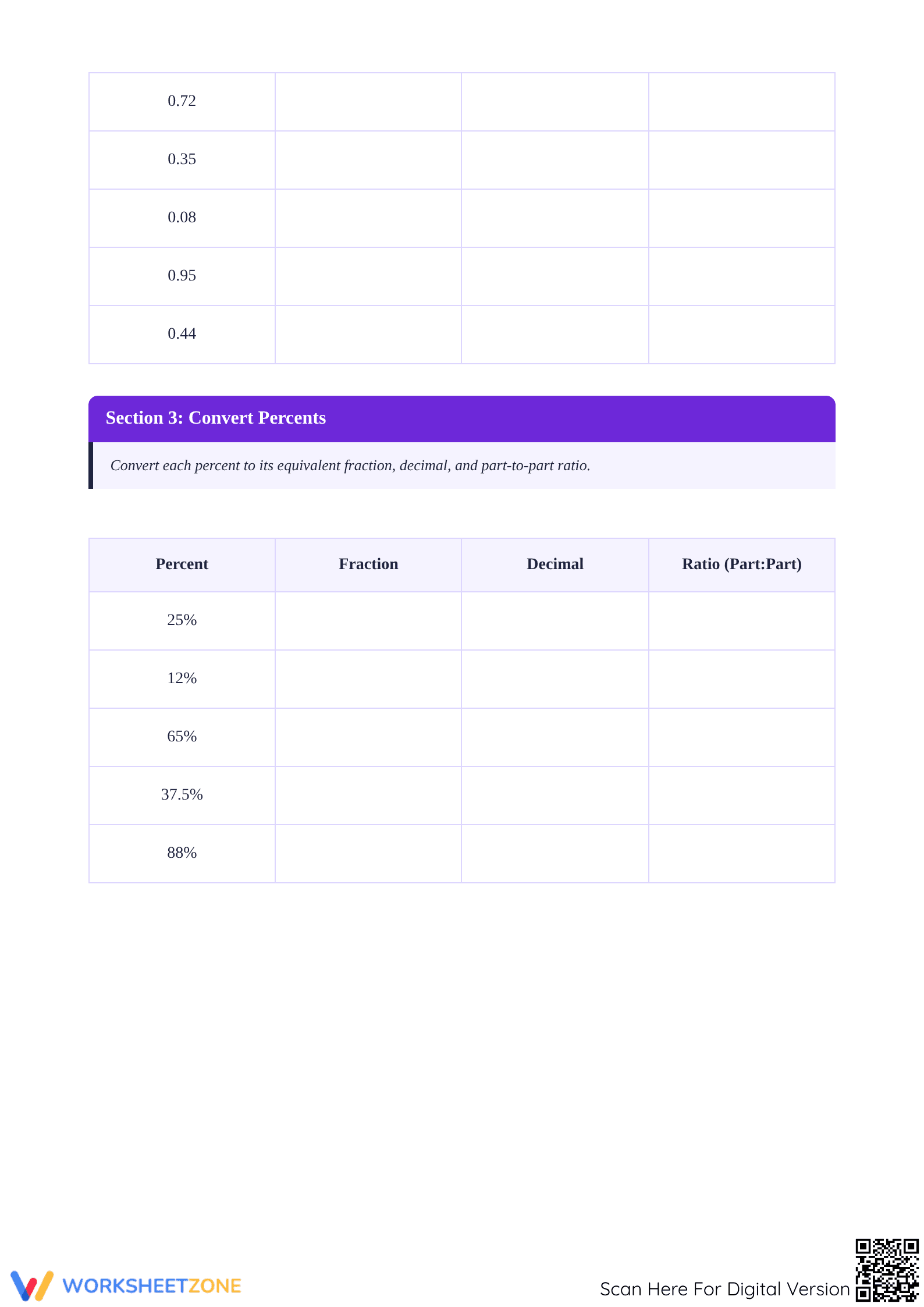
Build mathematical fluency with this comprehensive practice set designed to help students master the fluid movement between numerical representations. This worksheet provides a systematic approach to converting fractions, decimals, percents, and ratios, ensuring students can identify equivalent values across different contexts. By completing these structured exercises, learners develop the representational flexibility required for advanced algebraic reasoning and real-world statistical analysis.
At a Glance
- Grade: 6–7 · Subject: Math (Fractions/Ratios)
- Standard:
CCSS.MATH.CONTENT.6.RP.A.3.c— Find a percent of a quantity and express percentages as fractions and decimals- Skill Focus: Multi-way numerical conversions
- Format: 4 pages · 40 problems · Answer key included · PDF
- Best For: Independent practice and fluency drills
- Time: 25–35 minutes
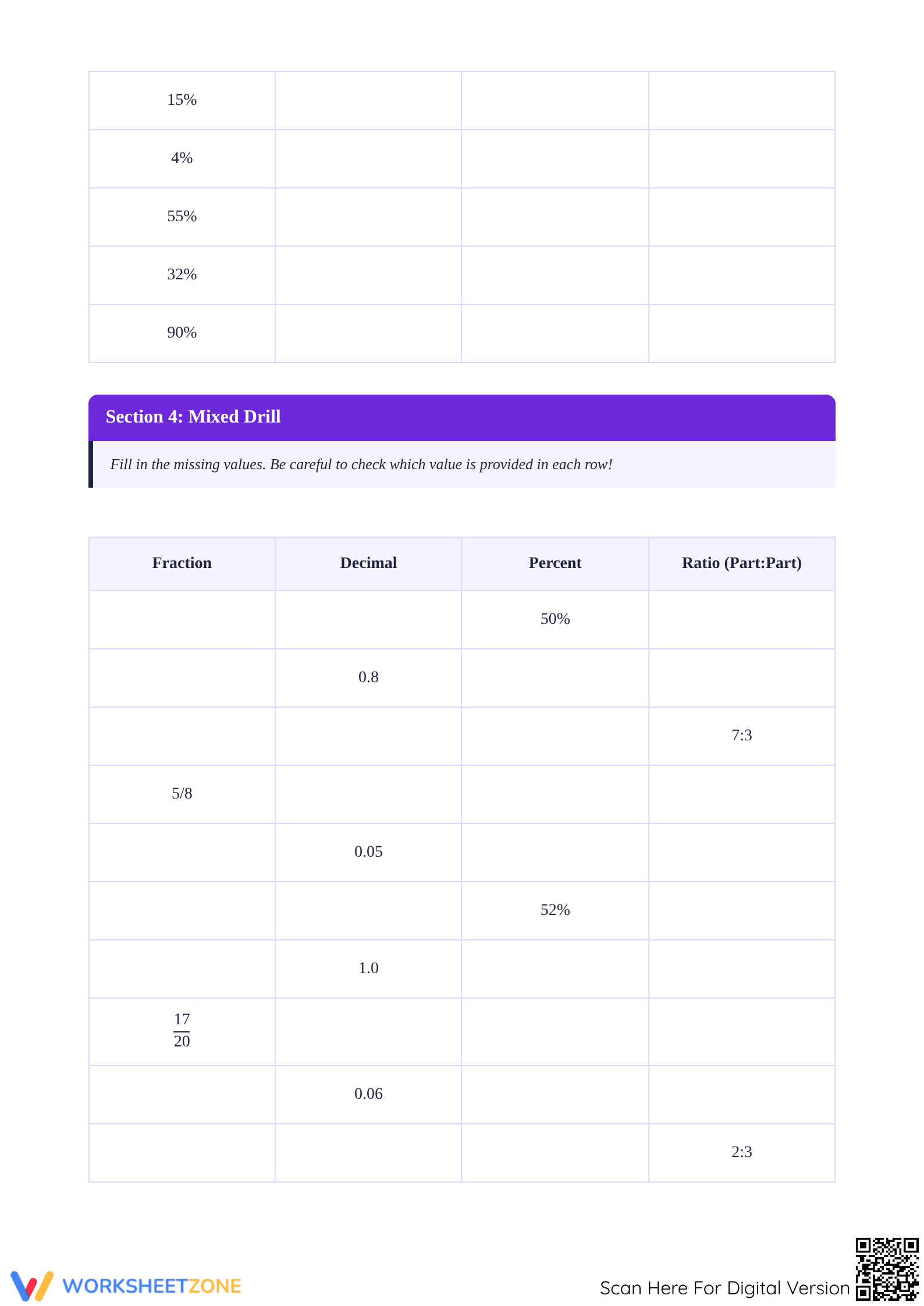
This resource features a clear, tabular layout across four distinct sections. The first three sections focus on a specific starting value—fractions, decimals, or percents—and require students to find the three corresponding equivalents. The final section, a mixed drill, challenges students to identify the given value and calculate the missing fields, reinforcing total mastery of the conversion pipeline across 40 total tasks.
The zero-prep workflow for this resource is designed for maximum teacher efficiency. First, print the four-page PDF, which takes approximately 30 seconds. Next, distribute the packets to students for a focused 25-minute practice session. Finally, use the included answer key to review results or facilitate student self-grading in under 2 minutes. This streamlined structure makes it an ideal choice for emergency sub plans or low-prep warm-ups.
This worksheet is strictly aligned to the CCSS.MATH.CONTENT.6.RP.A.3.c standard, which requires students to find a percent of a quantity as a rate per 100 and express a percentage as a fraction with a denominator of 100. It also supports 7.NS.A.2.d regarding decimal expansions. Both standard codes can be copied directly into lesson plans, IEP goals, or district curriculum mapping tools.
For optimal results, use this worksheet during the independent practice phase of a lesson or as a formative assessment after direct instruction on equivalency. A useful observation tip for teachers is to check if students are using a consistent base (like 100) or if they are performing long division for more complex fractions. The expected completion time for most middle school students is roughly 30 minutes.
This resource is specifically designed for general education students in grades 6 and 7, though it serves as an excellent remedial tool for 8th-grade students preparing for state testing. It pairs naturally with a visual anchor chart displaying common equivalents (like 1/4, 0.25, and 25%) to provide a scaffolded experience for learners who are still developing their mental math speed.
According to research by Fisher & Frey (2014) regarding the gradual release of responsibility, structured practice sets like this one are essential for moving students from guided instruction to independent mastery. This worksheet addresses the CCSS.MATH.CONTENT.6.RP.A.3.c standard by requiring students to demonstrate representational flexibility, a core component of mathematical literacy. By engaging with 40 distinct conversion tasks, students internalize the relationships between parts and wholes expressed as decimals, percents, and ratios. The inclusion of a mixed-drill section ensures that learners can categorize and process information without the prompt of a specific starting unit, which is a critical higher-order thinking skill. This resource provides the repetitive, high-quality engagement necessary to bridge the gap between conceptual understanding and procedural fluency in middle school mathematics curricula. Such evidence-based practice is highly recommended for building the foundational skills needed for success in introductory algebra and data science.


