


























Views
Downloads
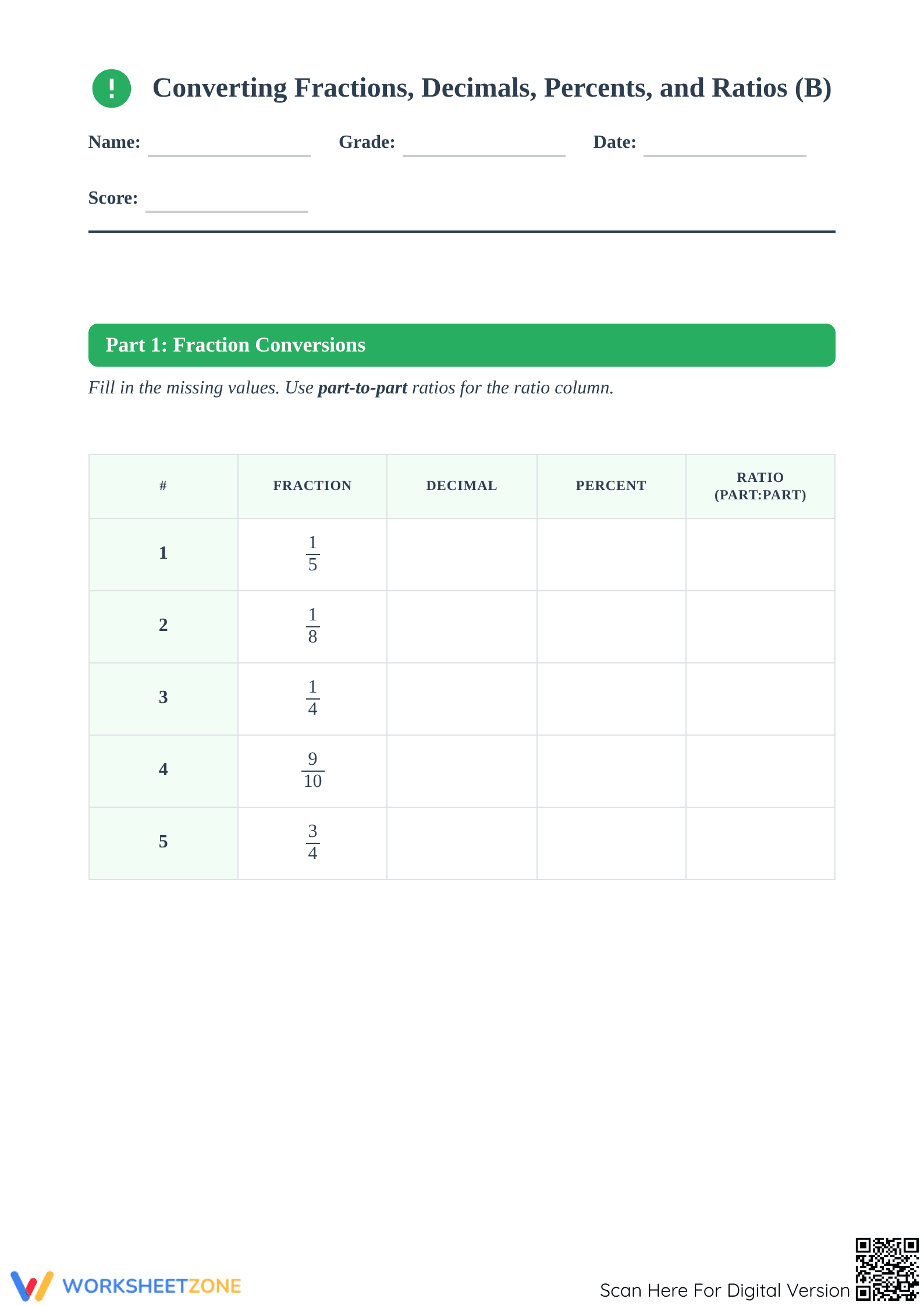
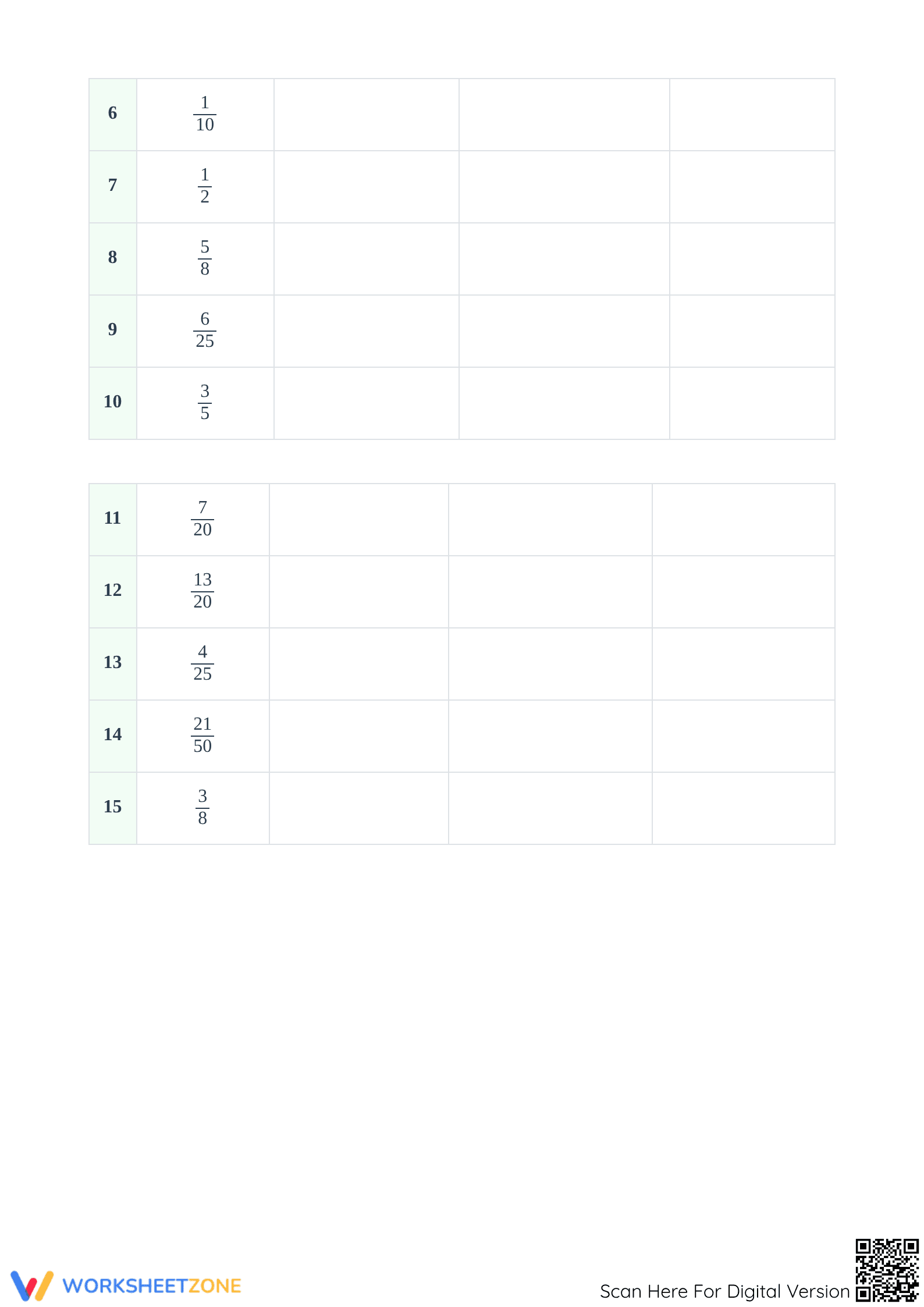
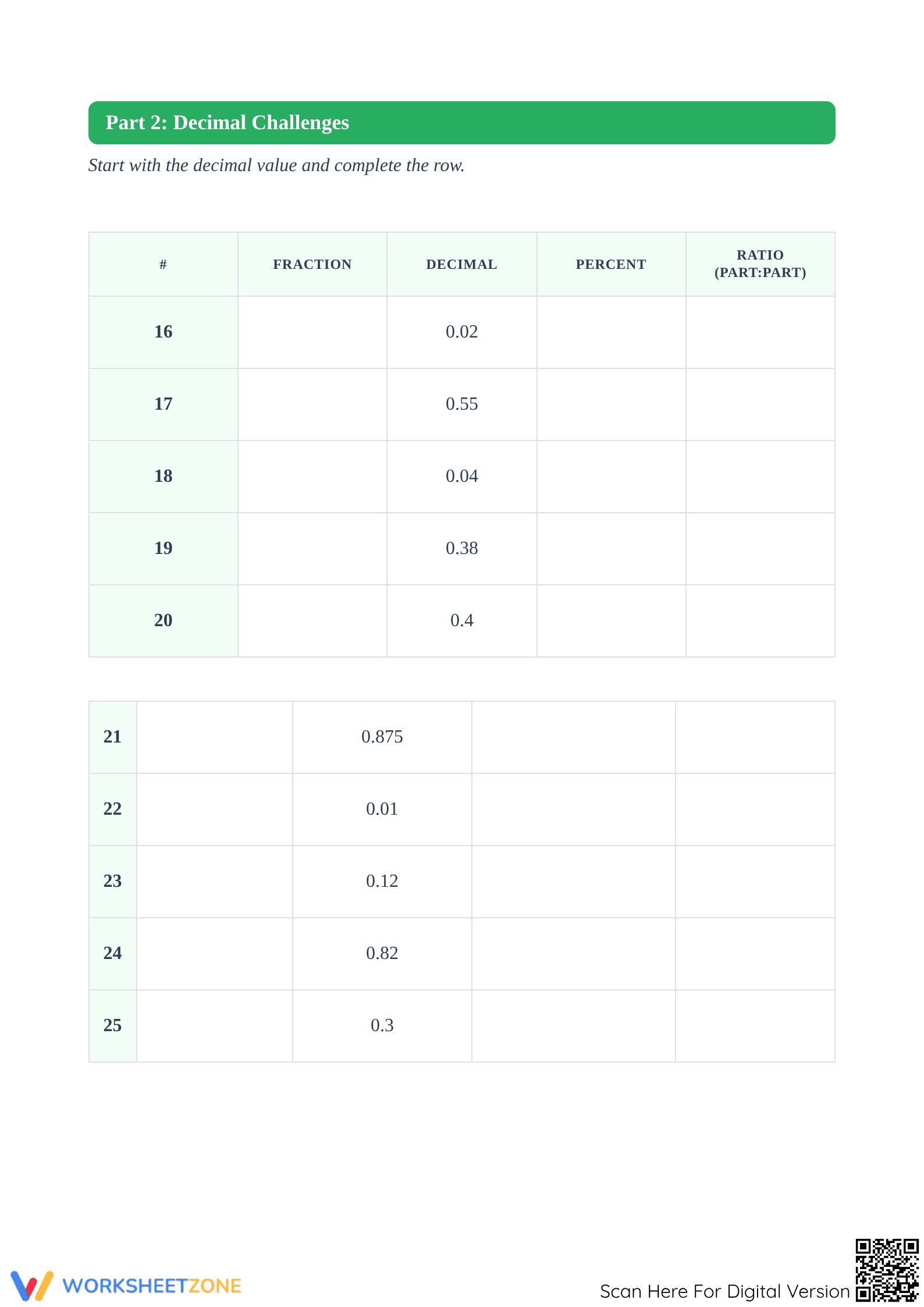
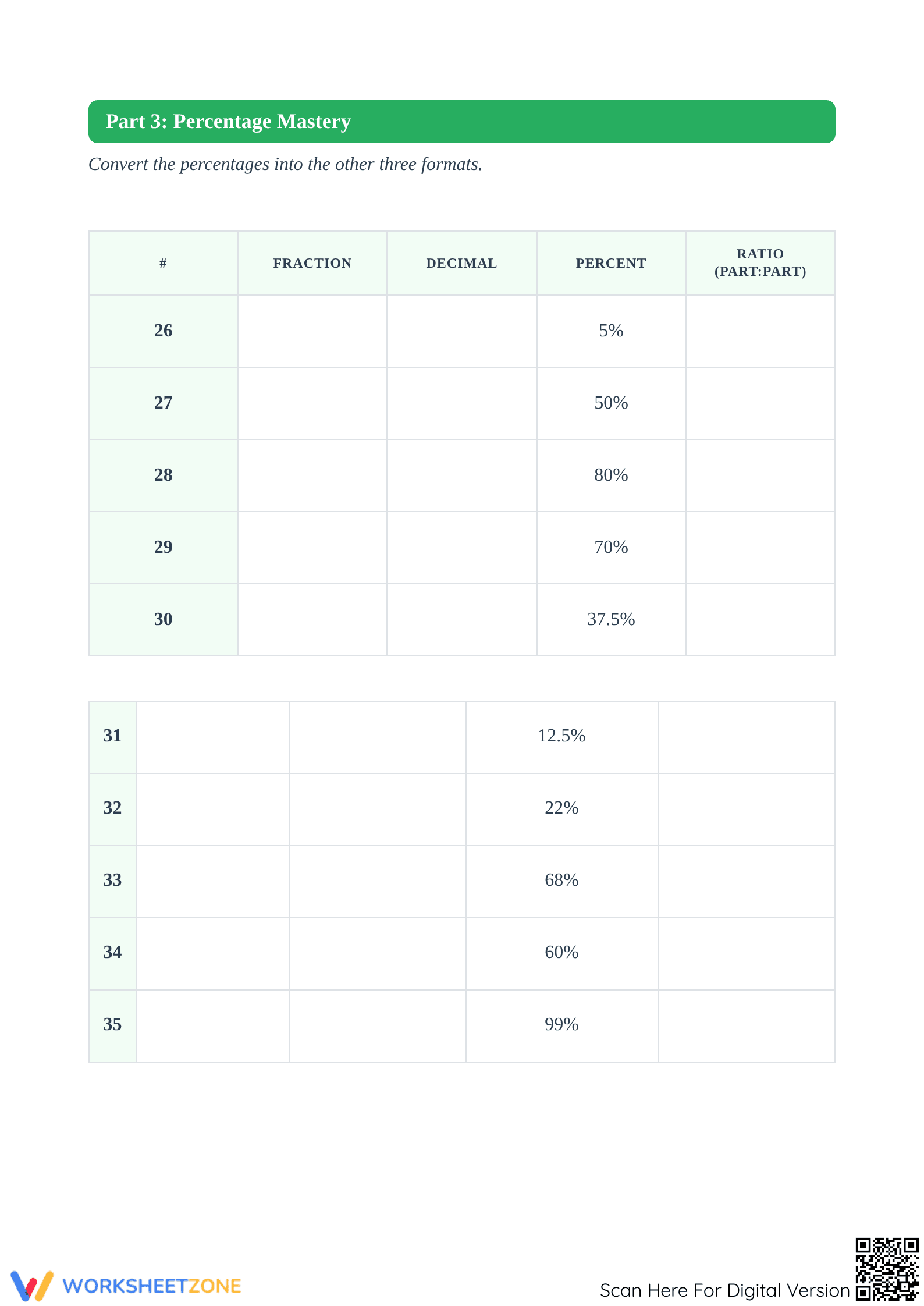

Essential Fraction Decimal Percent Ratio Practice | Grade 6+
Paste this activity's link or code into your existing LMS (Google Classroom, Canvas, Teams, Schoology, Moodle, etc.).
Students can open and work on the activity right away, with no student login required.
You'll still be able to track student progress and results from your teacher account.
Comprehensive Numerical Conversion Practice
This essential Grade 6-8 mathematics worksheet provides comprehensive practice in converting between fractions, decimals, percents, and ratios. Students build numerical fluency by navigating multiple representations of the same value across 45 structured problems. This resource ensures students can fluidly translate data for statistical analysis and real-world financial contexts.
At a Glance
- Grade: 6–8 · Subject: Mathematics
- Standard:
CCSS.MATH.CONTENT.6.RP.A.3.C— Find a percent of a quantity and solve problems involving equivalent ratios.- Skill Focus: Multi-representation numerical conversion
- Format: 5 pages · 45 problems · Answer key included · PDF
- Best For: Middle school ratio and proportion units
- Time: 40–50 minutes
What's Inside
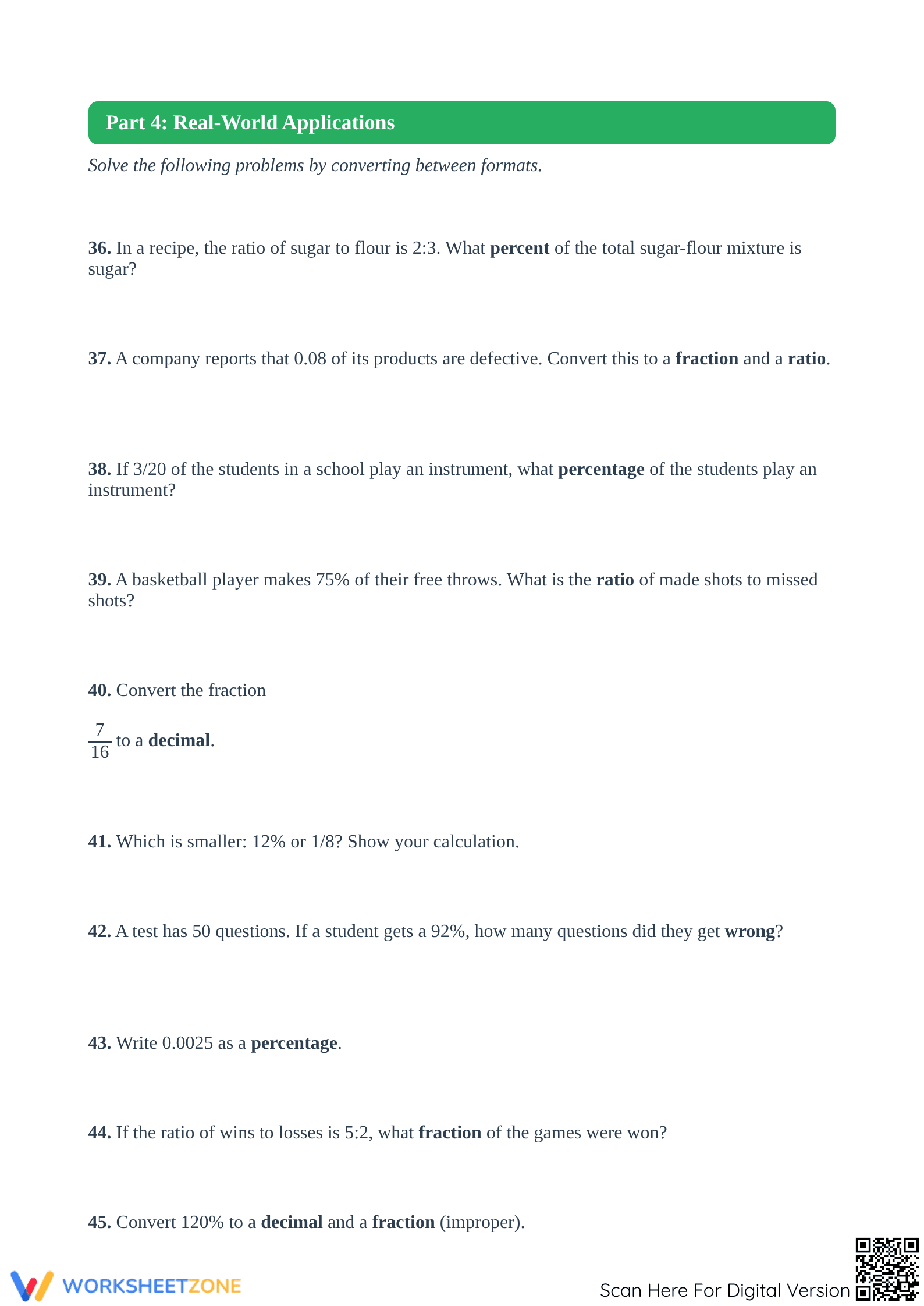
This five-page PDF collection contains a deep-dive into numerical equivalency. The first four pages utilize a clean, tabular format that prompts students to fill in missing values across four columns: Fraction, Decimal, Percent, and Ratio. The final page elevates the cognitive demand with ten real-world application word problems. A full answer key is provided for immediate feedback.
Skill Progression
- Guided Practice: Early tables provide clear starting points with common benchmarks to build initial confidence.
- Supported Practice: Mid-level tasks introduce complex decimals and fractions requiring multi-step calculations to complete each row.
- Independent Practice: Concluding word problems force students to apply conversion skills without a scaffolded table.
This progression ensures students can identify and execute necessary mathematical operations independently through a gradual-release model.
Standards Alignment
The primary alignment is CCSS.MATH.CONTENT.6.RP.A.3.C, focusing on finding a percent of a quantity and using ratio reasoning to solve real-world problems. It also supports CCSS.MATH.CONTENT.7.NS.A.2.D by requiring students to convert rational numbers into terminating decimals. Both standard codes can be copied directly into lesson plans, IEP goals, or district curriculum mapping tools.
How to Use It
Use this as a summative assessment at the end of a unit on ratios to gauge mastery of multiple representations. Alternatively, assign individual pages as rotating station activities. Teachers should observe students during the word problem section to see if they can accurately translate "of" into multiplication, providing a quick formative check on conceptual understanding.
Who It's For
This resource is designed for middle school students in Grades 6, 7, and 8 who are developing their proportional reasoning skills. It is particularly effective for students requiring extra practice with mental math benchmarks. Pair this worksheet with a visual equivalent values anchor chart or a set of fraction tiles to provide concrete support for learners who are still bridging the gap between abstract numbers and visual models.
The ability to transition fluidly between fractions, decimals, and percents is a cornerstone of middle school mathematics, acting as a prerequisite for high school algebra. Research by Fisher & Frey (2014) indicates that structured tables comparing multiple mathematical representations help students internalize part-whole relationships. This worksheet aligns with those findings by using a 45-task progression moving from tabular identification to contextual word problems. By explicitly requiring the CCSS.MATH.CONTENT.6.RP.A.3.C standard, the resource ensures students develop the numerical flexibility needed for statistical analysis. The inclusion of part-to-part ratios alongside percents and decimals provides a comprehensive view of proportional logic. This systematic approach supports long-term retention of fundamental skills required for success in standard-aligned curricula. It provides the necessary repetition for students to master complex conversions while preparing them for more advanced algebraic concepts and real-world data interpretation.


